Monday, 30 November 2015

I SOLD MY CAR!

Last month, I sold my 2014 Mercedes CLA250 to a nice woman from Stratford.  I’d advertised it on Kijiji and Autotrader to get the word out.  There followed a virtual flood of inquiries from an assortment of lowballers, scammers, and just plain dickheads, the likes of which I’d never encountered!

I’ve never been a ‘car guy’.  The nicest car I’d ever owned before the Mercedes was a 1969 Buick Skylark two-door hardtop, robin’s-egg blue with a white interior and a 350 four-barrel.  I bought it from the late Lowell Barlow in 1974 while I was still in university.  He always had the nicest car in Wellington, and she was a beauty.  And could she burn rubber!  This old photo hardly does her justice.

Elva and I dated in that car.  One Friday evening, we watched the sun set over Barlow’s Pond, minding our own business.  Along comes a cop car.  Oh, shit!  He strides over and asks me to roll the window down.  “Could I see your license and registration, please?”, he says, a big grin on his face.  “Sure, Officer,” I reply.  “They’re in the back seat, in my pants pocket.”

We got the last laugh though.  As we drove gingerly out the laneway, we passed by the cop car, stuck to the axles in a notorious Wellington mudhole.

After the Buick came a succession of practical cars: Volkswagen Rabbits, Nissan Sentras, Dodge Caravans, Mazda 3s.  All of them economical and rather bland.  Heck, I even drove my late mother’s old jalopy for eight years.  Until the driver’s side door fell off!

To throw in a little excitement, we owned a Harley-Davidson for a while, but I traded it in for a bicycle.

I saw cars as a necessity, not a luxury; nothing more than a depreciable asset.  One of the worst investments one could make, I thought.  Then came retirement, and the urge to buy a nice car hit me.  In Saint John one weekend, I drove into the Mercedes dealer and was smitten.  There she sat, the car of my dreams!  Un vrai coup de cœur!  Not normally given to impulse purchases, I was helpless.

I explained to friends that I’d changed my mind.  Yes, she was a depreciable asset.  No, it wasn’t a good investment.  I reasoned that I’d become the depreciable asset, and it was time for me to enjoy a little comfort in my dotage.

My Mercedes took me everywhere, from four-lane highways to dead-end dirt roads.  During fishing season, the trunk was a jumble of rods, chest waders, mosquito repellent, and trout flies.  But I took good care of her, and she always looked her best for the weekend.

Fate intervened however.  While away from home last February, we got an email telling us that Elva’s beloved convertible had been lost in a storage barn fire.  Long story short, she decided to buy something more practical: a Mazda 3 hatchback.

As the fishing season drew to a close, I got to thinking: “Why two cars?  Couldn’t we get along with just the one?  We walk almost everywhere anyway.”  I discussed it with Elva, and she agreed.  It was time to part with my beloved.

I’m not a salesman, and I’d never sold a car before.  I consulted with a car dealer acquaintance and did some research of my own before listing the car.  I had two prices in mind: the one I wanted, and the one I’d take rather than let the car sit for the winter, and depreciate even more.

My first call came from a company in Spruce Grove, Alberta.  The guy said they’d sell my car for $500 more than I was asking.  Great!  All I had to do was send them $500, up front, for their services.  “That’s $500 I’d never see again,” I thought.

Next, I got a call from a dealer in Rancho Cucamonga, California.  Swear to God!  The sales pitch?  Because the Canadian dollar was so low, they were buying high-end cars up here to ship to the US.  All I had to do was drive the car to Moncton, put it on a railcar, and they’d wire the money to my account.  My banker explained that a fool and his money are soon parted.  “If it sounds too good to be true, it probably is,” she told me. 

Over the four weeks or so that my beloved was advertised, I must have gotten fifty emails, phone calls, and texts.  Guys from Montreal and Toronto, most of them with heavy accents, wondering where Charlottetown was, and if we had an airport.  Guys offering me $5,000-$10,000 less than the asking price, hoping I needed to sell the car for some quick cash.

But the one who took the cake was this young guy from Halifax, a Hong Kong student taking English courses before enrolling in university.  He just had to have the car.  Daddy would send him the money in two weeks, he told me. 

Then, the texts started.  At least five a day.  Did the car have navigation?  Did it have a back-up camera?  Were there any scratches or dents on it?  Could I send more photos?  Did it have leather seats?  Could I drop the price a bit?  On and on it went…

Then, out of the blue, he texts me that he doesn’t have a driver’s license and would have to wait a month before taking the test!  I wanted to tell him where to go, but he happened to be one of my best leads at the time.  Finally, late one evening, I got one last email from him.  “Your car too expensive,” it read.  “I can get better car for same money.”  “Good riddance,” I muttered to myself.

One day, while I enjoyed a coffee at Starbucks, the phone rang.  It was a local number.  The guy said he’d seen the ad on Kijiji.  Was the car still for sale?  We agreed to meet later that day.  He drove up in a nice car, and right away I had a good feeling.  Here, finally, was a ‘car guy’.  I gave him the keys.  “It’s for my  wife,” he said.  “I think she’ll like the car.”

Before the sun set that day, she and I shook hands, and the deal was done.

I told the story of my experience as a car salesman to a friend, telling her that, although I’d enjoyed the car, I had no regrets.  “Well,” she said.  “You’ll always be able to say you owned a Mercedes.  Lots of people wish they had, but were just too cheap!”

At the end of the day, my Mercedes didn’t make me any happier.  It may be a status symbol for some but, for me, it just didn’t feel that way.  Yes, it was nice to experience German engineering.  And, yes, buying on impulse felt good for a change.

But it was just a car.  The dictionary defines ‘vehicle’ as “a machine used to carry people or goods from one place to another.”  Clever advertising makes them appear to be something far more important, far more useful, and far more necessary.


The lesson learned for me is that experiences matter more than material things.  I now have two life lists: a bucket list, and a fucket list.  On the first are things I want to do before I kick the bucket.  On the second are those I won’t ever do.  Like being a car salesman…

Thursday, 29 October 2015


LA GESTION SCOLAIRE


This week’s edition of La Voix acadienne features an article celebrating an important 25th anniversary.  On July 1, 1990, the Commission scolaire de langue française was granted the right to administer the French-language school system on Prince Edward Island.  The article rightly mentions the significant contributions of several individuals who were instrumental in bringing about this significant victory.  Though not among them, I was deeply involved in language politics at the time.  I’d like to share my recollections of three related events.

The first event goes back to the early 1980s when I was a member of the Board of La Société Saint-Thomas-d’Aquin.  We became quite interested in the debates around the Canadian Constitution.  Pierre Elliott Trudeau and the Premiers were hammering out an agreement to bring home the Constitution from London and to implement the new Canadian Charter of Rights and Freedoms.  Prince Edward Island initially opposed patriation and the new Charter.

Provincial Attorney General Horace Carver spoke to us one evening in Summerside.  The gist of his argument was that our interests would be better served by elected members of Parliament in Ottawa and our own Legislative Assembly than by the courts.  I had no doubt that Mr. Carver was well-intentioned, but we knew where Trudeau stood on the issue of minority language education rights and we trusted him.  Naïve as I was then, I knew in my gut that our rights would be protected by the courts, and that we had no chance if our fate was left in the hands of politicians.  My instincts were correct, as it turned out.

Section 23 of the Charter of Rights and Freedoms is the section of the Constitution of Canada that guarantees minority language educational rights to French-speaking communities outside Québec.  Some scholars argue that Trudeau considered it one of the most important parts of the Charter.  The picture below is my favourite of Trudeau, taken April 17, 1982, the day he and Queen Elizabeth II signed the Proclamation of the new Constitution Act.
Our three children graduated from École François-Buote in Charlottetown.  Two of my grandchildren attend École Samuel-de-Champlain in Saint John, New Brunswick.  The youngest, barely three years old, attends a French daycare next door to École Gabrielle-Roy in Edmonton, Alberta.

None of this would have been possible without successive favourable decisions by the courts, including the Supreme Court of Canada.
The second event occurred during my brief term as president of La Société Saint-Thomas-d’Aquin.  In 1988, the French school board, Unité scolaire no. 5, administered only one school, École Évangéline.  The second French school, École François-Buote in Charlottetown came under the control of the Unit 3 School Board.

Believing the political climate would be favourable, with Joe Ghiz as Premier and Léonce Bernard as our representative in Cabinet, I met with Minister of Education, Betty Jean Brown, and Bernard, at the old Centre culturel Port-LaJoie on Dorchester Street.  Our purpose was to propose the formation of a province-wide French-language school board, in other words, La gestion scolaire provinciale.

I was struck by their evident surprise at the suggestion, and their apparent view that it made no sense.  I can still see the look on Léonce’s face; like he thought it was the craziest idea he’d ever heard!  Fortunately, reason prevailed.  In February 1990, the provincial government adopted new regulations, granting the Commission scolaire de langue française province-wide jurisdiction.  It became official that July 1.

I put language politics aside for awhile (two years in an MBA program at Université Laval) but continued to follow developments closely on the local and national scenes.  The two years I spent in Québec taught me a lot about being a member of a linguistic minority.  Most importantly, it taught me that it’s up to us to preserve the French language and culture.  We have very few allies, and Québec is not among them.

The third event occurred in April 1998 when I was the Chair of the Comité acadien, a group that advised the provincial government on matters relating to French-language services.  The Minister responsible, Mitch Murphy, a man for whom I had the greatest respect, walked up to me during a reception marking French Awareness Week.  He said: “I have very bad news.  The decision on the Arsenault-Cameron case just came down from the Court of Appeal.  It overturns Judge DesRoches’ decision and the lawyers tell us there’s no way it can be taken any further.”

I’d read the Armand DesRoches decision and I knew it was sound.  He was one of us and understood the Charter.  It was inconceivable to me that supposedly learned judges could have overturned it.  I nodded to the Minister, without saying anything.  As we say in French: “Je riais dans ma barbe.”  I knew that the next stop was the Supreme Court of Canada, and that there, our poor provincial government would get whacked.

I read the decision written for the Prince Edward Island Court of Appeal by Hon. Justice McQuaid.  In it, he laid out the Court’s finding that the Minister of Education had done the right thing by refusing to build a French school in Summerside, thus overturning the decision of the Commission scolaire de langue française.  Speaking of Section 23, he wrote: “…language rights are fundamentally different than other rights protected by the Charter in that they are founded on political compromise.”  I chuckled to myself, astounded at the ignorance displayed by the Court, remembering what we’d been told before the Charter came into force.

In November 2000, the Supreme Court of Canada disagreed with the Appeal Court, upholding Judge Armand DesRoches’ 1997 decision.  The Court wrote that: “…a school is the single most important institution for the survival of the official language minority.”  Regarding the decision of the Minister of Education, the Court stated: “The Minister’s discretion was limited to verifying whether the [School] Board had met provincial requirements. …he had no power to substitute his own criteria or decision.”  Amen!

And so the Summerside school was built, École-sur-Mer, yet another symbol of the determination of the Acadian people and the strength of the Charter.
The October 28 edition of La Voix acadienne contains another very important article, the one announcing the refurbishment of the former Rollo Bay Consolidated School, soon to be reborn as École La Belle-cloche.  The announcement by the Commission scolaire de langue française states that $6.1 million will be spent to construct new spaces for K-12, as well as a community centre to serve the Acadian and Francophone community of Eastern Kings.

What a contrast to the earlier fiasco surrounding the construction of the Rustico facility, École Saint-Augustin, when residents were pitted against one another because of the poor judgement of politicians.  This time, not only do we have competent elected trustees at the helm, we have a provincial government led by people who understand their obligations under the law.  It makes all the difference.
The other day, I stood in line at my bank and watched as a teller served an Asian customer in Mandarin.  My Charlottetown is being transformed by the arrival of new Canadians.  I welcome them.  We need their talent, their work ethic, and their tax dollars. 

There were no signs at the bank telling me that I could be served in French.  RBC is a business.  Its choice to hire and train a Mandarin-speaking teller is a business decision.  This example reminded me, yet again, that fundamental rights, like language, need and deserve the protection of the highest law of the land.  They cannot be subjected to the vagaries of political and business decisions.

When I started Grade 8 at École régionale Évangéline in the fall of 1965, it was the only French school recognized as such by the provincial government.  Now, there are six.  Each has its own unique story.  None was built without a struggle.  A solid 5% of Island students attend the six French schools.  Enrollment is steady.
I can’t imagine what the state of French-speaking minorities would be were it not for Trudeau’s vision and the presence of Section 23 in the Charter of Rights and Freedoms.  It granted us the right to control our most important institution, our schools.  And it reinforced what we always knew: the people know best!

I rest easy now, knowing that my grandchildren can be schooled in French almost anywhere in our great country.  I hope they will recognize the importance of preserving our mother tongue when their turn comes.

Wednesday, 7 October 2015

FREDERICTON GRAN FONDO

“Pain brings me closer to God…”  That thought ran through my mind as I cranked over the pedals in the lowest gear I’ve got, listening to the sound of my own laboured breathing, hoping my legs would carry me to the top of ‘The Wall’.  Every organized ride worth its salt has a tough climb or two, and the 2.5 km. wall features a vicious 17% section that starts steep and doesn’t let up.


The first 50 km. to that point had been a breeze: beautiful weather, good roads, and an experienced group of riders, most of whom took a turn at the front.  But the Wall tested our climbing legs and separated the men from the boys.

The Over the Hill Gang (OTHG) opted for the Fredericton Gran Fondo several months ago.  We trained for the flat course originally promised by event organizers.  Due to road construction however, the route had to be modified to include a couple of tough climbs and lots of rolling terrain.

Five of us - Russ Melanson, Richard Birt, John MacQuarrie, Kent Wood and me - shoe-horned bikes, luggage, carcasses, and home-made cookies and muffins into a Dodge Grand Caravan and hit the road for Fredericton.  We’d hoped to have all the gang with us, including Ira Birt, Ian MacIntyre and Mark Grimmett, but they were unable to come for a variety of reasons.

Arriving at the Crowne Plaza mid-afternoon, we checked in and strolled to the local cycle shop, Radical Edge, where we drooled over the bikes and other gear on display.  Then it was on to McGinnis Landing for the mandatory evening-before pasta meal. 

Back in our hotel rooms, we groused like a bunch of old women: “It’s gonna be cold in the morning.  What are you gonna wear?”  Too old to party (except for Kent, who’s too serious to party), we hit the sack early, each one hoping his roommate wouldn’t snore.

I couldn’t see the Saint John River, barely 50 metres from my room, when I looked out the window on Sunday morning.  Fog so thick you could cut it with a knife.  The temperature had dropped to near freezing overnight, promising to rise to a balmy 6 degrees by the time we were to leave at 10:00.  After filling our faces with a nice buffet breakfast at the hotel, we made our way to the start line, hoping they’d hurry up and get the thing going.


The group started slowly, following a City Police cruiser across the Westmoreland Street Bridge toward Marysville.  We followed the Nashwaak River upstream for 10 km. or so before crossing it a second time, then headed west on Route 105 through Nashwaaksis toward Douglas.  Kent took a long pull, pacing the group at a leisurely rhythm.  I even had a chance to glance at the Saint John River off to my left, when I wasn’t watching the backside in front of me.  It brought back memories of my years at UNB.


At the 35-km. mark, we turned north onto Route 104, feeling none the worse for wear.  One of the locals was on the front and doing all the work as we rode through Burtt’s Corner, a group of a dozen or so riders following close behind.  We got to the first refreshment point, made the hairpin turn and started the climb up Keswick Ridge.  The first part was just a teaser.  Too soon, after a short downhill section, the monster loomed directly in front.


Our rule on a group ride is that everyone sticks together, except on a steep hill, when it’s “Every man for himself.”  If anyone were to ask me: “How fast do you go up a hill like that?”, I’d answer: “Somewhere between falling over, like the old guy in Laugh-In, and burning out!”

We all climb at different rates, depending on the day and how we’re feeling.  Except for Kent who, many years younger, is by far the strongest.  He crested The Wall long before the rest of us and it was the last we’d see of him until we got to Fredericton.  (More on that later.)


Two guys, Greg Masiuk from Oromocto and Elwyn DeMerchant from Saint John, joined us for the grunt up The Wall.  OTHG reassembled at the top and white-knuckled it down the long, treacherous descent, trying to distinguish holes and cracks in the pavement from the shadows that danced across the road.

After a steady climb on the shoulder of Route 105, we stopped for the first time at the Mactaquac Dam refreshment point where, as John says, “We did like the Quebecers” in answering calls of nature.  (I hope none of the cars that drove past was coming home from church!)

Across the dam, our group of six turned onto the old Trans-Canada Highway, going west toward the Mazerolle Settlement turnoff on a gradual 2.5-km. climb.  The next stretch was over a series of ‘rollers’, short climbs and descents that kill your legs if you’re getting tired.  Greg fell off the back, and we didn’t see him again until the finish line.


The three km. we rode along the Hanwell Road were heaven: easy grades, good pavement, and a wide shoulder.  Too soon, at the 100-kilometre mark, we turned onto the rougher chip-seal surface of Deerwood Drive.  Elwyn jumped us on one of the hills and was gone.  Nine kilometres later, we hit the scary-steep Carriage Hill descent, hoping like hell our brakes would stop us before we went through the stop sign and out onto the highway.


From there, I knew the road back to the finish line was flat, so we got the big train rolling and made good time on the old Trans-Canada Highway, reeling in Elwyn and catching him just before we turned onto the Woodstock Road.  I was on the front, not realizing we were supposed to turn onto the riverside trail, until someone said: “We missed a turn!”

Eventually, we picked up the trail after riding through the Delta Hotel parking lot.  We pedaled on the gravel track a short distance until we reached a sign that directed us to take a 300-degree turn, through another parking lot and up to King Street.  What the hell?

That’s where we found poor Kent, totally lost after riding around for ages and being told by course marshals to go here, there and everywhere.  Confused, we decided to take the most direct route back to the Crowne Plaza and across the finish line.  Poor Greg, as lost as we were, rode past the hotel and all the way to the Princess Margaret Bridge before turning around.

We completed the 120-km. ride in four hours, not a bad average speed for us considering the hilly terrain (over 1,000 metres of climbing).  Event organizers recognized the confusion caused to all riders by the poor course marking.  They gave Kent a more accurate time, making him, by far, the fastest rider on the 120 km. course.


After well-deserved showers and a refreshment break, we joined other riders and event volunteers for a nice meal at the hotel.  We left Fredericton around 6:30, aiming for a 10:00 pm arrival in Charlottetown.  Alas, it was not to be.  Near Havelock, in the middle of nowhere, we came upon an accident scene and had to wait two hours or so before being allowed to pass.  Oh well, we got to see the lunar eclipse along the way, and the moon still showed traces of rusty brown when I stood on my doorstep at 12:30.


I’ll be 62 in two weeks and trail Russ by 6 years!  As a group, the four of us finished second to Kent in the 120-km. ride.  We dropped many younger riders who couldn’t hack our pace.  Several of them asked us afterwards how old we were.  The looks on their faces were priceless!

The annual road trip is an occasion for us to get away together, suffer a little, and have a few laughs.  We experience new courses and meet new people.  We get a chance to promote our Island as a cycling destination and to invite others to come see for themselves.


I burned over 4,000 calories in four hours in the saddle, and so got to eat my face off for a couple of days.  I conquered The Wall and got to spend quality time with my best buddies.  What could be better?

Sunday, 16 August 2015

 
ROAD TRIP

Draw a line due north from North Cape, extend it about four hundred kilometres, straight across Anticosti Island, and you’ll hit Havre-Saint-Pierre, a tidy community of some 3,500 hundred souls on the shore of the Gulf of St. Lawrence.  I’d been here once as an employee of the Parks Canada Agency and vowed to return someday with my best friend.  We decided it would be as good a place as any to mark our 40th wedding anniversary on August 15.
We left Charlottetown on Sunday, August 9, and stopped in Dieppe where we attended our grand-niece, Rubie’s, baby shower.  We made it to Campbellton that evening and, early Monday morning, crossed the mouth of the Restigouche River and into Québec.  Up the Matapedia Valley to Amqui, then north to Matane where we boarded the brand-spanking-new F.-A. Gauthier for the two-and-a-half-hour ferry crossing to Baie-Comeau.  We drove six hours east on Highway 138, arriving in Havre-Saint-Pierre just before suppertime, and checked in to our comfortable housekeeping unit at Gîte Chez Françoise.  Françoise is a delightful lady and made us feel welcome right away.
Havre-Saint-Pierre is a popular destination for tourists wishing to experience something different.  It’s home base for the Mingan Archipelago National Park, a chain of protected islands with unique flora, fauna and geological features.  The local mine, producing a high-grade ore of titanium and iron, employs 350 people and is the principle economic driver.  The town boasts a beautiful beach, modern marina, brand-new performance venue, two good restaurants, and all the conveniences one would expect to find in a small, if somewhat isolated, regional centre.  It’s the perfect location for visitors like us who enjoy active vacations.

The first morning, we straddled our bikes and headed out of town on the 138 toward Baie-Johan-Beetz.  Elva asked: “What direction are we going?”  My answer: “There’s only one road.  We’re either going east or west.  Where’s the sun?”  Still she couldn’t figure it out.  But I keep trying!  She is getting better at drafting and figuring out the direction of the wind.

The 138 is as nice a road as I’ve cycled: flat as piss on a plate, smooth pavement, light traffic, a wide shoulder, and considerate motorists.  The sun was shining and there was just a light breeze.  We pedalled along at a nice pace, crossing a rather bleak landscape featuring bogs and ponds, stunted black spruce and eastern larch; an ecological region that covers much of northern Canada called the “taiga”.  At the 25-kilometre mark, we turned for home, fighting a slight headwind.
That afternoon, we took a stroll along the beach and into the centre of town, stopping to visit the craft store and taking a very interesting guided tour of the local museum.  My first time here, I was quite surprised to hear the Madelinot accent and to see the Acadian flag everywhere.  In the 1850s, six families left the Magdalen Islands in search of a better place to live, and settled here.  Their descendants have retained the distinctive accent and many of their ancestors’ traditions, and feel a strong kinship to Les Îles.
Day 2 started out raining and wasn’t promising to get any better.  So we decided to drive to the eastern terminus of the 138.  After crossing sixty-five kilometres of empty taiga we came to the pretty little village of Baie-Johan-Beetz, home to 81 hardy souls, named after a Belgian naturalist who settled there in 1897 and was instrumental in developing the silver fox industry.  His impressive manor house, referred to as Le château by locals, is shown in the photo below.

An hour or so later, we arrived in Natashquan, birthplace of revered Québec chansonnier Gilles Vigneault.  After visiting the local tourist information centre, we headed east again, toward the last village on the 138, Kégaska.  The pavement ended just east of Natashquan and we drove 44 kilometres across a very fine gravel surface, meeting only two cars along the way.  Kégaska is a fishing village, population 138, and only recently linked to the outside world by road.

I stopped at the Welcome Centre located next to the two-room school and asked the woman in French if she could tell me a bit about the village.  She answered, in an unmistakeable Newfoundland accent, that she didn’t speak French.  I learned that the village was founded at the end of the 19th century, mostly by Newfoundland fishermen.  And so the accent…
We walked along the wharf and spoke to three cod fishermen from the village of Tête-à-la-Baleine, 150 kilometres down the coast, then visited the Anglican church, noting from the register that tourists from France and Switzerland had found their way to the end of the 138 that day as well.
Just beyond the village, we came to the airport, a gravel strip, and watched as the attendant drove out onto the runway to check that everything was OK, ready for the arrival of the Air Labrador plane.  Two women drove up with their luggage.  I asked them where they were going.  “To Chevery”, they replied, in a pronounced Newfoundland accent.  “It’s the next village downshore.”  Turns out Chevery is where Kégaska students go by boat or plane to continue their schooling after Grade 8.  Fascinating!
Back in Natashquan, we took the guided tour of La vieille école, an interpretive space devoted to the life and music of Gilles Vigneault, and featuring several of the village characters that make up his songs.  The guide was excellent and, even though it was pouring rain outside, we thoroughly enjoyed our short stay in the little village.

Fog shrouded the village as we awoke on Thursday.  I spent the morning writing while Elva explored on foot.  That afternoon, I headed east on the 138 for a 50-km ride.  We bought a home-made pizza aux fruits de mer at La poissonnerie du Havre.  It was mind-numbingly delicious!  In fact, we tried their pâté au saumon the next evening and it was just as good.  If you ever come to Havre-Saint-Pierre, check it out!
Friday was the first of two days we spent in the archipelago.  We boarded a zodiac for the twenty-minute trip to Quarry Island.  A Parks Canada guide led us on a one-hour walk across the island, stopping along the way to explain features of the various ecological zones.  On our own, we walked around the eastern half of the island, enjoying magnificent views of the monoliths and the unspoiled landscape.

After lunch, the zodiac dropped us off at nearby Niapiskau Island.  We walked the 4.5-kilometre trail from the dock to l’Anse aux Bonnes Femmes, home of the Park’s iconic monoliths named les bonnes femmes because a few, and one in particular, have distinctly feminine silhouettes.  The one shown below is called Madame de Niapiska.

We booked our second island excursion in Longue-Pointe-de-Mingan.  Before sailing, we drove to the nearby village of Rivière-au-Tonnerre.  We’d been told the church was well worth visiting.  Saint-Hippolyte was patterned on the monumental Sainte-Anne de la Pointe-de-l’Église (Church Point) in Nova Scotia.  In addition to being a place of worship, it’s an incredibly beautiful work of art and a tribute to the pioneers of the parish who built it entirely by hand, including the intricate interior carvings.

We hit the jackpot, arriving just in time for a guided tour with local historian Yvon Bezeau, an 89-year-old dynamo who enchanted us with tales of the village’s origins as well as the fascinating story of the building itself.  We could have listened to him all morning!  From the church, we made our way to the nearby Maison de la chicoutai, a boutique featuring products made from my now-favourite berry, the chicoutai, or cloudberry, also called plaquebierre by we Acadians.
Back in Longue-Pointe-de-Mingan, we boarded a twenty-foot open outboard and placed our trust in our weathered, toothless captain, a retired fisherman who’d plied the local waters for most of his life.  Soon, we were ashore on Île Nue (Bald Island) where a Parks Canada guide gave us an interesting tour of the monoliths.  We even found a few fossils, of the 500-million-year-old variety from the Ordovician period, embedded in limestone along the shore.

Next, we sailed to nearby Île Perroquet, home to a lighthouse and a thriving colony of Atlantic puffins, locally known as perroquets de mer, more properly, macareux moines.  Our guide explained the interesting human history of the tiny eight-acre island which was home to five lighthouse keepers and their families until the light was mechanized in the 1950s.  We had plenty of time to observe and photograph the puffins.  As added bonuses, we saw porpoises and grey seals, and I had my first taste of sea urchin roe.  Delicious!

Then, it was back to the Poissonnerie du Havre to pick up our 40th anniversary meal: lobster and snow crab.  Yum!  Yum!
As we say goodbye to this charming area, I’m left with a few observations.
1.    With careful planning, you can get to this area in a day’s drive from Charlottetown.  There’s lots to do here, accommodations are cheap, the people are very friendly, each community has a unique and fascinating history, and the unspoiled landscape is very different from what we’re accustomed to. 

2.    Villages here are defined by what year they were founded, where the pioneers were from, and when the 138 arrived: 1976 in Havre-Saint-Pierre; 1996 in Natashquan; and 2013 in Kégaska.  Maybe someday, the 138 will link Kégaska to Blanc-Sablon, almost 500 distant on the Québec-Labrador border. 

3.    Everywhere we went, people made it clear they knew their history and that it was important to them.  This applied to the English in Kégaska and the French we met elsewhere.  Unfortunately, we didn’t connect with any of the local natives, the Innu.  As for the French, they feel strongly connected to the Îles-de-la-Madeleine.  Even more impressive to me, they know what came before: le Grand dérangement and, before that, la nouvelle France.  I wish I could say the same about les gens de par chez-nous. 

 
4.    L’Acadie is a real place for me.  Natashquan and Havre-Saint-Pierre form one end of the chain that begins on the west coast of Newfoundland in Cap-Saint-Georges and extends through Cape Breton Island down to Argyle and Clare counties in southern Nova Scotia, through New Brunswick and Prince Edward Island and well into the Gaspé.  No one can truly know and understand l’Acadie unless and until they’ve visited each and every one of the unique links that together form this chain and met the fascinating people who’ve kept our culture alive against all odds.
 

Saturday, 15 August 2015


WELL, WELL, WELL!

Say these three words to anyone over 40 in Egmont Bay, or indeed to anyone who got to know the man, and they’ll answer: “Ça, c’est Jos à Denis!”  It was the trademark expression by which we came to know and love the man.  My beloved father-in-law, Joseph D. Arsenault, left us far too soon, six years ago today.
I knew Jos before I knew Elva.  I first met him at our house where Mom would have introduced him as a member of the Board of Directors of the Wellington Co-op.  We’d welcome the Directors as they arrived, and chat before the meeting began in our kitchen.  Rather than go to bed or watch TV, Id sit at the foot of the stairs and listen to what was being said.  I learned that Jos was a brother of Edward, our next-door neighbour.
From the first time I walked into Jos’ house to pick up Elva, I felt welcome.  I saw this incredible man do what came so naturally to him.  And I saw him welcome many others into his home over the years.  He was a kind and generous man who had a simple philosophy about life.
Jos and Aline raised eight children, losing five in early childhood.  Like all men of his generation, Jos worked hard to feed and provide for his family.  At various times, he was farmer, fisherman, lumberjack, truck driver, roadmaster and dump attendant.  When something needed building, he built it.  When something needed fixing, he fixed it.  When a neighbour needed help, he was the first one there.
Jos never got past elementary school but he became an avid reader: every newspaper he could get his hands on, French or English, and books, mostly about politics.  It would be fair to say that politics was almost as important in Jos’ life as religion.  And that he held Pierre-Elliott Trudeau in higher esteem than any of the saints in the Catholic pantheon.

Jos and Aline travelled with us to Ontario in 1986.  On a stopover in Ottawa, I’d arranged for he and I to attend Question Period on Parliament Hill.  We sat together in the visitors’ gallery as Liberal Opposition members badgered Brian Mulroney’s ruling Tories.  Jean Chrétien fired a pointed question at the Prime Minister in his trademark flourish of Québécois rhetoric.  Caught up in the moment, Jos sprang from his seat and exclaimed, loud enough for everyone to hear: “Oué!”  Not five seconds later, a security guard had his hand on Jos’ shoulder, whispering in his ear that if he wanted to watch the rest of Question Period, he’d better keep quiet!

Jos and I discussed politics every time I saw him.  But it was always the second topic of our regular conversations, the first being my answer to: “Comment ça va sur la job?”  He took great interest in my career and, although he may not have understood why I changed jobs so often, he never tried to dissuade me.  In fact, I seldom heard him criticize anyone’s life decisions.  He believed that every one of us would find the right path eventually, on our own: “Y fera son chemin!” (“He’ll find his way!”)
I asked him once why he and all the members of his family were such staunch Liberals. He told me that it hadn’t always been so.  One day, shortly after the Tories had won the provincial election, Pierre Gallant (Gros Pete), came up to the road crew and told Jos’ father, the foreman, that they were all fired!  “Allez-vous en!”  The government had changed, they were on the wrong side, and a crew of Tories would take their place later that day.  “Damn de Torés.  Depuis ce temps-là, mon père a toujours voter Libéral!  Pis moi aussi!”
Jos was devoted to his family and his community.  He served as marguillier (church warden), school board trustee, long-time poll chairman, and director of La Société Saint-Thomas-d'Aquin and the Wellington Coop.  He “took the pledge” as a member of the Mouvement Lacordaire to set an example for his young family.  Together with his new wife, he saw to the wellbeing of Aline’s mother, Melanie, and her Aunt Obéline, both of whom lived out their lives in the family home. 

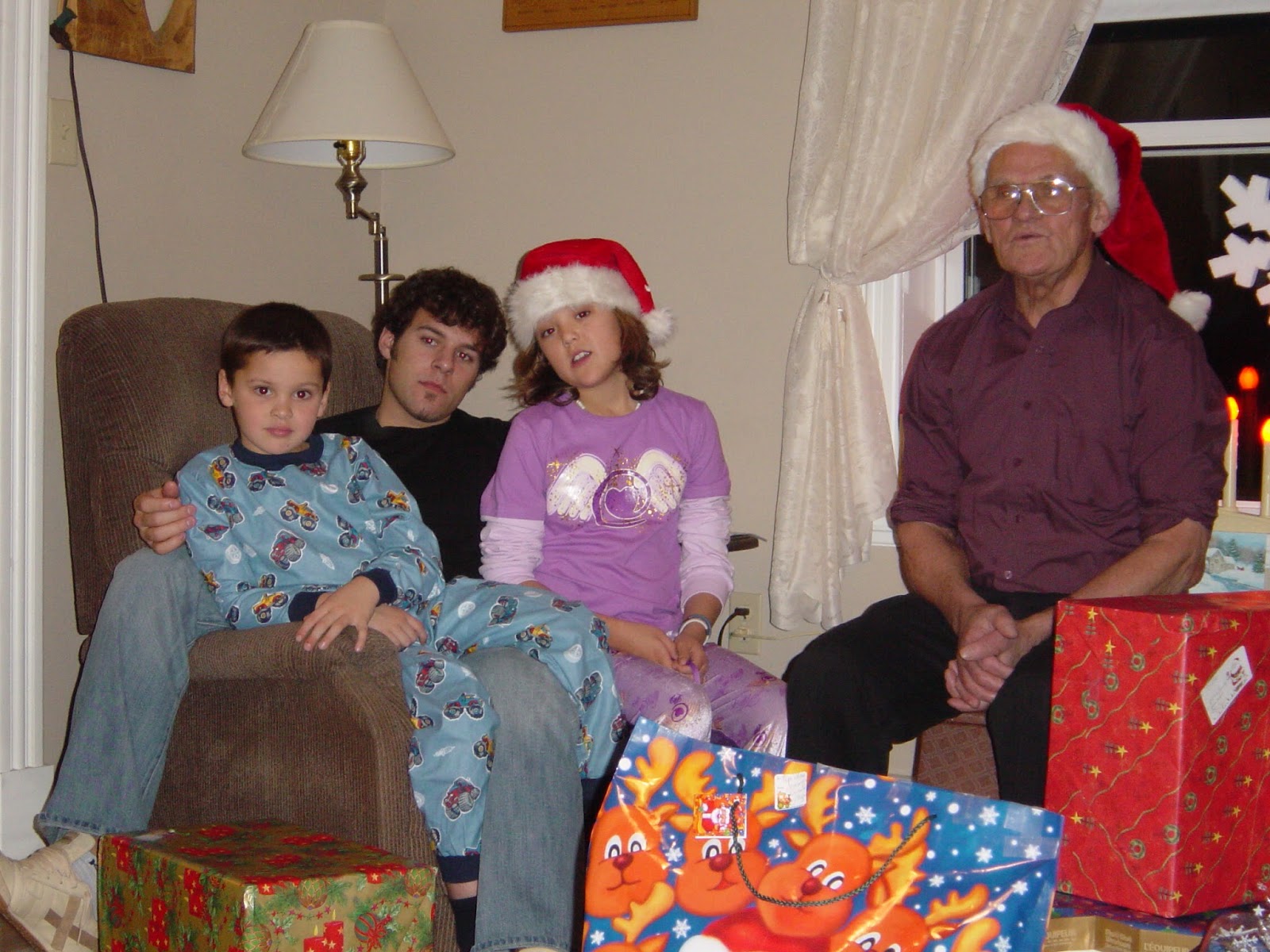
He loved Christmas!


He was a loving and devoted Pépé to our three children and loved their visits.  Sometimes, we left them with he and Aline while Elva and me went off on one of our adventures.  He taught Clément to drive the tractor lawnmower and encouraged him to go faster: “Donnes-y d’la gas!”  He and Aline loved to listen to Jacques sing and play.  Sylvie remembers the time Pépé met her at the door when she stayed out too late one night.  She never forgot the stern lecture he delivered.


Though he never weighed more than 145 pounds soaking wet, Jos was a powerful man, with Popeye forearms and a tireless work ethic.  He smoked for the better part of sixty years and mostly rolled his own Export ‘A’s.  He quit at 75.  I asked him why one day.  His typically understated answer: “Je commençais à avoir le vent court” (“I was getting a bit short of breath”).  He enjoyed a social drink and he loved to dance.  No one  I’ve ever seen could duplicate his “step”.  It was like his many sayings: unique to Jos.
Aline told us once that Jos didn’t venture from his native village of Saint-Chrysostôme to Wellington, only 12 kilometres away, until around the time he got married.  That floored me!  Jos was born into a culture, time and place where ones life was essentially pre-ordained.  A man knew what he’d likely do for a living, he knew where his wife was likely to come from, and he knew where he’d live.  He knew that, if God willed, he’d have a large family, that he’d be expected to look after aged relatives, and that he’d be looked after by his children in his old age.  He knew where he’d go to church, and where he’d be buried when the time came.

In Jos case, as for most men of his generation, there’s much to be said for the pre-ordained life.  He lived it well and he was happy and content with his lot.  Because of his great faith, that his life didn’t end the way he would have liked would not have concerned him.  He believed things turn out the way God means them to.  He never asked for much, and never wanted for much.
I went to see Jos one last time on Sunday, August 9, 2009.  When Elva and I arrived in his room, he was sitting in a chair in the corner by the window.  He smiled at us and gave his standard greeting: “Bein, Hallo!”  First impressions that he knew us were quickly dispelled however as we tried to make him understand things and to engage in basic conversation.  Elva had seen him several times over the previous two weeks and knew what to expect.  The dementia that would take him from us less than a week later was too far advanced.
We had brought him a donut and a Tim Hortons coffee and we watched him struggle with the basic tasks of eating and drinking.  At one point, he picked up the hospital menu and turned it right-side-up, mouthing a couple of the written words but unable to focus for any length of time.  He seemed to enjoy looking out the window but was preoccupied with any noise in the corridor outside his room.  He could no longer speak.
After an hour, we told him it was time for us to go.  He rose from his chair, hugged Elva and gave her a kiss on the cheek.  Then he took my hand in his, gave it the usual firm shake, looked me in the eye and sat down.
My last image of him is from the door of the hospital room.  It will stay with me as long as Im conscious.  Hes sitting in the corner chair by the window with the sun shining at him from behind.  His beautiful smile and bright blue eyes are fixed on me and hes waving his right hand.  Because of the angle of the sun, I can see hes missing the first joint of the middle finger.  He says: Bye, OK, Bye!
If theres an afterlife, hes watching over us and enjoying his reward.  I hope he’s managed to impart some of his good humour, profound wisdom and common sense to those around him and that they too have come to know him by his trademark: “Well, Well, Well!”