Saturday, 15 August 2015


WELL, WELL, WELL!

Say these three words to anyone over 40 in Egmont Bay, or indeed to anyone who got to know the man, and they’ll answer: “Ça, c’est Jos à Denis!”  It was the trademark expression by which we came to know and love the man.  My beloved father-in-law, Joseph D. Arsenault, left us far too soon, six years ago today.
I knew Jos before I knew Elva.  I first met him at our house where Mom would have introduced him as a member of the Board of Directors of the Wellington Co-op.  We’d welcome the Directors as they arrived, and chat before the meeting began in our kitchen.  Rather than go to bed or watch TV, Id sit at the foot of the stairs and listen to what was being said.  I learned that Jos was a brother of Edward, our next-door neighbour.
From the first time I walked into Jos’ house to pick up Elva, I felt welcome.  I saw this incredible man do what came so naturally to him.  And I saw him welcome many others into his home over the years.  He was a kind and generous man who had a simple philosophy about life.
Jos and Aline raised eight children, losing five in early childhood.  Like all men of his generation, Jos worked hard to feed and provide for his family.  At various times, he was farmer, fisherman, lumberjack, truck driver, roadmaster and dump attendant.  When something needed building, he built it.  When something needed fixing, he fixed it.  When a neighbour needed help, he was the first one there.
Jos never got past elementary school but he became an avid reader: every newspaper he could get his hands on, French or English, and books, mostly about politics.  It would be fair to say that politics was almost as important in Jos’ life as religion.  And that he held Pierre-Elliott Trudeau in higher esteem than any of the saints in the Catholic pantheon.

Jos and Aline travelled with us to Ontario in 1986.  On a stopover in Ottawa, I’d arranged for he and I to attend Question Period on Parliament Hill.  We sat together in the visitors’ gallery as Liberal Opposition members badgered Brian Mulroney’s ruling Tories.  Jean Chrétien fired a pointed question at the Prime Minister in his trademark flourish of Québécois rhetoric.  Caught up in the moment, Jos sprang from his seat and exclaimed, loud enough for everyone to hear: “Oué!”  Not five seconds later, a security guard had his hand on Jos’ shoulder, whispering in his ear that if he wanted to watch the rest of Question Period, he’d better keep quiet!

Jos and I discussed politics every time I saw him.  But it was always the second topic of our regular conversations, the first being my answer to: “Comment ça va sur la job?”  He took great interest in my career and, although he may not have understood why I changed jobs so often, he never tried to dissuade me.  In fact, I seldom heard him criticize anyone’s life decisions.  He believed that every one of us would find the right path eventually, on our own: “Y fera son chemin!” (“He’ll find his way!”)
I asked him once why he and all the members of his family were such staunch Liberals. He told me that it hadn’t always been so.  One day, shortly after the Tories had won the provincial election, Pierre Gallant (Gros Pete), came up to the road crew and told Jos’ father, the foreman, that they were all fired!  “Allez-vous en!”  The government had changed, they were on the wrong side, and a crew of Tories would take their place later that day.  “Damn de Torés.  Depuis ce temps-là, mon père a toujours voter Libéral!  Pis moi aussi!”
Jos was devoted to his family and his community.  He served as marguillier (church warden), school board trustee, long-time poll chairman, and director of La Société Saint-Thomas-d'Aquin and the Wellington Coop.  He “took the pledge” as a member of the Mouvement Lacordaire to set an example for his young family.  Together with his new wife, he saw to the wellbeing of Aline’s mother, Melanie, and her Aunt Obéline, both of whom lived out their lives in the family home. 

He loved Christmas!


He was a loving and devoted Pépé to our three children and loved their visits.  Sometimes, we left them with he and Aline while Elva and me went off on one of our adventures.  He taught Clément to drive the tractor lawnmower and encouraged him to go faster: “Donnes-y d’la gas!”  He and Aline loved to listen to Jacques sing and play.  Sylvie remembers the time Pépé met her at the door when she stayed out too late one night.  She never forgot the stern lecture he delivered.


Though he never weighed more than 145 pounds soaking wet, Jos was a powerful man, with Popeye forearms and a tireless work ethic.  He smoked for the better part of sixty years and mostly rolled his own Export ‘A’s.  He quit at 75.  I asked him why one day.  His typically understated answer: “Je commençais à avoir le vent court” (“I was getting a bit short of breath”).  He enjoyed a social drink and he loved to dance.  No one  I’ve ever seen could duplicate his “step”.  It was like his many sayings: unique to Jos.
Aline told us once that Jos didn’t venture from his native village of Saint-Chrysostôme to Wellington, only 12 kilometres away, until around the time he got married.  That floored me!  Jos was born into a culture, time and place where ones life was essentially pre-ordained.  A man knew what he’d likely do for a living, he knew where his wife was likely to come from, and he knew where he’d live.  He knew that, if God willed, he’d have a large family, that he’d be expected to look after aged relatives, and that he’d be looked after by his children in his old age.  He knew where he’d go to church, and where he’d be buried when the time came.

In Jos case, as for most men of his generation, there’s much to be said for the pre-ordained life.  He lived it well and he was happy and content with his lot.  Because of his great faith, that his life didn’t end the way he would have liked would not have concerned him.  He believed things turn out the way God means them to.  He never asked for much, and never wanted for much.
I went to see Jos one last time on Sunday, August 9, 2009.  When Elva and I arrived in his room, he was sitting in a chair in the corner by the window.  He smiled at us and gave his standard greeting: “Bein, Hallo!”  First impressions that he knew us were quickly dispelled however as we tried to make him understand things and to engage in basic conversation.  Elva had seen him several times over the previous two weeks and knew what to expect.  The dementia that would take him from us less than a week later was too far advanced.
We had brought him a donut and a Tim Hortons coffee and we watched him struggle with the basic tasks of eating and drinking.  At one point, he picked up the hospital menu and turned it right-side-up, mouthing a couple of the written words but unable to focus for any length of time.  He seemed to enjoy looking out the window but was preoccupied with any noise in the corridor outside his room.  He could no longer speak.
After an hour, we told him it was time for us to go.  He rose from his chair, hugged Elva and gave her a kiss on the cheek.  Then he took my hand in his, gave it the usual firm shake, looked me in the eye and sat down.
My last image of him is from the door of the hospital room.  It will stay with me as long as Im conscious.  Hes sitting in the corner chair by the window with the sun shining at him from behind.  His beautiful smile and bright blue eyes are fixed on me and hes waving his right hand.  Because of the angle of the sun, I can see hes missing the first joint of the middle finger.  He says: Bye, OK, Bye!
If theres an afterlife, hes watching over us and enjoying his reward.  I hope he’s managed to impart some of his good humour, profound wisdom and common sense to those around him and that they too have come to know him by his trademark: “Well, Well, Well!”


Wednesday, 3 June 2015


THE PACELINE AS LIFE METAPHOR

So, what exactly is a ‘paceline’?  And what could possibly make it a metaphor for life?
Paceline is a cycling term.  It refers to a line of riders following one another closely in order to overcome air resistance more efficiently.  How closely?  Certainly less than a bike length - often as little as six inches!  How much more efficiently?  In a head wind, up to a 30% reduction in effort for riders behind the leader.
Why metaphor?  A metaphor is a figure of speech that identifies something as being the same as some unrelated thing for purposes of comparison, thus highlighting the similarities between the two.  We humans are social animals.  Riding with my buddies, I reflect on the congruence between what makes a successful paceline and the principles that apply to a life well lived.
I started riding with a group of guys - the Over the Hill Gang - in 2004.  In the eleven plus years since, we’ve logged close to 40,000 kilometres together.  That’s about equal to the circumference of the Earth!  A couple of the group’s members have left us along the way and others have joined.  We’re what I’d call ‘serious recreational riders’.  We ride together three times a week, personal schedules and weather permitting.
Current members of OTHG are Ira Birt, Richard Birt, Russ Melanson, John MacQuarrie, Kent Wood, Mark Grimmett and myself.  Others who’ve ridden with us over the years are Gerry Ridgeway and Graeme Carr.
These basic rules of paceline riding apply equally to life.
1.    Relax

Learn to move with the flow of the group and you soon realize that it has a certain dynamic to it.  Find a spot in the paceline that’s quiet and away from the wind.  Be calm, focused and observant. 

2.    Hide your suffering

Use your game face to gain a psychological advantage. 

3.    Work smart

Do only as much work as the rider working the hardest; never more. 

4.    Watch for erratic riders

Avoid riders who are dangerous.  A rider who isn’t holding a straight line, who’s taking his hands off the bars, who won’t keep a constant pace, or who isn’t looking ahead is trouble in the making. 

5.    Look ahead

Always keep your eyes on the road; not on the rider ahead of you.  A paceline is no place for blind faith. 

6.    Be predictable

Don’t make any sudden move that might put the rest of the group in danger or reduce the efficiency of the group.  The leader is responsible for everyone behind him.  When at the front, don’t brake.  (Kill the damn squirrel!) 

7.    Be loyal

Show up on time, and always pay for coffee when it’s your turn. 

8.    Don’t coast

Don’t soft-pedal when you’re on the front.  And don’t be afraid to ‘hammer’ sometimes when you’ve got good legs. 

9.    Don’t give up

We all have bad days.  The paceline will make sure you get home.  And the best cure for a crash is to get right back in the saddle. 

10. Don’t be a ‘wheelsuck’!

A guy who won’t take a turn up front is the lowest form of life! 

In life as in the paceline, the most important principle is trust.  Surround yourself with people you trust.  They’ll help you get through the tough times and the good.
 
Here are a few images from memorable OTHG rides.  The first is from 2004 - Russ Melanson, Ira Birt, Gerry Ridgeway and me getting ready to tackle Smokey on our three-day ride around the Cabot Trail.  It rained most of the way, we nearly froze in our tents, and the wind always seemed to be in our faces.  But we had a great time!
The next was taken at East Point in 2006 after we’d completed the 271-kilometre Tip-to-Tip ride from North Cape in the very respectable time of 8 hours 11 minutes.  From left to right: Joan and Richard Birt; Graeme Carr; Gerry and Phyllis Ridgeway; Tom from Calgary who rode with us and took his share of pulls on the front; Elva and me; Ira and Liz Birt; Russ and Sandy Melanson.

In October of the same year, Russ, Ira, Gerry and me traveled to France to climb the redoubtable Mont Ventoux, a 6,000 foot monster featuring a 21-kilometre climb with an 8% average grade.  Richard and Joan, traveling through Europe for five weeks, met us there.  The first shot shows Russ and Richard with the Géant de Provence in the background.  The second shows Russ, me, Gerry and Ira at the Tom Simpson memorial near the summit.

In 2011, we rode the Middleton, NS, century (160 km.) together.  This magnificent shot was taken by a professional photographer working for the Chronicle-Herald - Russ Melanson, me, John MacQuarrie, Ira Birt and Gerry Ridgeway.  MacQuarrie is looking like “There’s nothing to this!”  The rest of us were dying.

In 2012, we had one hell of a sweet ride from Cap-de-la-Madeleine to Saint-Augustin in the Grand Fondo Louis Garneau, an event that drew some 2,000 participants.

The following year saw us in Niagara Falls - what one of our group called “Every new bride’s second-biggest disappointment” - to participate in the inaugural Niagara Gran Fondo where we were awarded the prize for fastest team!  The photo shows the start of the event at 6:30 am with the mighty falls in the background.

Last year’s treat turned out to be our toughest challenge yet: the Gran Fondo Forillon.  We’d trained for the 126 kilometre route featuring 2,000 feet of climbing and hills with grades ranging from 12% to 16%.  But, you can’t train for rain!  It took us five hours to finish, but finish it we did.  The shots below show us in a paceline under grey skies with the mighty St. Lawrence River and the Gaspé mountains in the background. 

Last Saturday, five of us rode 80 kilometres through the Bonshaw Hills and along the Cumberland shore.  It was one of those days where the Island’s beauty just takes your breath away.  The two youngsters in our group chatted away while us old-timers struggled to keep up.  Talking in the paceline is something we elders just don’t do.  I thought to myself: “Must be a generational thing.  Just like making love, I suppose!”  God I love riding in a paceline…

Monday, 6 April 2015


2015 ADVENTURE – PART 9

After four days at sea, we arrived in Italy, glad to be on solid ground after having spent 11 of 13 days at sea between Mumbai and Naples.  Along the way, we met Bob and Lana Waugh who’d started their journey in Singapore.  Bob is an Islander, born and raised in Summerside; Lana a Newfoundlander from St. John’s.  They spend most of the year in Venice, Florida, and summer in Stanley Bridge.
First on the agenda was a visit to Herculaneum, a city that disappeared when nearby Mount Vesuvius erupted in 79 A.D.  I’d been to Pompeii, destroyed by the same eruption, and wanted to compare the two.  Volcanic material traveled down the mountain and hit the ancient city at high speeds and very high temperatures.  Many of its 4,000 inhabitants were buried alive.  The present shoreline is 400 metres out to sea from where it was before the eruption.  The photo below shows Herculaneum’s waterfront, covered by at least 20 metres of volcanic material.

Skeletons of some of the victims have been left in place as a reminder of the tragedy.  The streets and many of the buildings are very well preserved.

Naples is Italy’s second-largest city, made famous as the home of pizza.  Elva made us each a good one for lunch!

The next morning found us docked in Civitavecchia, the port city that serves Rome.  Since we’d been to Rome before, we opted to stroll around the port and make the most of the day.  We lucked out!  A crisp and clear day, with few tourists and an abundance of locals enjoying a Sunday walk.  We attended Palm Sunday mass in the packed Cathedral, had pizza at a sidewalk café, and strolled the handsome seafront promenade.  I watched enviously as a cyclist wheeled past on a high-end Colnago, followed not long after by an ear-splitting convoy of fifty or so Harley riders.  The best days are those that just happen!

Before arriving at our next port of call, Ajaccio, Corsica, we sailed through a pretty rough patch.  Our first time in Corsica, in the fall of 2013, we’d opted for an excursion and hadn’t had time to visit the city.  This time, we made the most of a short stay and explored on foot.  Besides the many statues and public spaces honouring Ajaccio’s favourite son, Napoleon Bonaparte, there’s much to see and do there.  It’s been added to our list of ‘keepers’, places we’d like to come back to some day.

We hadn’t forgotten how beautiful Barcelona is, but it was nice to reconnect.  We walked all day, visiting as many of our favourite places as time and our tired feet permitted: La Rambla, Plaça de Catalunya, Paseig de Gracia, Boqueria Market, Plaça d’Espanya, the Monjuic Fountains, the Gothic Quarter, Port Vell, and the beaches.  What a magnificent city!

Gibraltar is a British Overseas Territory, one of the few remaining vestiges of a once-vast Empire.  It’s actually a peninsula connected to the Spanish mainland by a narrow isthmus - 6 sq. km. or so of solid limestone that rises to a little over 400 metres and is home to 30,000 people.  The old saying “Solid as the Rock of Gibraltar” is quite appropriate.

Elva and I decided we’d climb to the top instead of riding the cable car or taking a taxi.  It turned out to be the right decision.  On the way up, we crossed paths with the ubiquitous Barbary apes, semi-wild macaques believed to have been brought here from North Africa by the Moors.  The view from the top was incredible!  On the way down, we visited the magnificent St. Michael’s Cave, which features the most impressive ‘cathedral’ we’ve ever seen.  This picture hardly does it justice.
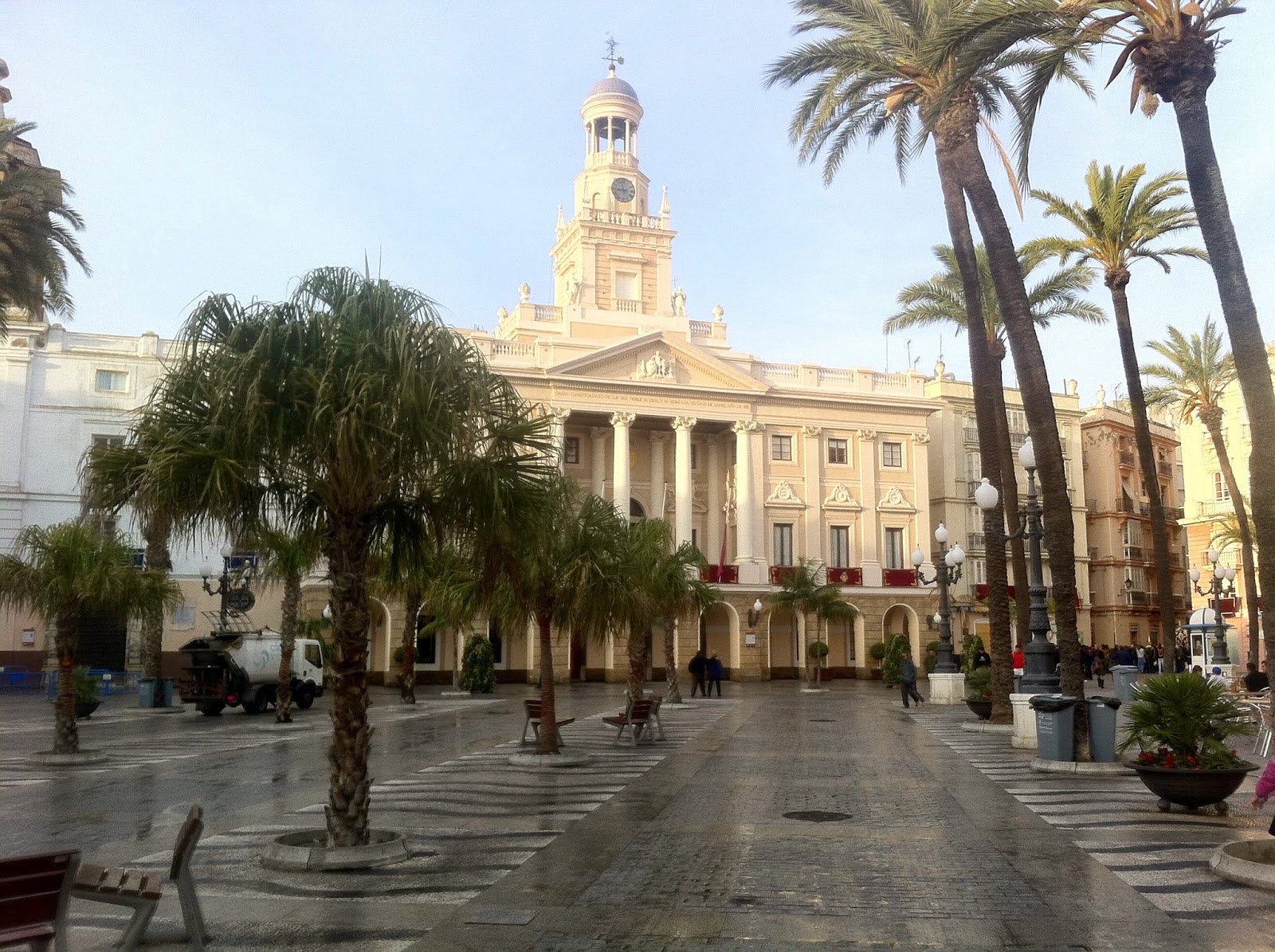
Our last port of call was Cadiz, a small city in the south of Spain on the Atlantic coast.  It being Good Friday, we didn’t expect much action.  But, as has often happened on this trip, we were surprised.  Around 9:30, we came across the beginnings of a procession, and figured it must be going to the Cathedral.  We parked ourselves as close as we could to the route and watched in amazement as a huge ornately carved platform was hefted through the narrow streets.  We were told that as many as sixty men were required to carry it; all we could see were their feet.

They were accompanied by people wearing these strange-looking costumes.  No, they’re not Ku Klux Klan!  In the Catholic context, the head coverings symbolize confession and repentance, and they’re probably the origin of the ‘dunce cap’.

Cadiz turned out to be yet another pleasant surprise.  A beautiful, clean, historic and interesting city we wouldn’t hesitate to visit again.

As is my habit, I’ll end my description of this adventure with a few concluding thoughts:

·        Elva and I have learned more about the world in the twenty months since I retired than we did in the previous twenty years.  I’m not arguing that travel is a pre-requisite to understanding, but to truly appreciate what’s going on in the world, you have to see for yourself.

·        We’re gradually being transformed from ‘tourists’ to ‘travelers’.  We’ve learned very little from the ‘tourists’ on the ship but a great deal from the ‘travelers’.  There’s an important distinction between the two.  The latter are true students; the former, just along for the ride.  Being a traveler means stepping out of your comfort zone to see and experience things that tourists are afraid to.  It also means being smart with your money and learning from others who know better.

·        My impressions of Southeast Asia were dead wrong.  Economically, it’s much more advanced than I’d thought.  Singapore is the most impressive city I’ve visited, and Kuala Lumpur is not far behind.  In Indonesia, Surabaya is well on its way to becoming an important city.  The days of European and North American dominance are over.

·        Countries like Morocco, India, Myanmar, Sri Lanka and Thailand need to get their acts together politically before ordinary people see a meaningful difference in the way they live.  The poverty we saw, especially in India and Myanmar, tells me it will be a very long time before this can happen.

·        Despite what we’ve been taught, a democratic form of government is not the only way to achieve economic development and a better standard of living.  Of the countries we visited, Oman, the United Arab Emirates, and Singapore are or were governed by autocrats.  Yet, their people enjoy a very high standard of living.  Compare India, a democracy, to China, an autocracy: there’s no question who’s better off.

·        Ninety percent of the world’s goods are transported by sea.  The largest container ships can carry 9,000 forty-foot tractor-trailer-sized containers.  Think about that!  The concept of shipping lanes was new to me and I saw with my own eyes that the oceans are more than just huge empty spaces.  For example, every year, 60,000 ships pass through the Strait of Malacca.  It’s busier than Cavendish on a Sunday afternoon in August, for goodness sakes!

·        “The longer the cruise, the older the crowd.”  On this cruise, virtually every passenger is retired.  While many of them are hobbled by one affliction or another, a good number are in very good health, even into their early eighties. 

·        We’ve directly experienced four of the world’s five dominant religions on this trip: Christianity, Islam, Hinduism and Buddhism.  Naturally, we’re more comfortable among our own kind.  We felt entirely at ease in countries where Hinduism and Buddhism are the dominant religions, but not so where Muslims form the majority.  That may change in my lifetime, but I’m not hopeful.

·        The MS Rotterdam is a community of 1,800 people, two-thirds passengers and one-third crew; from all over the world and from all backgrounds.  As with any community, you get to know some better than others.  The ship has everything you’d expect to see and experience in a community of this size.  Three people died while we were onboard: one, a crew member, while surfing during his day off; the other two, passengers, passed away before reaching the end of the voyage.  The young son of one of the officers learned to walk and is now into everything.  Couples celebrated wedding anniversaries; one their 55th.  Couples ‘hooked up’; others ‘broke up’.

·        Looking back to the places we’ve visited, seven are definite ‘keepers’; places to go back to: London, Malaga, Singapore, Bali, Langkawi, Ajaccio and Barcelona.

·        Spending 88 days in a 200-square-foot windowless cabin on a ship that doesn’t always sail on calm waters is a true test of a relationship.  I’m happy to say we passed, and wouldn’t hesitate to do it again!


It’s time to go home now and break out the bike and the fishing rod.  Elva and I look forward to planning our next adventure.

Friday, 27 March 2015


2015 ADVENTURE – PART 8

I can’t imagine two more different cities than Singapore and Mumbai.  It may well be the financial capital of India, but Mumbai leaves quite a different impression with the first-time visitor: filth, decay, chaos, and poverty.  Walking through the streets, one is overwhelmed by sights, smells, oppressive heat, and the ear-splitting cacophony of car horns.  Crossing the street is a risky venture to say the least.  The rule is: if you walk, vehicles may slow down; if you run, you’re target practice!
About 19 million people live in Mumbai.  That’s more than half the population of Canada shoe-horned into a space - 440 square kilometres - less than one-tenth the size of Prince Edward Island!  The ultra-rich and the poorest of the poor live next door to one another.  One of the richest men in India lives with his family in a 24-floor skyscraper while, less than a kilometre away, people live in cardboard shacks with plastic tarpaulins for roofs.
We spent two days in Mumbai.  Our first day there, we took a Holland America tour to visit the Elephanta Island Caves, a UNESCO World Heritage Site with a Hindu temple dedicated to the deity, Shiva.  The largest of the temples measures 40 metres x 40 metres x 4 metres, carved into solid volcanic rock, features magnificent carvings of ancient Hindu mythology.

We were told that 1,300 people live on the island, with no electricity and few prospects.  Islanders eke out a living by selling trinkets, mangy dogs wander everywhere and cattle have the run of the place.  The site has great potential as a tourist attraction, but it’s just another sad reminder of just how far behind the rest of the world India really is.

On day 2, we took another tour called A Day in the Life: Mumbai on the Move.  Our excellent tour guide and bus driver took us through downtown Mumbai, pointing out the more significant buildings, many of them dating from the British colonial era.  We visited Mahatma Ghandi’s Bombay house, an interesting memorial to one of the nation’s founders before making our way to a city train station.
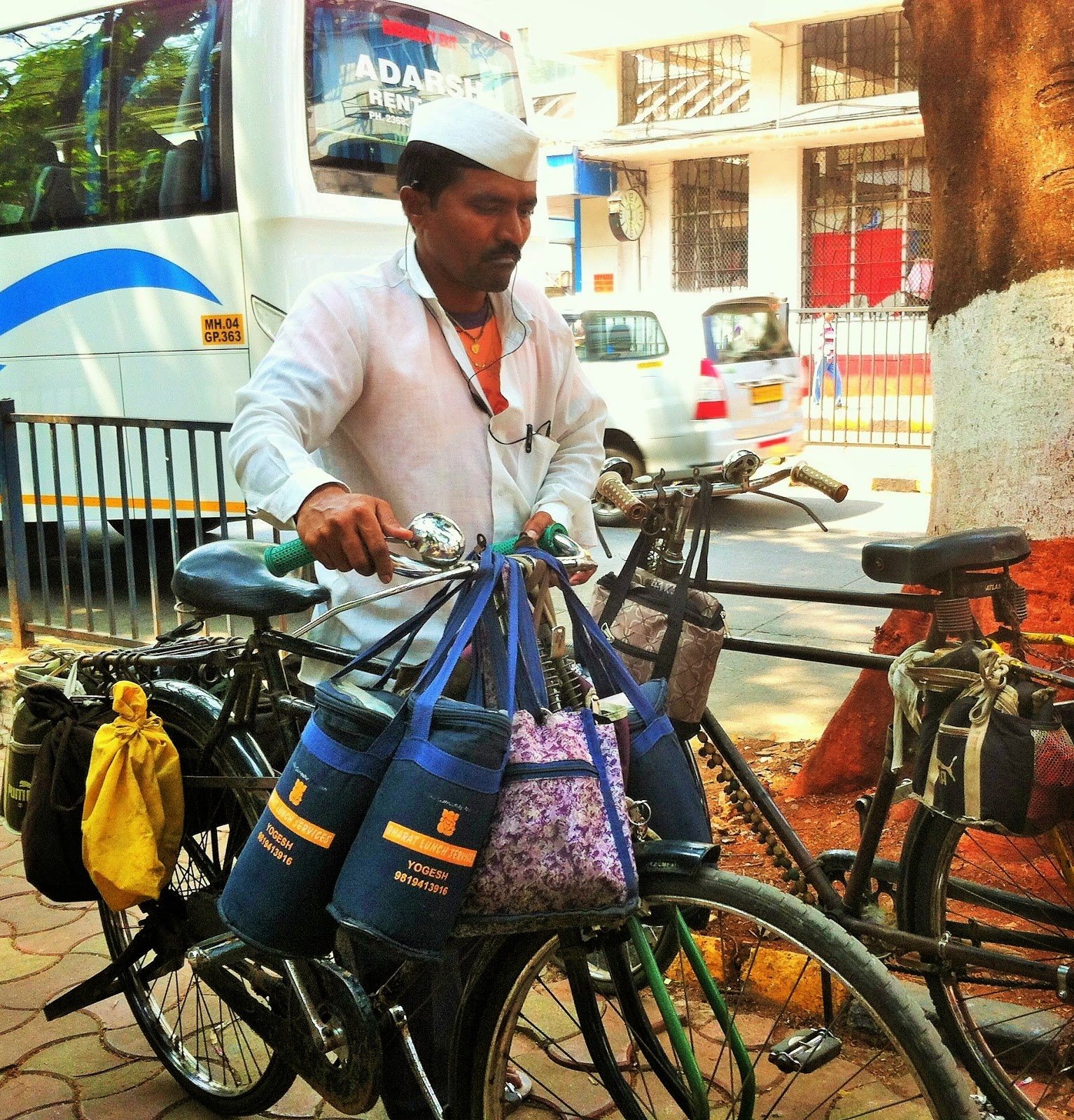
Here, we were introduced to one of the world’s most amazing businesses: lunch box delivery by a guild of men called the dhobi-wallah.  Every day, 5,000 dhobi-wallah pick up and deliver 200,000 hot lunches from people’s homes to their workplaces.  The door-to-door service involves transport on foot, by bicycle and by train, with several transfer points along the way.  Each lunch box is coded.  The error rate is 1 in 6,000,000, meaning that only one lunch box per month, on average, ends up in the wrong place!

After a short ride on one of the city’s trains, we stood at a overpass and looked down on a spectacle straight out of the Dark Ages: the Dhobi Ghat.  Here, much of Mumbai’s laundry is washed, dried and ironed, before being returned to homes, hospitals, restaurants, and hotels.  As with the lunch box system, it’s a door-to-door service, performed exclusively by a guild of men, all of them migrant workers from outside the city.  They work seven days a week in conditions that are unimaginable, live on-site in hovels perched around the perimeter of the site, and go ‘home’ once or twice a year to help with the harvest or attend a wedding or funeral.
The concrete structures in the centre of the photo are cement laundry ‘tubs’.  The tin-roofed structures are living quarters.

Mumbai was just too much for me.  While some people marvelled at how “it all seems to work”, I couldn’t get the images of misery and hopelessness out of my mind.  And, we didn’t even get to see the slums.

After three days at sea, we sailed into the port of Salalah, second largest city of Oman.  It was the main trading point on what was called the Frankincense Trail, named for the highly-prized aromatic resin used in religious rituals and healing.  The Sultan of Oman, Qaboos, lives here in his palace during the summer months, presumably to escape the heat of Muscat.
From the ship, all you can see are container ships and the huge cranes that unload them.  It’s clear from these and the frantic construction activity around the port that this is a country on the move economically.  We drove to the centre of the dust-dry city.  Judging by the size of the new houses we passed along the way, there is tremendous wealth here. 
While the women indulged themselves at the souk, I walked along the main street.  One whole side of it is being razed to make way for a seaside tourist development, an area three blocks wide by two kilometres long.  I’d say that, within two years, the whole area will be covered with high-end resorts.

One of the few traditional tourist attractions near Salalah is the tomb of Job, the long-suffering Old Testament prophet admired by Jews, Christians and Muslims alike.  Along the way there, the terrain changed from flat, dry desert to hill country, interspersed with deep ‘wadis’: valleys or canyons in our parlance.

Our taxi driver, Mohammed, proudly showed off his family’s camel herd.

After leaving Salalah, we sailed through the Arabian Sea and past the Horn of Africa before entering the Red Sea.  On March 20, not far off the starboard side of the MS Rotterdam in Sanaa, the capital of Yemen, 137 people were murdered while at prayer when two suicide bombers blew themselves up.  It’s tempting to say of the warring Muslim sects: “Let them kill one another if that’s what they want to do!  Why should we care?”  Unfortunately, it’s not that simple.  Just two days before, 19 cruise ship passengers visiting a museum in Tunis - people just like us - were gunned down by the same group that took credit for killing the worshippers in Sanaa.
We stepped ashore in Aquba, Jordan’s lone port city, and boarded a bus for Petra.  Our guide reminded us that the country is an oasis of relative calm bordered by countries that are unstable or hard to get along with, or both: Israel, Egypt, Saudi Arabia, the Palestine Territory, Lebanon, Syria, and Iraq.  Jordan, with 7 million residents, also provides shelter to 4 million refugees, mainly Syrians and Iraqis.
Since the Arab Spring uprisings and the advent of the Islamic State, tourism has nosedived by at least 80%.  Plans for economic development have been put on hold as the country is forced to turn its attention to military priorities.  I’m reminded of the horrific image of the caged Jordanian pilot burned to death by Islamic State butchers.  The Jordanians are a brave and determined people and represent the only hope for peace and civility in this war-torn region.
Ah, Petra!  One of the Seven Wonders of the Modern World, and on my bucket list.  Pictures cannot describe what we saw.  At its height, around the time of Christ, Petra was one of the most important cities in the region.  It was home to some 30,000 people who enjoyed a relatively high standard of living.  Of the many monuments hand-carved out of solid rock to serve as tombs for Nabatean rulers, the Al-Khazneh (aka the Treasury) is the most recognizable.  Note the difference in colour of the sandstone in these two photos taken two hours apart.

To get to and from it, you walk through the As-Siq, a 1.2-kilometre-long deep, narrow gorge of red sandstone cliffs soaring above to a height of 80 metres.

The theatre, also carved out of solid rock, could hold about 7,000 spectators.

The largest of the royal tombs is called the Urn Tomb.  The colours are incredible.

To see Petra properly would have taken two or three days; we had about three hours!  Just the same, it was one of the highlights of our trip!