Saturday, 2 November 2013


EUROPEAN VACATION – WEEK 6

 
Elva and I are by no means experienced ‘cruisers’, but after visiting several cities on this trip, we’ve come to appreciate what makes us feel interested, welcome and satisfied.  It has left us wondering what cruise passengers’ impression is of Charlottetown and Prince Edward Island.  From our new digs downtown, we see cruisers wandering around, maps and cameras in hand, and we now have a better idea of what they’d be looking for.

First impressions are based on the view of the city from the ship as it comes into the harbour and arrives at the dock.  Here, we have no doubt that passengers would be very impressed by what they see.  The cruise terminal itself is a rather drab building, but most of them are. 

By the time the ship ties up, passengers have decided what they’re going to do for the day: excursion, self-guided tour, or a local guide hired on-site.  Excursions on the Island include the visit to Green Gables and the National Park, the Confederation Bridge, and perhaps a visit to a beach.  Others that would interest me would be a matinée at the Confederation Centre, a round of golf, a trip out on a lobster boat, and a farm tour.  Another interesting cultural experience would be a trip to Abram-Village, including a lunch featuring Acadian cuisine, and a performance by local artists.

Since excursions organized by the cruise line tend to be quite expensive, in the $150 range per person for a full day and $90 for a half day, passengers often opt for a self-guided tour.  For a small city like Charlottetown, the prospect of walking around is certainly attractive.  So, what would a visitor like to see, and what is needed to make the day interesting?

Well, for starters, we need to find the Tourism Office.  It needs to be open when the shop arrives, be staffed with helpful, enthusiastic people who aren’t wishing for the tourist season to end, and the staff need to be knowledgeable about their city.  We found, for example, that staff tend to stereotype cruise ship passengers, assuming we are old and decrepit, and that we have mobility problems.

Next we need to be able to find a good Wi-Fi connection.  Our cruise line, Holland America, offers an on-board internet service, but it is expensive, slow and unreliable.  So, we wait until we get ashore.  While many cruise terminals advertise their Wi-Fis, none we’ve tried was much good.  The better option is finding a café, ordering a drink, and asking for the password.  Usually, this works fine, but in Capri, a coffee and a tea cost us $15!  We wonder how many businesses in Charlottetown offer Wi-Fi?

There need to be public washrooms available; clean public washrooms.  While I wouldn’t hesitate to walk through the lobby of the Delta Hotel in Charlottetown to find my way to the washroom, hotel staff in the cities we’ve visited are on the lookout for people who try to do this.  I don’t know if public washrooms are marked on the city map given to passengers visiting Charlottetown, but they should be.  When travelling, I always bear in mind the wise words of Jack Nicholson from the movie Bucket List, when he recited his three rules for older men: “Never walk past a bathroom; never waste a hard-on; and never trust a fart!”

Finally, people need to have nice places to just hang out.  Here, Charlottetown is in very good shape, with its abundance of parks and public places.  However, recent attempts to create ‘café-style’ spaces by extending patios out into the street just don’t do it.  Only Victoria Row and the restaurants with a view of the harbour offer the kind of experience cruise passengers expect.

This week started with a visit to Kotor, Montenegro, the third port we visited on the east coast of the Adriatic Sea.  Kotor is a small city, probably about the size of Summerside, the perfect size for walking around.  The harbor is spectacular, framed by mountains, and its old town is a UNESCO World Heritage Site. 


As soon as we stepped on the dock, we picked up a map and headed for Fort Saint John, the fortress guarding the old town.  We’ve learned through experience that the best way to get the true sense of a city is to see it from above.  This time, we had to climb a tough and winding staircase to the partially-restored fortress which sits at 260 metres above sea level.  But it was well worth it!

The view was spectacular, and I even captured the flag of Montenegro!  From our vantage point, we could trace the fortress wall from the summit, down into the old town, and around to the seafront.  It’s the best example we’ve seen of a fortified town.  The old town itself is spotless, featuring a host of cafés, shops, and restaurants with reasonable prices.  We found the people there very friendly and accommodating, and we hated to leave.


Next, it was off on an excursion to a country visited by few North American tourists, Albania.  This small country lies on the Adriatic Sea, between Montenegro to the north, and Greece to the south.  We boarded a hydrofoil on the island of Korfu for the trip to the small port city of Saranda, on the south coast of Albania.  Saranda was a small fishing village until about twenty years ago when the money and the tourists started rolling in.

Albania was governed by a repressive and paranoid régime, not unlike North Korea’s, from 1945 until 1990.  For much of that time, the country was completely isolated from the rest of the world, its closest ally being communist China.  As a result, the people suffered greatly and are just now emerging from a long nightmare.  A good annual salary is $10,000, about one-third the European average.  Yet, these people pay twice what we do for fuel!

Officially, we were there to see the ruins of Butrint, a UNESCO World Heritage Site which features four distinct periods of occupation: Greek, Roman, Venetian, and Ottoman.  While I had some interest in the ancient history, I was more curious about what has happened to the country since 1990, and how things are today.


Fortunately, we were accompanied by a very knowledgeable guide who explained that the country is trying to attract foreign investment and build a tourist industry similar to that of its Adriatic neighbours.  It’s clearly got a good start on things, judging by the pace of new construction in and around Saranda, but the 2008 recession has resulted in many projects being delayed or cancelled.  As a result, the place has a half-finished look to it.  I’d like to visit again in ten years.  At this point, I feel things could go either way; boom or bust.


We sailed south along the Adriatic coast to the town of Katakolon, gateway to Olympia, site of the ancient Olympic Games.  While most people opted for a visit to the ruins, we went to Magna Grecia, an agriturismo featuring home-grown organic olive products.  After receiving a detailed explanation of how the olives are harvested and processed, we had a delicious lunch, complete with Greek music and dancing.

Next, we rounded the Peloponnese, the large peninsula that forms the southernmost part of mainland Greece, and landed at the port of Nafplion.  Most of those who took the excursion route went to Mycenae, the golden city referenced in Homer’s epic poem, The Odyssey, or to Corinth to visit the Temple of Apollo or the Tomb of Agamemnon.

While I do know the difference between Zeus, Athena, Poseidon, and Apollo, I confess that the Greek gods don’t do much for me interest-wise.  As for ruins, one set looks pretty much like the other to my eyes.  My impression of Greece is that people here are too focused on the past.  Because of the country’s chronic economic problems, infrastructure is falling into disrepair. 

Nafplion’s beautiful seaside promenade is lined with expensive streetlamps, most of which have been smashed, and there’s graffiti everywhere.  The same is true of the stairway leading to Palamidi Castle: all the spotlights have been smashed as has the electric panel.  It’s a shame, because the town’s setting is beautiful.  I took advantage of a pretty little pocket beach to go for a swim.


Next, it was off to Athens, capital of Greece, and the birthplace of democracy.  We only had a short time to spend in the city, but did get to see the Acropolis and its centerpiece, the Parthenon.  This major tourist attraction is absolutely crawling with people.  The Parthenon is perpetually under repair, so there are scaffolds and cranes everywhere.  It’s hard to make head or tail of the various temples located on the Acropolis, and without a guide, the whole thing is mass confusion.


A major demonstration was underway in the centre of the city the day we were there.  People are unhappy with the drastic measures taken by the Greek government to keep the country from being kicked out of the Euro Zone.  I understand their frustration, but they’ve been living the dream for too long; now it’s time to get real!

We then sailed across the Aegean to Kusadasi, Turkey, the port closest to the ancient city of Ephesus.  We took a tour and visited the site of a house where Mary, mother of Jesus, is thought to have lived for a time.  From there, we went to visit the ruins of Ephesus.  The iconic image of the city is, of course, the façade of the library.  But there’s much more to see: a theatre which sits 15,500 people, various temples, the marble streets, and even a brothel.  Our guide told us that only 10% of the city has been excavated to date. Imagine a city of 200,000 souls at the time of the Roman Empire, 2,000 years ago!

Elva and I took a ‘selfie’ in front of the library façade.  For those of you who haven’t been to this part of the world, prepare to encounter many stray cats and dogs, some of them living in pretty pitiful conditions.  But not these three; they were as snug as could be, sleeping in a sink in the men’s washroom in Ephesus!  Finally, I couldn’t resist snapping this sign, which shows that the Turks are nothing if not honest. 

 
After the history lesson, our guide took back to Kusadasi to visit a store, a co-op actually, that retails carpets made in villages in central Turkey.  We were treated to a demonstration of how silk is made from cocoons of the silk worm, and how the carpets are made.  Next, our host and his staff rolled out at least thirty carpets of all sizes, colours, and patterns.  Amazing!  The most expensive ones were over $20,000…
 
Yesterday morning, as we were having breakfast, who walks by our table but Cheryl Stead and John Cox of Charlottetown.  Imagine!  Actually, they're the second couple we've met on the MS Rotterdam from the Island.  We also ran across Ted and Gail Lewansky from Stratford last week in Split.


Sunday, 27 October 2013


EUROPEAN VACATION – WEEK 5

 
Last week, I entered my seventh decade of life when I turned 60.  A half-deaf, half-blind epileptic, I’m proud to have all my own teeth and enough hair to cover most of my head.  I can still get out of bed every morning without holding on to anything, and there are no signs of arthritis yet.  I get up a few times in the night, but figure that’s better than the alternative.  Most everything still works. 

On my birthday, Elva wished me “Bonne fête!” and told me “Tu me fais pas zire!”.  The latter comment, for those of you who don’t know Acadian, is a back-handed compliment, one I’ll gladly take.

Our first port of call this week was Dubrovnik, Croatia, a spectacular port city on the Dalmatian Coast of the Adriatic Sea.  For those who may not know, Croatia is one of seven countries that formed the former Yugoslavia, the others being Slovenia, Serbia, Bosnia-Herzegovina, Montenegro, Macedonia, and Kosovo.

The old city of Dubrovnik is one of many UNESCO World Heritage Sites we’ve seen thus far, and it’s quite charming.  We got there early in the morning, before the worst of the crowds arrived, and the first thing we noticed is that the stone pavement of the main street literally shines!  It’s that clean!  The streets are narrow, many consisting entirely of stone steps.  The only vehicles we saw in the old city were of the battery-operated golf cart variety.


We took the cable car to the top of Mount Srd, dominated by a fortress built by Napoleon in 1812.  We visited a very interesting museum in the old fortress that tells the story of the 1991 military conflict between Croatia and Serbia-Montenegro, when Dubrovnik was bombed and held under siege for a time.  The people suffered terrible hardships and much damage was done to the old city.  You’d never know it today as everything has been repaired.  Dubrovnik is the most interesting city we’ve seen to date.


We spent two days this week in Venice, a beautiful and interesting place, covering most of the essentials: St. Mark’s Square, the Rialto Bridge, the Doge Palace, the Bridge of Sighs, and the Museums.  We travelled by water bus and walked many kilometres, getting a sense of how this unique city is laid out and how it functions.  And having a little fun, of course, as demonstrated by the “Pigeon Lady of Saint Mark’s Square”.


Imagine a city constructed totally on islands in the middle of a lagoon: no motorized vehicles on the streets, no bicycles, no utility poles or overhead wires, and no asphalt.  Imagine a city where people get to their destination by water bus or taxi, where goods are delivered in the narrow streets by hand cart, and where everything of any size moves by water through the extensive canal system. 


We watched with fascination as gondolas travelled the same canals as water buses and taxis.  There are no traffic lights or stop signs, but everyone seems to get along.  Boats carry cement, construction waste, lumber, furniture, laundry, and suitcases.  There are ambulance boats, police boats, and even an armored boat, a substitute for the Brinks truck.  No one in their right mind would ever build a city in such an unlikely locale, yet it exists and continues to function.

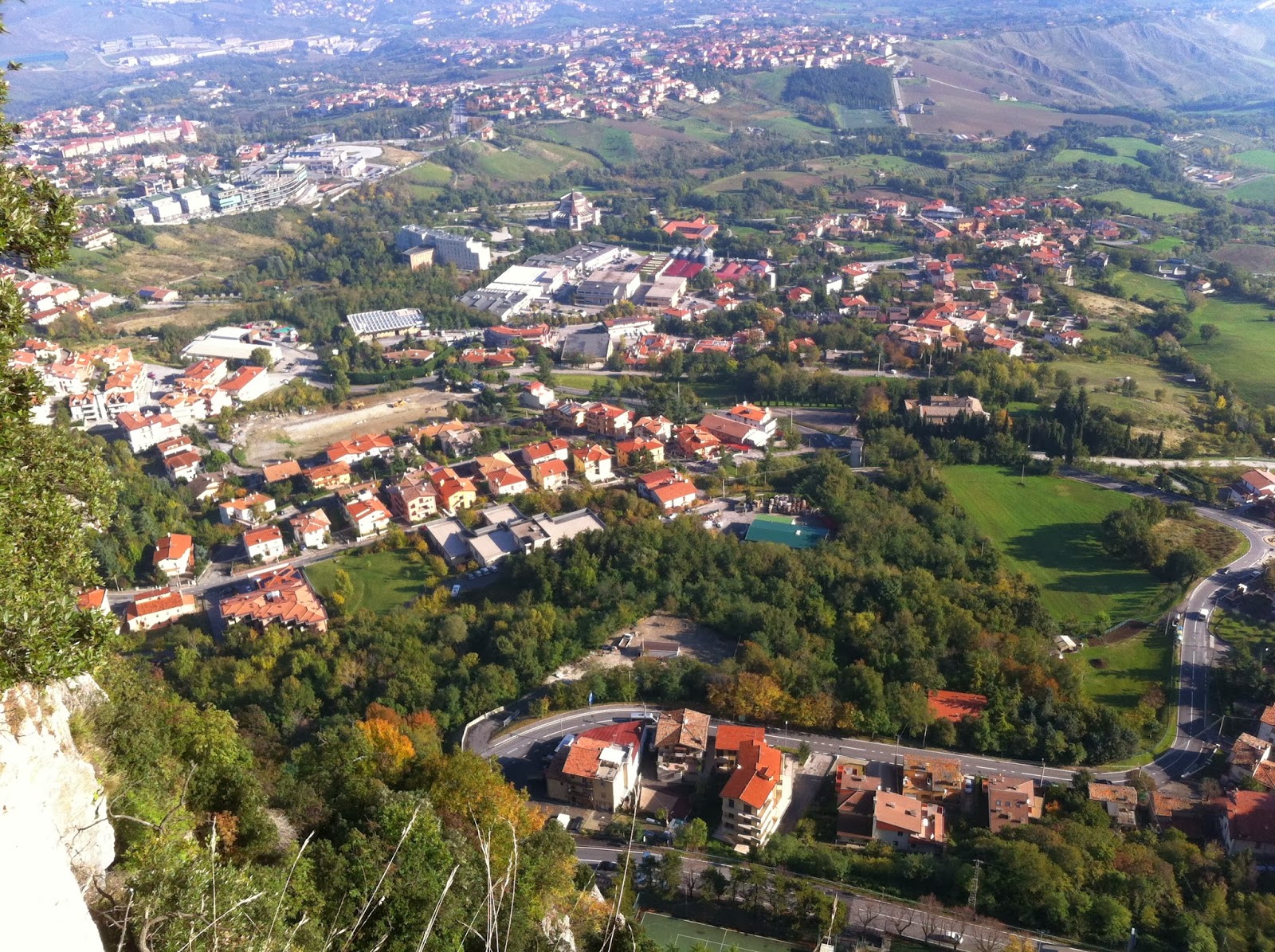
Next, it was off on a bus excursion to San Marino.  When I attended la grande école in Wellington, Madame Orella would let me look at the map of the world when I’d finished my assigned work.  In this way, I became familiar with the countries and their capitals.  For some reason, I was fascinated by the smallest countries.  On this trip, we’ve visited Andorra, Monaco and Malta thus far, and will see Vatican City before it’s over.

San Marino is the world’s oldest and smallest republic, founded in the year 301 AD.  Its total area is 61 square kilometres, making slightly larger than Charlottetown, I’m guessing, and with a similar population: 31,000.  The country spreads out on the slopes of Monte Titano, and the oldest part consists of narrow, spotless streets lined with hotels, restaurants, and high-class shops.  We walked along the crest of the hill and visited the three castles, the oldest dating from the XI century, but stayed away from the Torture Museum, said to house the “most disquieting collection in the world”.


San Marino is very prosperous, due mostly to tourism; it welcomes over 2.5 million visitors a year.  Our guide told us that residents pay income tax at the rate of only 15%, and there’s no sales tax!  The country accepts no immigrants, except women who marry citizens of San Marino; they must remain in the country for fifteen years before becoming eligible for citizenship. 


It’s the only country in the world that does not have a single traffic light; it functions entirely with round-abouts.  Now, I know where Ronnie MacKinley and Clifford Lee got the idea!  What a neat place!

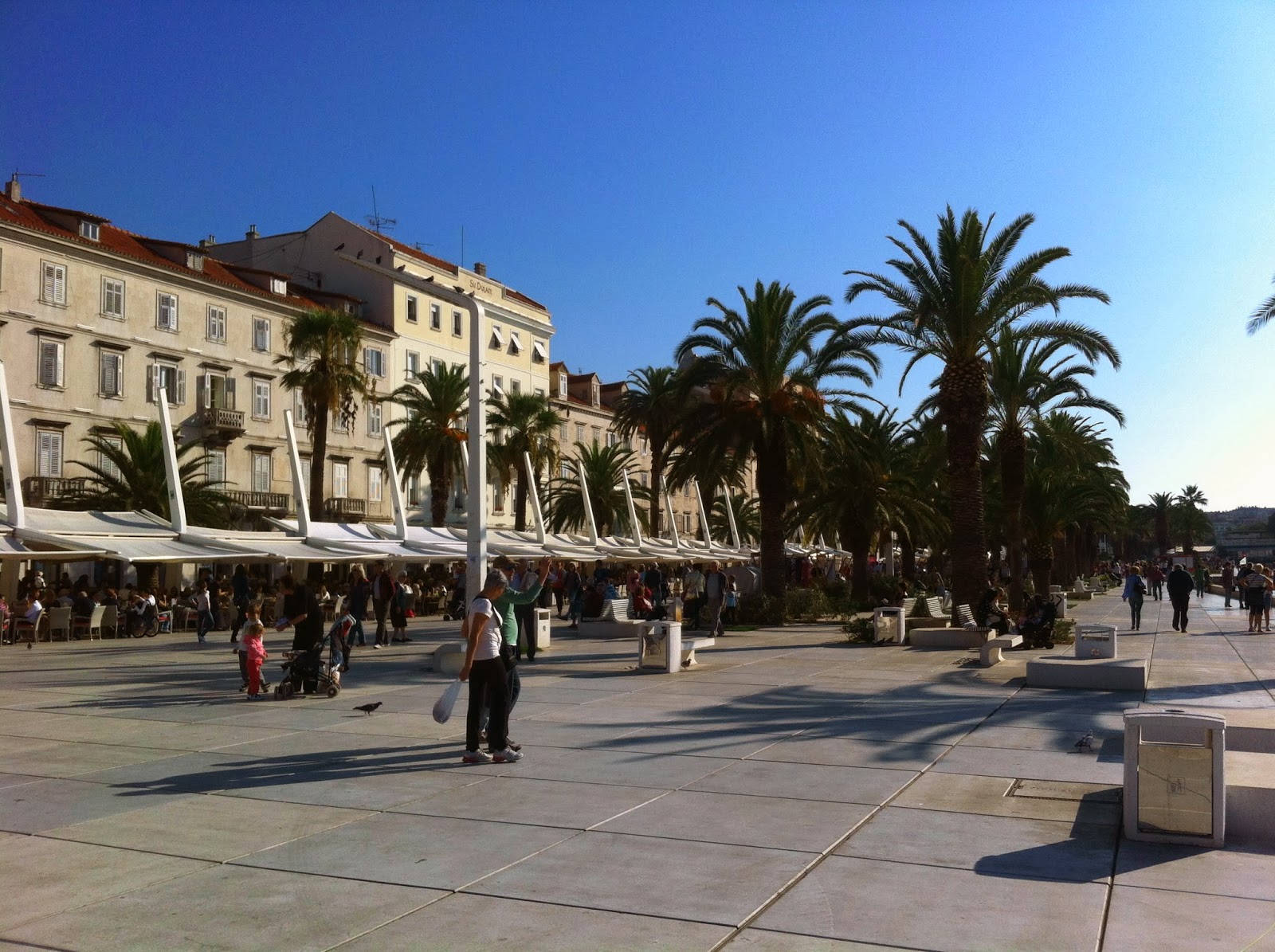
Next, it was off to Split, across the Adriatic, and west of Dubrovnik.  The city’s claim to fame is that it was the site of Roman Emperor Diocletian’s palace when he decided to retire there in the fourth century.  As was the case in Dubrovnik, Elva and I opted to tour the city on foot rather than take an excursion and shuffle along with all the old people.  We find that we get to see much more this way, and the exercise helps to burn off the calories we inevitably consume onboard ship.  Split was beautiful!  It is not a large city but the old section features an impressive seaside promenade. 


We were lucky to be there to see a cultural fair of some sort, with young people displaying their singing and dancing talents.  The, a group of a dozen or so mentally-challenged young adults came onto the stage.  Several of them participated in a song-and-dance routine, and each one then gave a short, emotion-filled speech.  We were touched!

Next, we wandered through the streets of Old Split, surrounded by the walls of Diocletian’s palace, and came across a group of four men singing a beautiful folk song.  It all seemed so natural and unscripted; beautiful voices, fine accompaniment, people sitting around to just listen and join in.  Before boarding the tender to take us back to the ship, we lazed on a bench on the promenade and just enjoyed the sunshine and the 25-degree day.  What a life!

Sunday, 20 October 2013


EUROPEAN VACATION – WEEK 4

 
We started our second week on the MS Rotterdam in Ajaccio, Corsica, the main city on the large island that belongs to France.  It is, of course, the birthplace of Napoleon Bonaparte (not Sylvère Napoleon’s father, for those readers from Wellington; the other Napoleon; the guy who was defeated by the Duke of Wellington at Waterloo).  Confused?

Anyway, we took our first excursion that day and travelled by coach across a mountain pass – part of the 2013 Tour de France – to the village of Cargèse.  The community was founded over two centuries ago by refugees from Greece, fleeing a Turkish invasion.  The village itself is beautiful, perched as it is high on a hill overlooking a beautiful bay.  Our guide explained to us that many inhabitants still speak Greek, and we visited their Greek Orthodox Church.  Greek Orthodox adherents are Catholic in most ways, except they don’t recognize our Pope, and they touch their right shoulder before the left when making the sign of the cross.  Whatever!

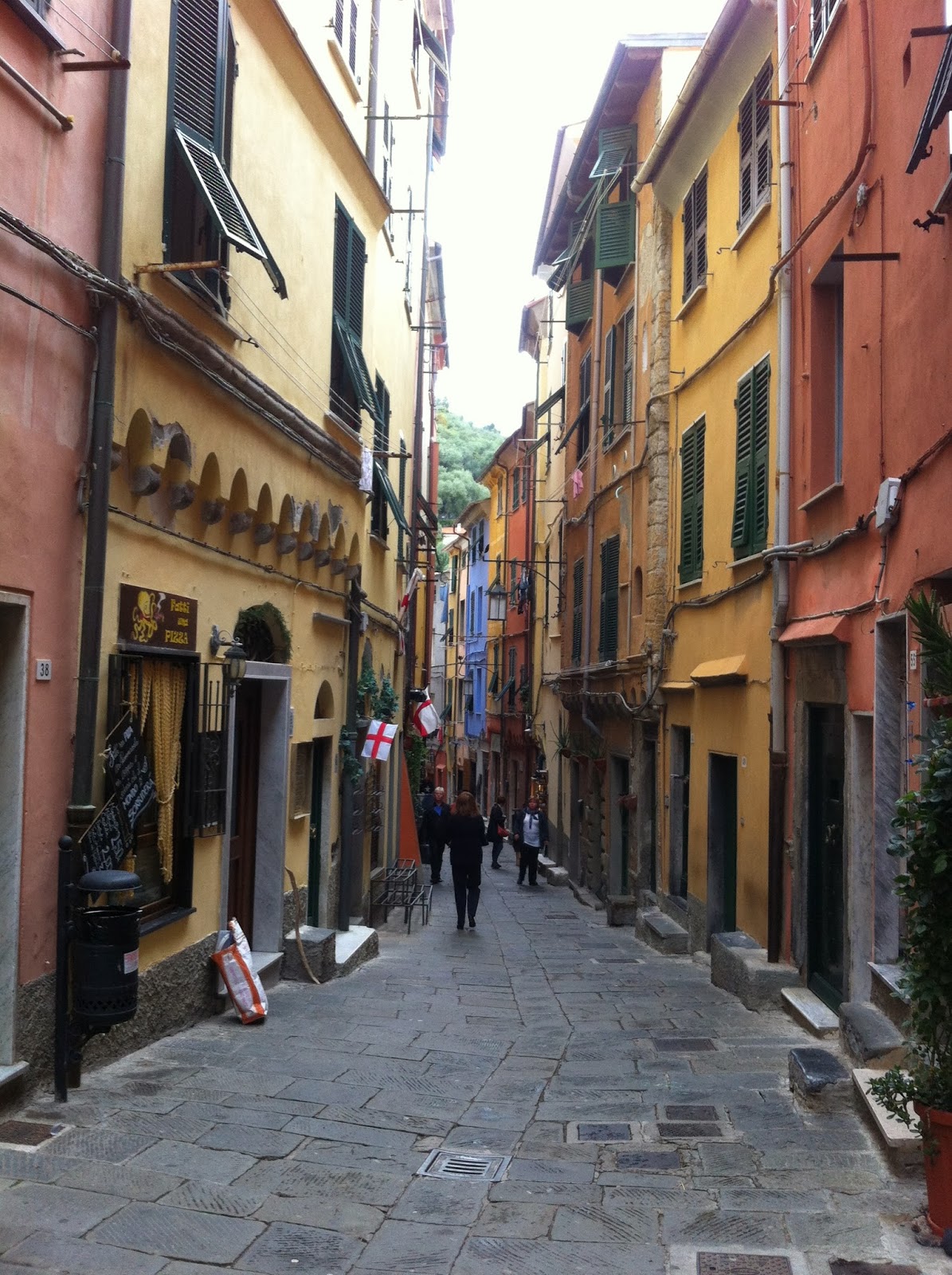
The next day, we debarked at the port of Livorno, on the Italian mainland, and drove to the village of Portovenere, the southern gateway to Cinque Terre.  After a stroll through the quaint old quarter, located inside an old fortified castle, we boarded a boat for the trip to our first stop, the village of Vernazza, one of five hamlets that make up the region of Cinque Terre.

 
Our guide explained that these villages would challenge our understanding of the vertical and the horizontal.  By this, she meant that the people who settled there many centuries ago learned to eke out a living on slopes that would challenge a mountain goat.  They built terraces by hand using dry stone walls, filled them in with whatever soil they could find, and grew grapes and olives on them.  One of the settlements, the one shown in the photo below, is accessible only by sea, after climbing over 1,000 steps.  The people who live there have no electricity or running water!


Our last stop of the day was Monterosso, the largest of the five villages.  We had a delicious lunch there and walked around a bit, climbing above the settlement to get a better idea of its layout.  The villages of Cinque Terre have been accessible by train for some time now, but by road for only about forty years.  There’s one main street to get in and out.  Most residents access their houses on foot, climbing steep steps to get from place to place.


We could have gone to Pisa or to Florence from Livorno, but are glad we chose Cinque Terre.  Many people experience the area by walking from village to village over the well-established trail system.  The coastal region has been designated as a UNESCO World Heritage Site because of the uniqueness of the villages and the preservation of certain aspects of the traditional way of life; seeing it from the water made it very special.

Speaking of Pisa, Galileo developed an understanding of one of the fundamental forces of nature, gravity, by dropping objects of different weights from the leaning tower.  He learned that gravity applied equally to all objects, regardless of their mass.  This got me thinking about what our tour guide said about redefining the horizontal and the vertical…

Europeans are far more liberal that North Americans when it comes to displaying their bodies.  We first noticed this on Spanish beaches, where many people sun themselves in various states of undress.  Alas, I’m sad to report that there are as many bottomless men as there are topless women!  But some would be better off clothed, owing to that afore-mentioned fundamental force called gravity, and this applies equally to both genders!

Elva was somewhat taken aback by one particular gentleman in Barcelona, who made a point (no pun intended) of exhibiting his naked body while surveying the beachscape from a standing position.  A lady in front of us, a 250-pounder in a too-small string bikini, was obviously enjoying the sun, not in the least way inhibited.  While I admired both of them, I was not about to imitate either one.

My curiosity was piqued by a nearby twenty-something topless girl with implants.  They reminded me of Madonna’s ‘bullet bra’.  When she lay down, they stuck straight up, and when she sat up, they stuck straight out!  I wonder what Galileo would have thought of these masterpieces of the plastic surgeon’s art?  So much for gravity!

After Livorno, we sailed to the island of Sardinia.  Instead of an excursion, I’d decided on a meal of porchetto arrosto, roast suckling pig.  The Sardinians specialize in the dish, and I was not disappointed.  The city where we landed, Olbia, is small but does a good job of catering to cruise ship passengers; it reminds me a bit of Charlottetown.  Elva found a nice little shop where the owner makes sandals, and she had a nice pair custom made for herself at a very reasonable price.

 
The next day was taken up by our journey from Sardinia to Malta.  Malta, an independent country consisting of two main islands, is a very interesting place for those who like history.  I’m guessing its land area is a bit larger than Andorra’s, and it’s very densely populated.  We toured part of the main island by hop-on-hop-off bus and spent the rest of the day walking around the capital city, Valletta, another UNESCO World Heritage Site.


From Malta, we sailed to Sicily, landing at the port city of Messina.  From here, we took a tour to Mount Etna, the tallest active volcano in Europe at 3,000-plus metres.  Our tour took us up to the 2,000 metre level where we walked around a couple of inactive craters and were able to capture some amazing views of the upper part of the mountain and the plain of Catania below.  The 25-km. road up the mountain would be a great climb on a bicycle!

Next it was off to Naples, through the narrow Strait of Messina, and northwest along the Italian mainland.  From Naples, we took another excursion, this time by ferry to the Isle of Capri, one of the most beautiful places I’ve ever seen!  It’s right up there with Les Saintes, an island we visited off Guadeloupe, and the Îles-de-la-Madeleine, two of our favourites.  But at $15 for a coffee and a tea, I don’t think we could afford to stay very long!

 
Today, we’re docked at Civitavecchia, the port city which services Rome.  This marks the end of the voyage for many passengers, and a new group will board for the next leg of the voyage.  Since we’ve decided to spend time in Rome after our cruise, we’ll spend the day in port and on board the ship.

Life on the MS Rotterdam is like staying in a four-star hotel every day: nice room, steward service, choice of restaurants, well-stocked library, good fitness centre, and entertainment every evening.  Everything is included in the price, except drinks, excursions, wi-fi service, and purchase of items on-board.  I don’t have to drive anywhere, and we don’t have to pack and unpack.  Our steward, Bali-born Wayan, makes us an animal from towels every evening when he turns down our bed: the photo below features his most ambitious creation.
 

The passengers are an older crowd, averaging over 70 by my estimate.  There are very few young people.  The oldest we’ve encountered is an 88-year-old lady from San Francisco.  We overheard her saying this was her forty-third cruise, including three that were of the around-the-world variety.  An 84-year-old gentleman from Missouri told us he’s visited 120 countries and isn’t done yet!

Many have mobility issues but seem determined to enjoy the experience nonetheless.  There is a good mix of Americans, Canadians, British, Australians, New Zealanders, Dutch, Chinese, and Japanese.  Most people appear to be enjoying themselves.  It’s quite entertaining to observe those who are not: the chronic whiners; couples who don’t agree on things; and guests who complain about every aspect of service one can imagine.

This evening, the ship will leave Civitavecchia and round the southern tip of Italy.  We’ll spend tomorrow in the Adriatic and land on Tuesday morning in Dubrovnik, Croatia.

Sunday, 13 October 2013


EUROPEAN VACATION – WEEK 3

We are now officially part of the cruising scene, having spent our first three days aboard the MS Rotterdam, a medium-sized ship owned by Holland America, very similar to the ones that call in Charlottetown.  She began this voyage in Ipswich, England, and arrived in Barcelona on October 9.
We spent six days in Barcelona, one of the most beautiful cities we’ve visited.  The Greater Barcelona area boasts a population about the same as Toronto’s but the place has a far different feel to it.  Friends and family members who’ve visited here raved about it and we can see why.  It is definitely world class. 

It’s the cleanest big city we’ve seen.  Municipal workers are constantly at work, armed with brooms and various motorized cleaning devices, even on a Sunday evening.  They all wear the same colourful fluorescent uniforms.  Construction workers also seem to pay particular attention to cleanliness and order when they’re jack-hammering sidewalks; all refuse is placed in large bags and is stacked neatly, to be picked up the very next day.  Cleanliness and order have become part of the Barcelona culture and a noticeable feature of its brand.
Every part of the city centre is designed for walking.  There are broad boulevards along the waterfront and other main thoroughfares, and parks everywhere.  Vehicle traffic is strictly controlled on the narrower streets to insure pedestrian safety.  Barcelona has five kilometres of beachfront, all of it easily accessible by foot or public transportation.  Our room was located in the Gothic Quarter, near La Rambla, a tree-lined pedestrian walkway with a buzz that makes you want to be there every day, especially in the evening, when artists and buskers are on full display.

 
But one cannot truly experience Barcelona without seeing the works of Antoni Gaudi, its most celebrated architect.  Elva and I spent a morning exploring his masterpiece, the church of La Sagrada Familia, a structure begun over a century ago and still far from finished.  It is more sculpture than church, however, with a truly unique design.  Gaudi’s imagination and genius are incredible! 
 
As impressive as the exterior is, the interior is awe-inspiring.  With its massive dimensions, incredible columns and stained glass windows, it is a veritable kaleidoscope of light and colour.  I’ve seen Notre-Dame in Paris and Saint Peter’s Basilica in Rome; neither compares with La Sagrada Familia.  All of the work is financed through private donations: no money comes from the Catholic Church, the Government of Spain or the City of Barcelona.

 
Before leaving Barcelona, we visited Parc Guëll, another example of Gaudi’s work, this time consisting of buildings, walkways, stairways, and plazas, all in a peaceful, park-like setting.  We also toured the churches of Santa-Maria-del-Mar and the Barcelona Cathedral.  One evening, we saw a spectacular fountain show that makes the Bellagio in Las Vegas look like a fountain with poor lighting and an enlarged prostate!

 
I’m not a particularly religious person, but when I visit a new village, town or city, I like to tour its church.  Each usually features a historical plaque or panels that explain when it was built, added to and renovated.  Some of the churches are plain and stuffy; dark and dank even.  Others are more ostentatious.  But each is the heart and soul of the community, regardless of how many people attend religious services, and a source of pride for residents.
Each one evokes in me the sad memory of the church where Elva and I were married, the regretted Saint-Philippe-et-Saint-Jacques of Egmont Bay, needlessly destroyed a few years ago by small-minded parishioners who neglected their duty to save it.  All over Europe, one finds churches in far worse condition.  But they are not being demolished just because the present congregation lacks the needed imagination and vision to breathe new life into them.  People here have too much respect for the sacrifices made by those who came before to even think of making such hasty decisions.

Our first port-of-call on the MS Rotterdam was Marseille, an overnight sail through rough waters from Barcelona.  With apologies to my friend, Denise, I was not much impressed by the city.  It has a very hard and tired look to it, not nearly as welcoming as Barcelona. 
We rode the shuttle into the city centre and walked from there up to the highest point in the old city, the Basilica of Notre-Dame-de-la-Garde.  From here, one enjoys a very impressive view of the city, including the Château d’If, the Vieux Port, and the two fortresses that guard the harbour entrance, Fort Saint-Jean and Fort Saint-Nicholas.  After strolling along the inner harbour watching fishermen clean their catch, we visited Fort Saint-Jean and took in a very informative audio-visual presentation on the history of Marseille.  We finished our day’s visit with a tour of the Cathédrale-de-la-Nouvelle-Major.

 
On Saturday morning, we ate breakfast just as the sun was rising over the harbour in Monaco.  The Principality of Monaco is barely four square kilometres in total area, and every square inch is utilized to the fullest; no wonder, what with real estate running at about $53,000 per square metre!


We walked from one end of the country to the other and from side to side, all in the same day.  The place reminds me of Disneyworld; everything is so modern, perfect, and orderly.  We toured the Cathedral, the Prince’s collection of vintage cars, and saw the changing of the guard at the Palais du Prince.  Then we walked through the city of Monte Carlo, along the waterfront and through the tunnel where the Monte Carlo Formula 1 race is held each year, and up to the Casino de Monte Carlo.

The cars on the street here are a sight to behold: BMW, Mercedes, Rolls-Royce, Bentley, Porsche, Lamborghini, Ferrari, Audi, Range Rover, Jaguar, Maserati, Aston-Martin, etc.  They’re everywhere.  And what to say about the yachts; one was so big it had to be moored outside the harbour.  As you can see from the picture below, it even has its own on-board helicopter!
 
For a snot-nosed kid from the streets of Wellington, it’s all just too much!  Elva and I were reminded of Antonine Maillet’s character, the washer-woman named La Sagouine.  Too poor to ‘buy’ a pew in church, she could still stand at the back and watch the rich people flaunt their style.  Like my idol Jed Clampett would say: “We’re too poor to paint and too proud to whitewash!”

Tomorrow, we’re off to Corsica.  The Captain says it will be 22 degrees Celcius!  After just three days aboard, we’re enjoying ourselves so much we’ve decided to extend our cruise by a further ten days, allowing us to see more of Turkey and, in particular, Istanbul.

Saturday, 5 October 2013


EUROPEAN VACATION – WEEK 2

Well, my batching days are over for a while as Elva and I met up last Thursday evening after a three-week separation.  She walked half the length of the Camino de Santiago, about 400 km., all by herself.  I’m very proud of her!  She got along great and, after a few good nights’ sleep, is as good as new!

We spent five days with our friends, Ira Birt and Liz Kays, and travelled a lot across northeastern Spain.  Saturday was spent touring the city of Girona where Ira and Liz had rented an apartment for the week.  In the morning, we strolled through the massive outdoor market, stocking up on fresh fruit at ridiculously cheap prices.  Later, we walked through the old part of the city, along narrow alleyways and cobblestone streets, lined with shops, cafés and restaurants, and countless churches and religious buildings.


On Sunday, we drove to the Mediterranean coast to visit the area around L’Escala, a seaside town we’d cycled to the previous week.  While there, we toured the ruins of Empúries, a major military and trading post established originally by the Phoenicians, and occupied successively by the Greeks and the Romans. 
That afternoon, we toured the Salvador Dali Museum in Figueres.  While I’m not the art gallery type, Dali, judging by his art, was a fascinating character.  He was either high on something most of the time or suffered from some sort of psychological disorder.  Even so, I couldn’t help but wonder at the genius of his creations: fantastic and bizarre, yet strangely beautiful.


We eventually made it to Andorra, a small country located in the Pyrénées Mountains between France and Spain, after a harrowing ride through narrow mountain roads and a five-kilometre tunnel.  The country, about one-twentieth the size of Prince Edward Island, depends on tourism, financial services and tax-free shopping for its economic survival.  We spent an afternoon there touring around and getting the lay of the land.  It is a very modern and prosperous place, but with hardly a piece of flat ground anywhere to be found.  The houses and many apartment buildings, especially the newer ones, perch on impossibly steep hillsides and must cost a fortune to build.


Wednesday was our day to ride.  We rented bikes and helmets from a shop in Girona called Bike Breaks, and headed toward the nearest town, Banyoles.  After a few detours involving steep hills and hairpin turns, we decided there was no easy way to get to our lunchtime destination, so we headed out to the highway.  With big trucks whizzing by, we pedaled nervously until we reached the first exit to Banyoles and found our way to the centre of the old city.  After sandwiches and cold drinks, we pedaled through the city traffic to the lake and a more relaxing coffee and croissant. 


On our last day with Ira and Liz, we drove to Montserrat, a mountain refuge of the Benedictine order of monks that has become a major tourism destination.  The drive from the valley to the main monastery, 1,000 metres up, is a bit hairy but worth the effort.  We had scouted the place beforehand and knew that the 1:00 boys’ choir performance in the basilica was a must-see.  We took our places at 12:15 and watched as the space filled with visitors; there was not a square inch to spare by the time the boys came out on the altar.  They were worth the wait.  We watched as other pilgrims lined up to see the ‘Black Virgin’, one of the monastery’s major attractions.


Next, we rode the funicular to the very top of the mountain, high above the main monastery.  Here, we found a very interesting display that explained the natural and cultural history of the mountain, and we walked a couple of the trails along the summit.  The most interesting discoveries for me were the ruined monasteries of Sant Joan and Sant Oneffre, carved into the side of the bare rock face.   They were occupied for centuries by monks who sought the most isolated and harsh lives possible, and they surely give meaning to the word ‘ascetic’.

We’ve left comfortable surroundings near the small village of Serinya for bustling Barcelona.  It’s time to share a few observations of my two weeks in Cataluña:

1.    I haven’t seen a Spanish flag since I left Barcelona airport.  The old Catalonian flag and the flag of the independence movement are everywhere.  Catalans are a proud and independent people with their own language, culture, cuisine, and political aspirations not unlike those of our neighbours in Québec.

2.    Litter is almost non-existent here!  The ditches are clean and, in every village, town and city we visited, one could almost eat off the streets.  In Girona, we saw a man standing on a ladder, cleaning the lights at a pedestrian crossing, and another scrubbing the walls of an underground parking garage!  On Saturday mornings, crews are out sweeping sidewalks and pressure-washing streets.

3.    Each village and small town has its central square, dominated by the church and bounded by restaurants, shops and benches.  They become the centres of activity, especially in the early evening, and bustle with the sounds of children at play, and neighbours chatting and quaffing their beverage of choice.  What a contrast to our neighbourhoods back home, so sterile and impersonal.

4.    Spanish food is better than ours in one important respect: there are no fast food joints to be found.  People eat a healthier diet than we do and it shows on their waistlines.  However, the cuisine here does not compare with what one would find in France.  It’s bland and uninteresting to say the least; the meat is sub-par, but the fish is not bad.  My best restaurant meals thus far have been two dishes I’d never eaten before: cuttlefish and pig’s cheek.

5.    Catalans are industrious, friendly, good-humoured people.  While I don’t speak the language, I was never made to feel uncomfortable when I asked for something, especially if I made an effort to communicate in the local language.

6.    The coffee here is to die for; none of the codswallop that passes for coffee in Canada.  Also, no drive-thrus = no litter!  And, finally, if you don't like olive oil, this is not the place for you!