Sunday, 17 September 2023


GRAN FONDO BAIE-SAINTE-MARIE

“ES-TU PARÉ?”

The scenery changes as you cross over the Avon River in Falmouth and see the picturesque Minas Basin for the first time. After a rather boring drive on the Trans-Canada, and Highways 102 and 101, the Annapolis Valley appears in all its splendour. The Valley is one of my favourite places in all of Canada. The vegetation is distinctive, the air feels different, and the landscape is unique.

Nearby Grand-Pré is a place sacred to all Acadians, not because of Longfellow’s poem, Evangeline, but because of what really happened there during the 1755 Deportation. Though none of our direct ancestors were among those who suffered through that terrible time in Grand-Pré, the place has tremendous historical and spiritual significance. Elva and I stopped there on the way to our fourth Gran Fondo Baie Sainte-Marie. It was a time for reflection. We visited the replica church, took in the movie, and drove up to the parking lot that oversees the UNESCO World Heritage Site, The Landscape of Grand-Pré. It was a perfect day; sunny, calm, and 30 degrees C.

After driving through beautiful Wolfville, we headed for Pointe-de-l’Église and found the Fondo registration desk on the campus of l’Université Sainte-Anne. Volunteers were everywhere! All of them offered a smile and seemed genuinely to enjoy what they were doing. Pride in the event and the community shone through. We ran into University President Allister Surette and had a nice chat with him. He and I served together on the Société promotion Grand-Pré twenty or so years ago when the present visitor centre was being built at the National Historic Site.

Then, it was back along Highway 101 to our lodgings in Digby, the Coastal Inn. Now, for those of you who may not know, I’ve been a member of the infamous Over The Hill Gang for twenty years or so and we’ve travelled together to many Fondos. After enjoying the Baie Sainte-Marie edition three times myself, I finally convinced the boys to give it a try. Six of us made the trek: Ira Birt, Russ Melanson, Richard Birt, John MacQuarrie, Ian MacIntyre, and me.

We found the Coastal Inn to be a notch above our accommodation standard but, as Ira said: “It’s all I could find!” After a team meal of pasta at the nearby Pizza Delight, we retired early with an eye on the weather. I’d told the boys to ignore Environment Canada’s gloomy forecast. “I know a guy in Saulnierville who has an Acadian weather beetle, and he swears it’s not going to rain tomorrow”, I assured them.

On the morning of the Fondo, we made our way to the start line, meeting several Islanders along the way, including Dwayne Doucette, Tom Crowell, and Lisa MacInnis. The starting area was empty when we arrived but it soon filled to bursting. Our youngest member, Ian, rode up to tell me he’d been hit by a University security vehicle while loosening up on the road and had gone down. He was sore but able to ride. In the end, he’d finish second overall in the Gran Fondo, one second behind the fastest rider. It’s worth mentioning that Ian was reimbursed for the damage caused to several expensive bike components.

The excitement grew as 8:30 approached and we waited for the speeches to end. We five oldtimers headed out and soon got into a comfortable paceline. We hung out to the left and passed quite a few riders as we got up to speed. The loop through Bas-de-la-Rivière and New Edinburgh might have been scenic but the fog robbed us of a good view.

We got behind a large group and followed them to the start of the road through Ohio and Weaver Settlement. Finding them just a bit too “jumpy” for our liking, we took turns at the front, setting our own steady pace along the road through Havelock, New Tusket, and Corberrie. The stretch from Corberrie to Bangor is my favourite: tree-lined, smooth, gently-rolling. A couple of fast starters dropped back and rode with us until we pulled into the Bangor Sawmill rest stop for a snack and to fill our bottles.

I should mention that I rode my last Gran Fondo in September 2018; Baie Sainte-Marie, actually. In 2019, I developed atrial fibrillosis (a-fib) and, long story short, I finally had it treated through a surgical procedure called an “ablation” last May. My version of a-fib wasn’t dangerous but I had to ride solo for four years, not being able to keep pace with my OTHG buddies. This year, since the ablation, I was doing much better, that is until I caught COVID two weeks ago! So, it was a tough ride...

Three strong women riders took off from Bangor just ahead of us and we caught them near Clare Lake. I saw the sign for Saulnierville Station and sang Kenneth Saulnier’s song, M’en allant par Saulnierville Station, in my head for the rest of the ride. The women passed us on every hill and we caught them on the flats. I put this down to  weight; we simply carried more than them. Or, at least, I did! Reaching Meteghan, we turned left into heavy fog, headed for Cape Saint Marys. The cat-and-mouse game continued, and we passed a few more riders on the rollers around Saint-Alphonse. I was thankful for the pea-soup-thick fog as I chugged up the hill past Mavilette. Not being able to see the top gave me courage!

As we rounded the loop near Mavilette Beach, the fog was so thick we couldn’t even see the rest stop! Back on Route 1, we found our rhythm and traded pulls with the three women riders. I felt good as we got back to Meteghan, knowing that the worst hills were past us and it would be a straight shot to the finish line. I wanted to empty the tank. But, just as we passed Saulnierville, both quads started to cramp. “Shit”, I thought, as I fell off the pace. Coach Ira pulled up beside me and told me to “soft pedal”, so that’s what I did. The cramps were still there but I could crank the pedals. I caught up with the guys and watched the three women ride off in the distance.

“I’m going to catch them”, I told the boys, and bridged the gap just in time to see them speed up a small hill. I was following my own advice: “Make your next pull a good one ‘cause you never know when it might be your last”. At Petit-Ruisseau, we caught the women again and rode alongside Mark Bowlan, another Island rider, until the massive church steeple appeared out of the mist. Nine of us crossed the line within seconds of one another. My Garmin read 128.74 km, close to 5,000 calories, 30.5 km/hr, and over 1,000 meters of climbing. Not bad for five guys with an average age of 68, and well past our best-before dates!

Elva was waiting for me at the finish line, having finished the Medio, a distance of 67 kilometers, her fourth Baie Sainte-Marie Fondo. She had trained hard for the event, having battled asthma all through our very wet summer, and she found the section through Concessions very tough; “Up and down, up and down”. She’s not a wimp!

The two-pound lobster with all the fixins is a highlight of the event. Elva and I took our sweet time, enjoying every delectable morsel, taking in the entertainment while we ate. Endorphins coursed through my veins and I felt that glow that comes over you after a major exertion. There’s no better natural pain killer and mood booster!

Back at the Coastal Inn, Elva and I peeled off our grubby kit and got cleaned up. Since I’d missed out on Fondos in Trois-Rivières (2019), Guysborough (2021), and Bangor (2022), I was out of practice for the post-Fondo review with the rest of the gang. As we drank our pops in Coach Ira’s room, the entire ride was replayed, kilometer by kilometer, every one of us putting his own spin on things. I thanked my fellow riders for waiting for me on the hills and they raked me over the coals for “taking off” near the end. All was right with the world!

As the evening progressed, we glanced at the results on the Atlantic Chip Timing site. We five old guys finished in the top 15% among 228 Fondo riders while Ian, the young lad, did us proud as we knew he would. Elva finished second in her age group in the Medio Fondo and called it her best Fondo ever! While it’s not all about results for OTHG, we do take the training seriously and like to give a good account of ourselves in events like these.

Too soon, it was time for the six-hour ride back to the Island and normal life. As we watch the summer slip away, I know we’ll miss riding together and the special moments we experience after a sufferfest. As always, Gran Fondo Baie Sainte-Marie featured friendly volunteers, good roads, value for money, good traffic control, and locals encouraging riders all along the route. The weather was almost ideal; no wind, with just the right temperature. Unfortunately, the thick fog along Route 1 kept us from appreciating the seaside scenery.

I’ve ridden Fondos with my buddies on Prince Edward Island, and in Ontario, Québec, Maine, Nova Scotia, New Brunswick, and Italy. Baie Sainte-Marie ranks right up there as one of the best, and Elva and I were glad to share our discovery with five of my best friends.

Gros merci aux bénévoles, au comité organisateur, aux commanditaires, et à l’Université Sainte-Anne!

We hope to be back for the next edition in 2025. I’ll be well into the 70-79 age group by then. It’s easy to get old; it’s staying young that’s hard!


Friday, 24 February 2023


WORKING POST-RETIREMENT 

My last day of work with the Veterans Review and Appeal Board was September 18, 2013, a Wednesday. The next morning, I flew to Barcelona to join my buddies, The Over the Hill Gang, for a cycling trip near Girona. Elva had left home before me and was walking the Camino de Santiago solo from Saint-Jean-Pied-de-Port to the halfway point near Sahagun, Spain. We were to meet in Girona, spend a few days there with friends, and board a Holland America ship in Barcelona for our first-ever cruise, a forty-two-day adventure in the Mediterranean that would hook us forever on this mode of travel.

In my mind, this marked the end of work and career and the beginning of a new chapter in my life. I’d imagined myself travelling in retirement and enjoying myself doing, well, nothing much. We had the means and the time to do it and the good health it takes to enjoy new experiences. In the years before COVID hit, we visited some eighty countries, and always had our next two trips planned.

On Saturday morning, March 14, 2020, we had just finished a group bike ride near Ft. Myers, FL. The day before, Canada and the US had declared national emergencies because of the COVID outbreak. One of my buddies, a rider from Toronto, told me he’d heard that his health insurance would lapse on March 18th and that he’d be heading North soon.

Elva and I were to spend a couple of days with friends in northern Florida. We chatted with them to make sure they’d be comfortable if we came, and they said they would be. While there, we called our travel insurance provider and they confirmed that we’d have to be back in Canada before the 20th. Saying goodbye to them and our good friends in Ft. Myers, we never imagined that the world would be set on its head and that our lives would change as they did. The drive home was surreal: people with fear on their faces, near-empty interstates, nervous border guards.

We struggled as others did to keep active and socially connected through those early months of the pandemic before the first vaccines came along. We cancelled a planned fall trip to South America, and I began to get bored. We’d simplified our lives by moving into an apartment, so there were few chores to keep me busy. The road ahead wasn’t looking very promising travel-wise, so I decided to look for work, something I never expected I’d do. After a few doors closed, a friend helped me land a contract with Holland College to develop a preliminary plan for a centre of excellence in watershed management. It was the kind of project that was right in my wheelhouse – an area of great interest to me, a committed client, good money, and a tight timeframe.

Between September 2013 and October 2020, I’d done no work to speak of. A stint as the complaints officer under the French Language Services Act proved to be a waste of my time and government’s money, so I resigned after three years. I’d been a board member of the Winter River – Tracadie Bay Watershed Association for several years and continued in that role as we struggled through Zoom meetings, trying to make sense of the complicated masking and social distancing rules that would hamper normal summer operations.

The work with Holland College was a surprise in the sense that it demonstrated to me that I could still be of use and that, most importantly, my skills were still marketable. In December 2020, I came across a request for proposals in La Voix acadienne from La Société acadienne et francophone to conduct a feasibility study for a shared HR service. I threw my hat in the ring and was selected for the project although I hadn’t worked in the HR field since 2009. It turned out to be much more rewarding than I’d expected and reconnected me with the Acadian and francophone community – organizations and relationships I’d let slide.

In April 2021, I got a call from the Executive Director of La Fédération acadienne de la Nouvelle-Écosse. She’d heard about my work on the Island and was looking for someone to replace their HR specialist on an interim basis. I expected both assignments to be short-lived and for two HR specialists to be hired full-time in the summer of 2021. Both jobs were advertised but neither could be filled because the market for HR generalists is so tight. Long story short, ServiceRH Île-du-Prince-Édouard launched in the fall of 2021 and ServiceRH Nouvelle-Écosse hired an HR person in August 2022. I still work part-time for both.

While on a cruise in Norway last October, I received an email from the Director of the provincial Forests, Fish and Wildlife Division asking if I’d be willing to help develop terms of reference and a work plan for a forestry commission. Fiona had devastated Island forests, and, for a variety of reasons, several key public policy initiatives were lagging. I said I would, not imagining that my interest would turn into a twenty-nine-month project when the Forestry Commission was announced last January.

I’ve learned so much over the past two years and have enjoyed experiences too numerous to mention. I’m not a whiz at videoconferencing, but I can hold my own, and I’ve become more adept at using the other tools common in today’s workplace. I work remotely, from wherever in the world I happen to be, and that’s considered OK in today’s workplace. Most importantly, I’ve been able to connect with people half my age and offer them the benefit of my workplace and life experiences. Their attitude toward work may be far different than mine was at their age, but the onus has been on me to understand their work-life balance and the metrics they use to measure a healthy workplace. Truth be known, I’ve learned as much or more from them than they’ve learned from me.

I haven’t done this work for nothing! While Revenue Canada takes more than its fair share of my earnings, there’s usually enough left over for the next trip. And Elva and I have donated to various causes. Next time you’re at the Prince County Hospital, look for the donors’ banner and you might see our names there beside the Callbecks, the Keys, and the Robinsons. We’ve given to the Centre de récréation Évangéline, the Musée Acadien, the Société promotion Grand-Pré, and the Wellington Fire Department. I haven’t found it yet, but there’s a seat in the Confederation Centre of the Arts main theatre with our name on it. And, when Père Albin decides he’s going to save a church, we’re happy to help.

My life after retirement hasn’t been perfect health wise. In April 2019, I first noticed a problem while riding my bike, a passion of mine as many will know. In cycling parlance, it’s referred to as “blowing up”. I knew I’d slow down with age, but I expected it to be a gradual decline. This was very different.

My family doctor eventually referred me to a cardiologist who eventually diagnosed an irregular heart rhythm, atrial fibrillation, a-fib for short. It took two-and-a-half years to diagnose what should have been an obvious possibility given my physical condition, my medical history, and my symptoms. In November 2021, I was referred to the Saint John Regional Hospital for a procedure that’s supposed to correct the problem. The last time I spoke to the scheduling people there, they told me I might have to wait another year! So, best case scenario, I’ll have waited almost five years for a routine day surgery meant to improve my quality of life.

The best my cardiologist could do was put me on medication while I waited. I tried beta-blockers for a few months but they didn’t work. I’m now on an anti-arrhythmic; it worked for a while but its effects are wearing off. Physically, I can’t do the things I used to, like riding with my cycling friends, The Over the Hill Gang. Having coffee with them is not the same as riding (and suffering) in a smoothly running paceline like I did for fifteen years.

Our healthcare system, once the pride of Canada, is broken. And what frustrates me the most is that people who haven’t looked after themselves like I have jump the line consistently and get ahead of me.

To say that I’m thankful for work does not surprise me now like it would have before COVID came along. I’ll enter my eighth decade on this Earth later this year. We’ve got a trip planned for the fall. I’m enjoying meaningful work and don’t really see an end to it as long as I have my marbles. I keep hoping for a solution to my medical condition but will not sit on the couch while life passes me by.

Saturday, 19 November 2022


EUROPE – PART 10 

A cruise with Hurtigruten is not cheap; on a price-per-day basis, twice what we paid for the Princess cruise. So, was it worth it? There’s no short answer to that question.

The Hurtigruten brand is synonymous with “expedition cruising”. Other companies like Quark, National Geographic, and Viking offer the same type of cruise with a focus on smaller ships, the experience ashore, active excursions, and ports that are off the beaten path. On the plus side, we enjoyed the best food we’ve ever had on a cruise ship, excellent service, highly qualified expedition guides, and very active excursions that were included in the price. And we visited small ports in Norway that a larger vessel wouldn’t have been able to reach. On the other hand, small-ship cruising may not be for everyone. We endured some very rough days and nights at sea, and the near disaster with the gangway in A Coruña would not have happened with a larger ship. And we were thankful for a cabin without a window for three reasons: it was cheaper; it was much bigger; and we couldn’t see the swells when the sea was rough as it often was.

On the Norway leg of the trip, the MS Spitsbergen carried only 60 passengers. Several of them disembarked in Hamburg and Amsterdam and were replaced by some new faces. Some 90 passengers were on the ship for the second leg of the voyage. I’d say that about half were healthy and active enough to enjoy the onshore experiences. I really don’t understand why the other half chose an expedition-type cruise, but it’s their money. 

On balance, we’re quite satisfied with our Hurtigruten experience. We met many interesting guests who share the same interests, and who love to learn and be active when they travel. But whether we sail with them again will depend strictly on itinerary and price. At this point, I’d say likely not because of the high cost per day.

All we knew of Portugal was from a day spent in Lisbon while on a cruise a few years back. That day, we’d walked around the waterfront and taken the tram to visit the Tower of Belém, the Jeronimos Monastery, and the Monument to the Discoveries honouring Portuguese navigators. 

The population of Portugal is 10 million or so and the country’s land area is about equal to that of New Brunswick and Prince Edward Island combined. Portuguese navigators were the best in the world during the 15th and 16th centuries, a period when it was a world power with established colonies in South America, Africa, and Asia. After the fall of the monarchy in 1910, the country was ruled by an authoritarian dictatorship until 1974. Today, Portugal is a peaceful, modern country with a high Human Development Index, and an excellent health care system. However, in economic terms, it ranks in the bottom third of member countries of the European Union.

Our arrival in Lisbon marked the end of the cruise. We spent an enjoyable first day walking around on our own, then took a guided walk with our expedition guides. First, we visited the Museo do Fado, a museum dedicated to telling the story of a form of Portuguese traditional music and poetry called Fado, born in the district of Lisbon called Alfama. Fado is recognized by UNESCO as an “intangible cultural heritage of humanity” along with others that may be more familiar such as the Argentinian tango, mountain climbing in the Alps, and flamenco in Spain. Interestingly, the UNESCO list contains nothing of intangible cultural heritage worth preserving in either Canada or the United States. Then, we walked through the medina that defines the Alfama district and had some nice views of the cityscape below, the antique trolley cars, and a peek through a gated balcony.

On Day 2 in Lisbon, Elva and I got off the ship fully laden with knapsacks and suitcases and took a cab to our hotel. As it turned out, the Hotel Britania Art Deco offered four-star comfort just one block away from the Avenida Liberdade at a third the price of hotels on the boulevard. Once again, we learned the value of trusting booking.com, my go-to app for all accommodation bookings. The Avenida Liberdade is not Barcelona’s La Rambla but it has the potential to become just as interesting. We walked up to the highest point in Lisbon to get a view of the city and wandered back down where we visited the botanical gardens and came across a classic car show featuring mostly European cars and the occasional American entry like this lovingly restored 1952 Studebaker pickup.

We said goodbye to Lisbon, a city worth another visit, picked up our rental car, drove through the morning traffic guided by our trusty GPS and headed north. I had a vague idea of what the Douro Valley might look like and wanted to see for myself. Those who think I'm a meticulous trip planner would be wrong. I like surprises! The drive from Lisbon was uneventful and rather boring although Portugal’s highway system is impressive for a country not supposed to be that well-off. 

We descended from 1,000 meters down into the Douro and soon saw what all the excitement was about! Terraced hills like a patchwork quilt climbed from both sides of the river and were highlighted by gorgeous fall colours. The Douro region has been producing wine for at least 2,000 years and is recognized by UNESCO as a World Heritage Landscape (like Grand-Pré). Because the hills are so steep, vines and orchard crops like oranges, olives, and lemons are grown on terraces, probably hand-dug with pick and shovel many years ago.

As we climbed out of the valley toward our B&B, Quinta do Bosque (farm in the forest), we couldn’t believe where the GPS was taking us. Single-track cobblestoned lanes, hairpin turns, and 25% slopes with blind hills, terminating in a laneway barely wide enough to accommodate our Renault 2008! Ah! But the views! The pictures speak for themselves. It’s a place we’d come back to for sure to spend a couple of weeks just wandering around.

Looking out our window the next morning, all we could see was driving rain and fog. We were thankful for a few hours of dry weather and good light the day before. We headed southeast toward the coastal town of Nazaré, a former fishing village that now doubles as a beach and surfing destination. I’d planned the trip so that we’d see a variety of regions and landscapes. Since it poured rain all day, we certainly didn’t see the place at its best. Elva took this photo of fishing dories and mine is of a meal I’d been longing for, the triple threat of fresh grilled squid and octopus, plus salt cod. God they were good!

The next day of our Portuguese adventure was “cork day”. Elva had discovered that cork is produced in the region called Alentejo in the east, not too far from the Spanish border. So, we drove to the biggest town in the region, Evora, and asked where we could find cork production and a retail outlet. We were directed to the nearby village of Azaruja. Arriving there, we passed several cork production plants in the industrial park but no sign of a retail outlet. Elva is like a dog with a bone when she sets her mind to something, so she asked around and we finally found an amazing retail outlet at one of the plants with a selection of goods that would stand out in a high-end shopping mall in any major city. But no sign out front and, “sorry, but we don’t take credit cards”, the young salesman told us. We spent our last Euros on a few things and wished we’d been able to buy more from their amazing inventory.

Portugal has a major highway system that would be the envy of every Canadian province and American state. But, as we found out, tolls are very expensive. On one two-hundred-kilometer stretch, we were charged about $35! Now we know where the money comes from.

Our next port of call, Lagos, is a tourist town of about 20,000 located in the southwestern corner of the country on the Atlantic Ocean. We settled into our cozy nook at Villas Dinis and walked into town to have dinner at a nice local restaurant. Next morning, we hiked from the hotel out to the lighthouse nearby and walked down to a couple of pocket beaches framed by some impressive limestone formations sculpted by the pounding surf. Of course, when you walk down, you have to walk back up again! We met a couple of young women whose accents sounded Québécois. Turns out one of them worked in Morell last summer at the Nature Space Resort and Retreat Centre. Small world!

We wandered around downtown Lagos for a while before lunching on an amazing Italian sandwich, and then went back for dinner. That evening, I dined on another old favourite, pig’s cheeks, not something on many menus back home. Although it’s the shoulder season, there were still lots of people around. The place is just as beautiful after dark, and we’d like to come back some day.

After one final stroll around Lagos, we hit the road again, bound for the seaside village of Porto Covo, halfway to Lisbon. Our lodgings for the night turned out to be less than we’d expected, and so did the village. Ah well, you can’t win ‘em all! We were thankful for the sunshine though.

On our last day in Portugal, we visited Cascais and Estoril, twin cities near Lisbon. We’d heard about them from a Spaniard we met on the MS Spitsbergen. Both have lovely beaches and Cascais has a nice historical district typical of Portuguese cities. As you can see from the photos, the area offers lots of opportunities for a nice stroll. People were taking advantage of the nice weather to play beach volleyball and beach tennis, and a few surfers tested the waves.

Portugal is a place we’ll return to someday soon and with these three locations at the top of our list: the Douro Valley, Lagos, and Cascais.

We have a few suggestions for friends and family who travel. First, use a travel agent to book the big stuff: airline tickets, cruises, and car rentals. Second, use booking.com to find and book hotels, and always include breakfast. Third, visit anything that has the UNESCO label attached to it. You won't be disappointed.

It’s been one hell of a trip! We left home on August 27 and haven’t had a quiet day since. We’re very happy to have finally been able to get away and, although we caught COVID on our trip, it only spoiled six days out of eighty-four. Time now to head home and plan our next adventure!


Friday, 11 November 2022


EUROPE – PART 9

Our sea day between Hamburg and Amsterdam turned out to be a lie-in-bed-so-you-don’t-toss-your-cookies kind of day! The MS Spitsbergen pitched, rolled, slammed, and shuddered for the best part of 24 hours. By the end of this cruise, we’ll have been on ships for 313 days by my count and have only been cabin-bound twice so far, but this storm was the worst we’ve experienced.

Finally on solid ground in Amsterdam, we hit the bricks early and wandered aimlessly around Old Town, a twenty-minute walk from the cruise terminal. Bicycles rule in this city and canals are as common as streets. The old houses lean precariously against one another and might fall down if they weren’t. The ones shown in the photo are seventeenth century and are not an optical illusion. Since Amsterdam was built in a swamp, the result is not surprising. The same thing could have happened in my home village of Wellington, originally called “Quagmire”!

While it’s tempting to look up when in Amsterdam, important things can be found when one looks down. We came across many brass markers like the ones shown in the photo below. These tell the sad story of one Jewish family who lived in a lovely Amsterdam house overlooking a canal before they were deported by the Nazis in 1942 and 1943. The markers state that all four were murdered at Auschwitz in December of 1942 and February of 1943. Ten percent of Amsterdam’s population was Jewish, and three quarters of Dutch Jews were murdered. While Anne Frank’s story may be the best-known, I found these markers just as poignant.

There are 2,500 houseboats moored more or less permanently in the city’s canals, some of them of modern construction, others converted canal boats like the one shown in the photo. After our morning walk, we took a canal cruise, then went back into the city on foot. While Elva and her friends shopped, I strolled through the red-light district, Zeedijk, a rather tame neighbourhood, I thought. Maybe it livens up after dark when the snakes and the old skunks come out! Amsterdam is one city we’d like to return to and a longer visit to the Netherlands may be in the cards some year hopefully.


Soon after we left Amsterdam, the Captain asked that we all meet in the Explorer’s Lounge to hear what we suspected would be bad news. Either we were headed for Davey Jones’ Locker, or we were about to change course. A forecast storm in the Bay of Biscay, the body of water between Brittany and the Iberian Peninsula, would mean a change in plan for the voyage. Instead of stops in Dover, England, the World War II Normandy beaches, and at the city of Caen, we’d be at sea three days before our next stop in Northern Spain. And not three calm days either. So, we endured. Sometimes prone, sometimes sitting, hanging on to the rails, bobbing like corks in a jacuzzi, and hoping the sea-sickness pills would work so that we wouldn’t have to use the barf bags. It will be interesting to see what Hurtigruten has to offer for the rest of this trip and, perhaps, compensation for a future voyage. Certainly, many guests are unhappy, particularly those that embarked in Hamburg, expecting a quiet and uneventful journey.

I’m disappointed to have missed the Normandy beaches where Allied troops, including 14,000 Canadians, landed on D-Day, June 6, 1944. As was the case with Vimy in World War I, it became a coming-of-age moment for Canada as our soldiers stormed Juno Beach. By the end of the day, the 3rd Canadian Light Infantry Division had penetrated farther inland than any other landing force. While it’s easy to say that there will be another time, we’re not getting any younger and northern France is a bit out of the way when it comes to popular European destinations.

After a tedious and treacherous crossing of the Bay of Biscay, we landed in A Coruña, a city of 250,000 on the northwest coast of Spain. We couldn’t wait to get off the ship and onto solid ground. Fortunately, it was a sunny, warm Sunday morning and the locals were enjoying the day. Before lunch, we set out on foot and took in the beauty of the harbourside promenade which stretches an impressive 13 kilometers, and the lovely central square.

It got me thinking about what we have in Charlottetown by comparison. Here, they’ve built outward starting with a massive stone seawall; inside that is a broad pedestrian promenade; then a two-meter-wide two-way cycling path; and, finally, the roadway. Spain is no richer than Canada. So, why don’t we have similar infrastructure in, say, Charlottetown? One bad storm from the sou’west will wash away our lovely boardwalk and a good part of Victoria Park. We are vulnerable to sea-level rise but seem to be doing nothing to protect our city. While I have no sympathy for the people building that obscene monstrosity at Point Deroche, we must do something soon in downtown Charlottetown. The threat of sea level rise should incite us to do it right as they have in A Coruña.

We were supposed to spend two days in A Coruña but fate intervened once again. Just as we were about to leave the ship for an afternoon excursion, a sharp-eyed crew member noticed that something wasn’t right with the gangway. Sure enough, it came crashing down to the dock, some fifteen feet below. Thank goodness no one was on it because there could have been serious injury or death to one or more passengers. Due to high winds and the orientation of the ship, she kept moving back and forth until, finally, the flimsy setup shown in the photos gave way.

Since the MS Spitsbergen couldn’t tie up safely in A Coruña, we sailed into the harbour of Ferrol, just around the corner along the Galician coast, and hoped for a better day. Next morning, we drove to our scheduled walking tour of A Coruña by bus and listened to our excellent guide describe the city and the Spanish region called Galicia. She told us that her people are more Celtic than Spanish and that their favourite musical instrument is the bagpipes! The streets of A Coruña made for a beautiful walk. At our first stop, a restaurant called Bonilla a la Vista, we had hot chocolate and churros. Except the hot chocolate wasn’t like anything we’d ever had before; it was hot melted chocolate you had to eat with a spoon as it cooled in the cup!

During our walk, we saw many beautiful façades like the one in the photo and a tasteful bronze statue of John Lennon in the city park, another reminder of how far The Beatles influence has extended. Finally, we stopped for a photo of Torre de Hercules, the world’s oldest lighthouse, built by the Romans in the first century AD, and a UNESCO World Heritage Site. By mid-afternoon, the wind was howling, and the waves were crashing against the shore. We watched as a large cruise ship of the German Aida line made her way into A Coruña harbour to take shelter there. We’re thankful not to be on the open sea and would rather stay here until this Atlantic nor’wester blows over.

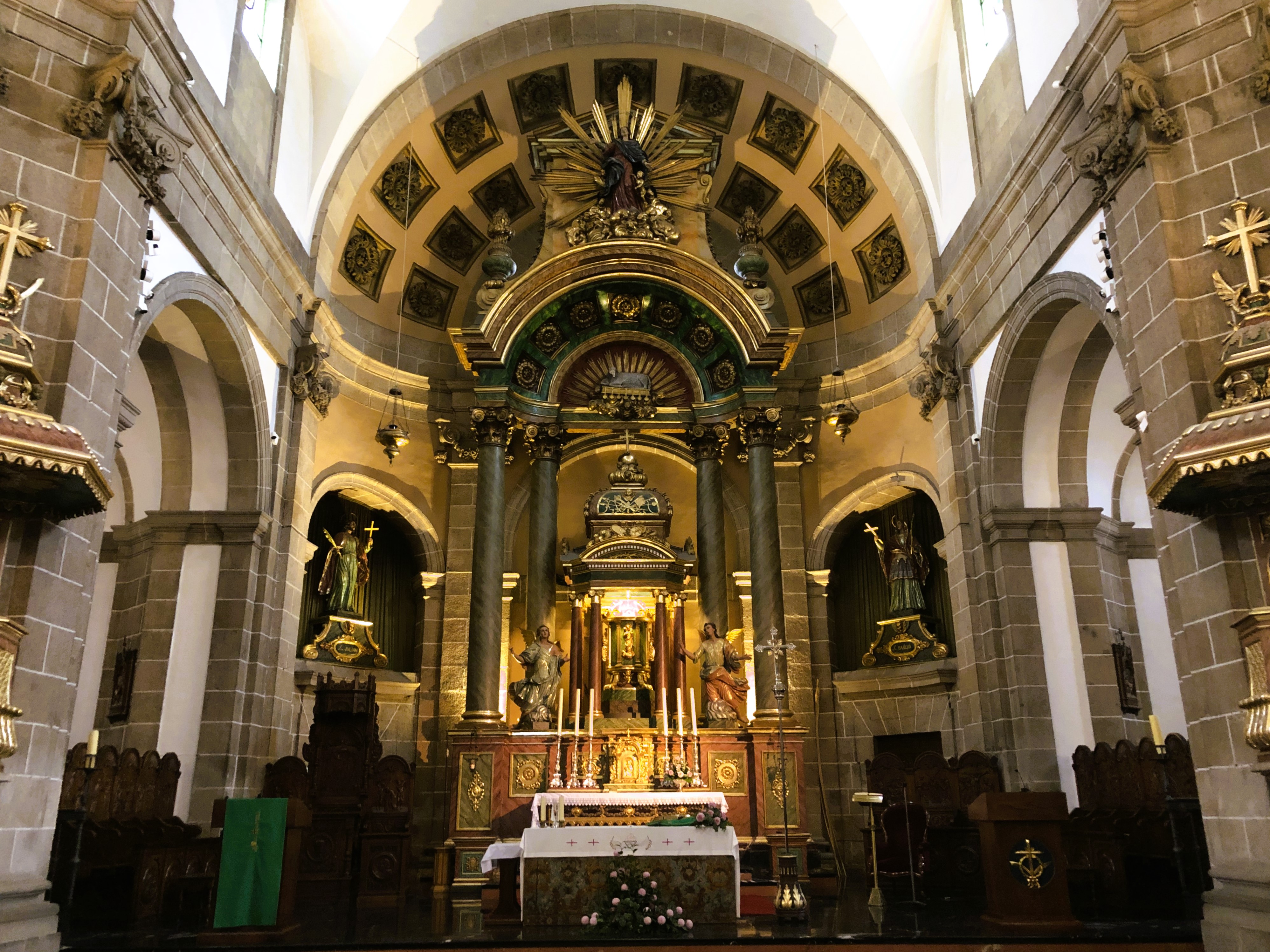
On our second day in Ferrol, I set out on foot on my own while the girls did some shopping. Although I’m not a religious person, I love to visit churches. Saint Julian Cathedral is a beautiful building and I had it all to myself as I walked around and took in the grandeur of the place. The city, population 65,000 and traditionally an important shipbuilding center, has fallen on hard times, and it shows in the buildings I walked past in the downtown area.

Ferrol is the starting point of the English Way, one of the many pilgrimage paths that lead to Santiago de Compostela. Seeing the scallop shell symbols that mark the way reminded Elva of her epic 400-kilometer solo walk in September 2013. Our afternoon guided walk gave us a better understanding of Ferrol’s history and what makes it tick nowadays. 

After another rock-and-roll night at sea, we docked in Vigo, Galicia’s biggest city with a population of 500,000. We took an early afternoon bus tour to nearby Pontevedra. Although our guide was quite good, by this time, we’d heard enough about European cities to get the picture. Back in Vigo, Elva and I set out on a one-hour walk on our own; much more satisfying than following a group and listening to historical tidbits we’ll never remember. In the photo, Elva gets friendly with a street performer in Pontevedra.

Day 2 in Vigo dawned bright and balmy. We’d decided to join a more active group for a hike along the Portuguese Camino. Finding our way out of the city following the scallop-shell signs was easier said than done but Gerd, our expedition leader, had GPS as a backup. She also carried a knapsack-full of stuff: water, snacks, tea, a first aid kit and, amazingly, a portable stretcher! We had a great group, all of them younger than us, of course. The views from our hillside trail were awesome and the 18 kilometers went by easily. We stopped for a coffee at our destination and took a bus back into Vigo. A perfect day!

Porto was our first port of call in Portugal and the second-last on this eventful journey. The city’s metropolitan area is home to around 1.7 million people, is a major industrial and financial center, and is perhaps best known world-wide as the birthplace of port wine. The old part of the city, which lies near the mouth of the Douro River, is a UNESCO World Heritage Site. Our day began with another forgettable guided walk through the city center. Don’t get me wrong. The guides are very good, but I don’t really care which king married which queen and had which palace built for their daughter. Or that it took one hundred years to build the Bishop’s Palace!

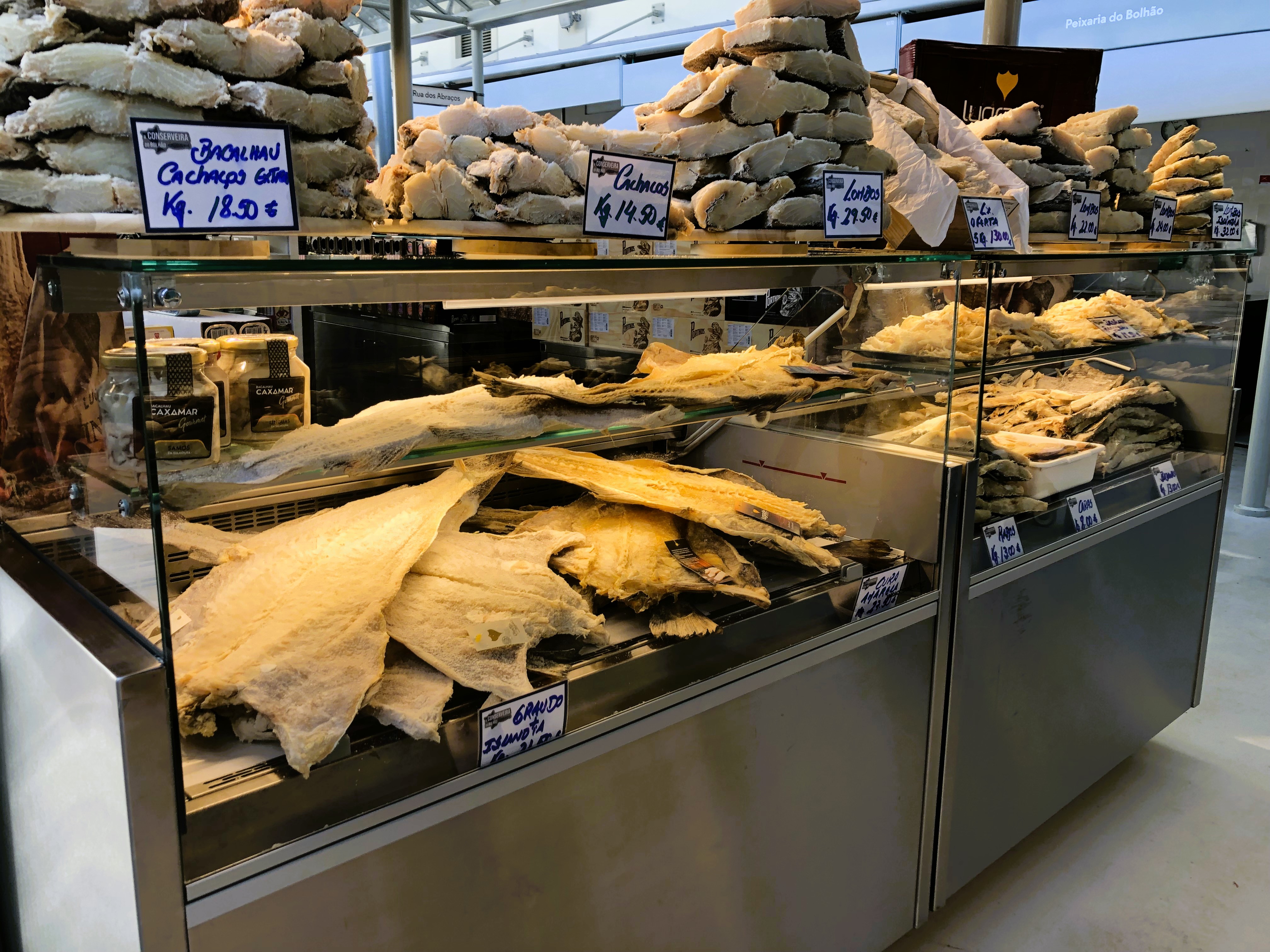
Elva and I broke free and went off on our own, retracing our steps. We took our time and explored the bustling pedestrian streets and bought fresh figs at a stall in the immaculate market. I took a picture of salted fish there, a Portuguese specialty. The smell reminded me of times spent in the “lean” at the old Coop store in Wellington when I was a kid. Salt cod, stiff as a cedar roof shingle, was stored there year-round along with other bulk items, like the 45-gallon puncheon of molasses for customers wanting to fill their cruche. While we’re in Portugal, I intend to try the local salt cod dish, bacalao. Then, we had tea and coffee on a terrace, enjoying the sunny day, 24-degree temperature, and quiet time just the two of us. It’s interesting that the weather has warmed exactly one degree per day since we left Tromsø on October 21. Dinner that evening was a feast of shellfish and seafood prepared by Chef Tomasz and his excellent kitchen staff.