Friday, 14 August 2020


TIP-TO-TIP RIDE FOR OUR FORTY-FIFTH

This is us in June 1970, in Elva’s yard, with my brand-new Yamaha Enduro 175cc bought as a high school graduation gift from Sportsmen’s Motorcycle Services in downtown Wellington. We were a little less bulky back then and a little hairier but very excited to go on our first ride. We’d been going together for about eighteen months. Fifty years later, we’re still going together. Our motorcycle phase has passed and we’ve moved on up to pedal power.

A couple of weeks ago, I asked Elva where she wanted to go to dinner to celebrate our 45th wedding anniversary on August 15. Next morning, she gave me her answer; “I’ve always wanted to do the Tip-to-Tip, so why don’t we do it this year.” An hour or so later, I had the route mapped out and our hotels booked on booking.com. We’ve usually been quick to agree on things and this adventure proved to be no exception. And we’ve always tried to do something different. It’s what’s kept our best-friendship alive and well these fifty-two years later.

For those who don’t know, to an Island cyclist, the “Tip-to-Tip” is a ride from one end of the Island to the other, usually in one day. I’ve done the North Cape to East Point one-day ride three times: in 1987, 2006, and 2009. The first time was a fund-raiser for Le Centre préscolaire Évangéline and I rode it alone. We raised about $4,400, equivalent to $10,000 or so in today’s dollars, and my knees never forgave me. The next two were done with groups of riders and with me much better prepared for the 260-kilometer journey.

We left home early the first morning, headed for our destination at North Cape. Our route that day would take us from the northwest tip of the Island to the Mill River Resort and back, a distance of 82 kilometers. We stopped for a moment at the pocket port of Seacow Pond to watch fishers and their helpers load lobster traps on their boats on the eve of setting day.
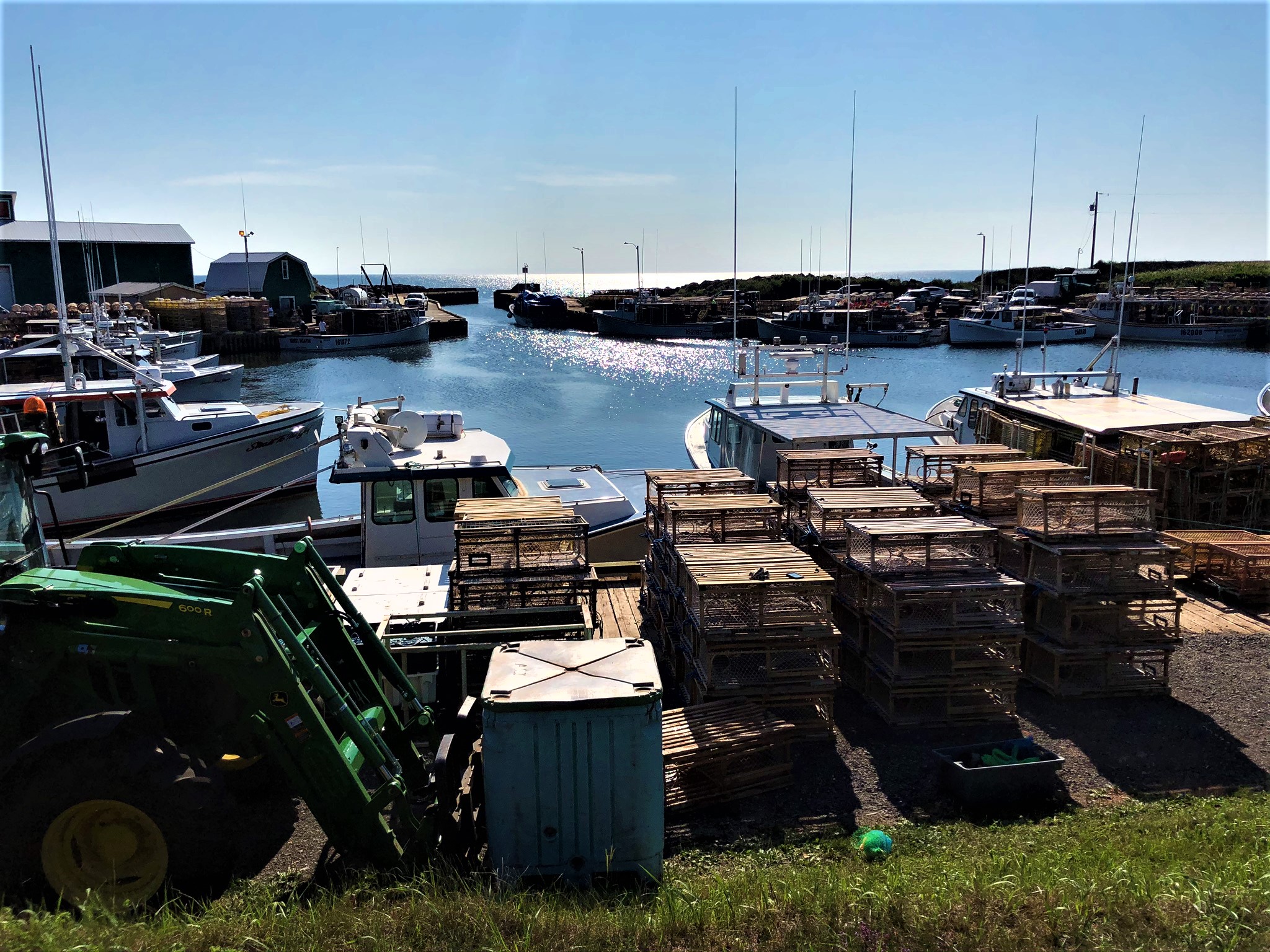
Our ride from there through Tignish and onto Route 2 was uneventful. We made it to the halfway point at Mill River, stopped for a snack and headed north to our starting point. By 11:30, the temperature had hit 30C and it was starting to get to me. I was glad to get off the bike and turn on the air-conditioning. We had a nice meal in Tignish and spent the afternoon exploring, coming across this fella hanging around at Gavin’s Auto Service: “Dirty Deeds Done Dirt Cheap”, according to the sign. Our stay at the Mill River Resort was very pleasant: a nice, clean room and two good meals.

Day 2 would see us pedal 38 kilometers from Mill River to Goodwin’s Corner near Wellington. We headed south first in order to have the wind at our backs on the return journey. It turned out to be an easier ride than the first day’s because the winds were lighter and we finished before the temperature became unbearable. There isn’t much to see on that section of Route 2 so, after lunch at Tim Hortons, we took the long way round, stopping at West Point for a short walk on the beach.
Chez Yvette in Urbainville was our next stop. We were treated like la parenté by host Yvette (à Edmond à Clément) Deschenes and had a lovely overnight stay. Day 3 dawned warm and windy. It was a relatively short ride to Kensington, 30 kilometers or so, and we had to contend with some fairly strong crosswinds. On the way back to our car at Goodwin’s Corner, we detoured into my home village, Wellington. 
The photo below shows the house where I grew up, built by my grandfather in 1913. Elva and I lived there from 1979 to 1990 and our three children spent their early years there. The caboose and speeder are among the few reminders of the railway’s importance to Wellington from 1875 until the last train came through just over a century later.
Back in Kensington, we checked in to The Home Place B&B, got cleaned up and drove through Cavendish and North Rustico, taking a stroll on the lovely village boardwalk, one of my favourite places on our beautiful Island. Our hosts, Angie and Greg Hitchcock were very gracious and served us an excellent breakfast before we hit the road.
Day 4 was the toughest: only 48 kilometers but very hot, very hilly, and with a stiff crosswind. Elva suffered more than I did but she made it to Charlottetown. A friend drove our car from Kensington to home, saving us the trouble of doubling back. The rolling countryside was beautiful to look at but rolling downhill in a 40 kph crosswind doing 50 kph required some serious concentration. We were glad to spend a night in our own bed and enjoy a home-cooked meal.
Day 5 was as close to cycling bliss as it comes: slight tail wind, not too many hills, nice wide shoulder, and not too hot. The old Chubby’s Roadhouse, Bud’s Diner and Spoke Wheel Car Museum in Dunstaffnage look pretty shabby these days but I’m old enough to remember the 1970s when such roadside attractions were popular with tourists and locals alike.
We rolled along the Hillsborough River to Mt. Stewart and from there to one of my favourite rivers, the Morell. I fly-fish upstream from the bridge on Route 2. At St. Peters Bay, we left Route 2 for the Northside Rd. to avoid the hills between Souris and East Point. Friends drove our car to a spot in Clearspring and parked it there for us. The odometer read 74 kilometers when we got there, none the worse for wear on my end but Elva’s was suffering from a case of “hotfoot”. Time for new shoes, I guess.
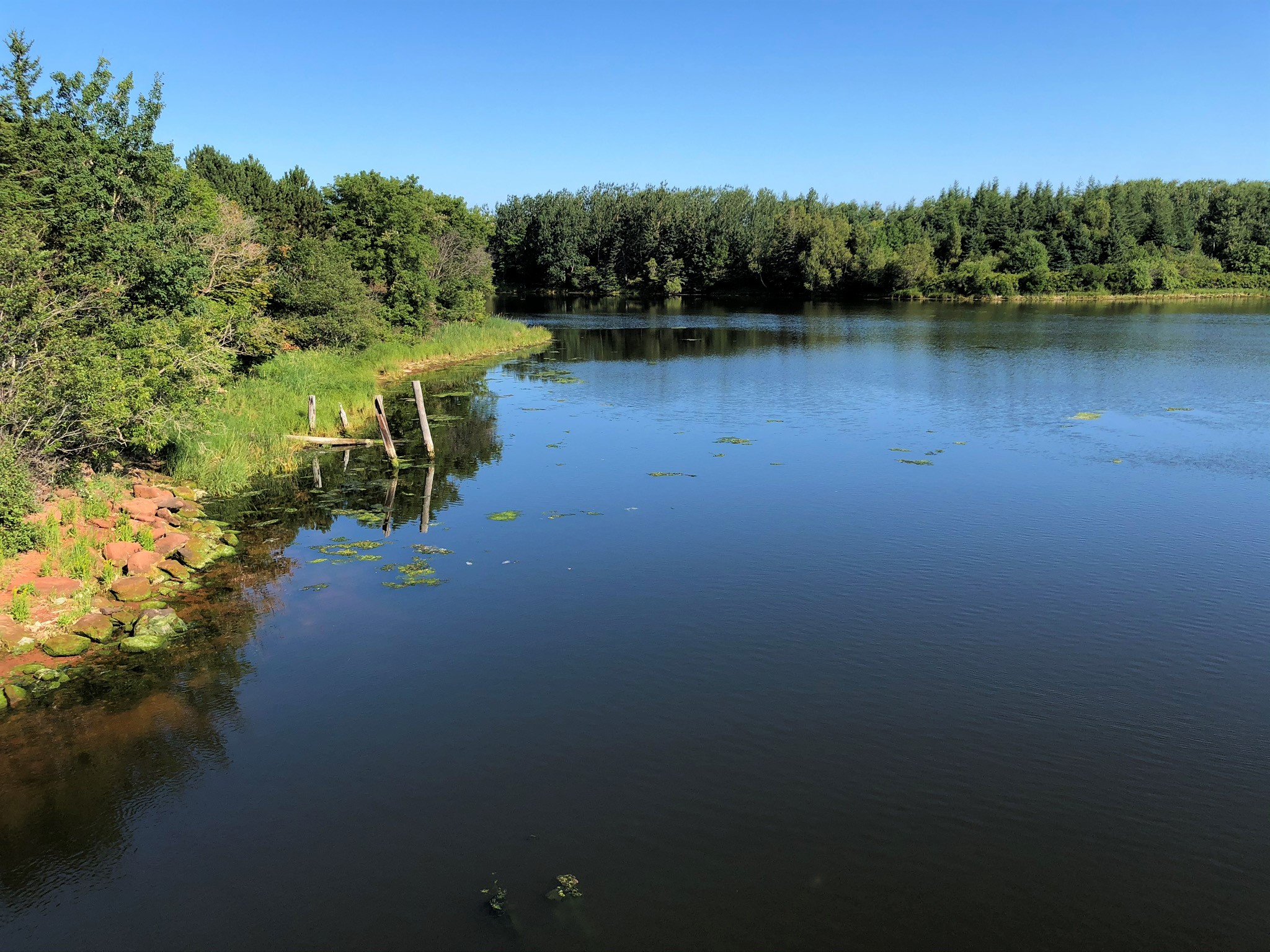
Since this was to be our Island staycation, we’d decided to stay at the Rodd Crowbush Resort. We weren’t disappointed. It’s a beautiful spot, right on the championship golf course and a few minutes walk to the beach. The view from our balcony wasn’t hard to take either! We watched the sun set over the Gulf of St. Lawrence, satisfied with another wonderful day.

Day 6 started at the East Point Lighthouse and our task was simply to ride 33 kilometers to Clearspring and back. An early morning rain shower and the unusual calm air amplified the late-summer smells, taking me back in time to childhood memories of blueberry picking. Of course, they were half eaten by the time I got home and Mom would ask: “How am I supposed to make us a pie with that?”

The Northside Road used to count several thriving fishing and farming communities, complete with schools and stores. Today, many of the fields are grown over, only a few active farms remain between St. Peters Bay and East Point, and the shoreline is dotted with summer homes. The contrast between modern windmill farm and abandoned farmhouse is striking.

Priest Pond and North Lake Harbour are among our favourite places along this shore and we stopped at each for a few minutes to take in the views. Before we knew it, we’d turned onto the Lighthouse Road and were coasting down to the northeastern tip of the Island, high-fiving one another, satisfied with our accomplishment.
We’re very glad to have done this ride and I can’t think of a better way to celebrate our 45 years as a married couple. Elva says it will be her last Tip-to-Tip. Me, I never say never. Fact is, in this unusual summer of Covid-19, we’ve met Islanders everywhere who have chosen to do things differently and explore this magnificent place we call home. Who knows what next year will bring.

An old bachelor gave me some advice one day when I was a young teenager: “My father told me what to look for in a woman: ‘Find yourself one that’s good on the harrows and looks like she could stand a hard winter’”. I took his advice and have never regretted my choice!

Friday, 31 July 2020


LIVING THROUGH COVID-19 – PART 3

This blog isn’t about Covid-19; well, not really. It’s about furniture, old and repurposed furniture, and what we call retrouvailles, the French word for reunion.

I mentioned in an earlier blog that Covid-19 had had a significant impact on our son, Jacques, his partner, Isabelle, and their daughter, Lucie. As a performing artist, Jacques saw years of hard work and a promising career crumble overnight as gigs evaporated one after another. As a CBC radio journalist, Isabelle experienced major changes in her workplace: too much work and too few resources. Lucie struggled to adapt to home schooling, missing her friends and the all-important social aspect of life in the classroom. Many of the things that drew them to Toronto life were affected negatively by Covid-19.

Long story short: in mid-June, they decided to move to Prince Edward Island! Naturally, Elva and I were thrilled at the news. We decided that the best way to help was to look after some of the little things and, in that way, make the move as easy as we could for them. They fell in love with a ninety-year-old farmhouse in Greenvale, nestled in the rolling Hunter River hills and offering an environment that couldn’t be more different from downtown Toronto.

The family arrived “home” on July 3 and did the mandatory fourteen-day quarantine while Elva and I worked on getting the house ready. Word soon spread that Jacques & Co. were back and might need a few pieces of furniture given that they were moving from a one-bedroom apartment to a nine-room house. Sofas, tables, chairs, carpets, and knickknacks appeared out of nowhere.

Sylvie’s family had decided to renovate their bedrooms and get new furniture for Samuel and Natalie. So, Elva and I stuffed dressers, desks and an old bed into a rented cargo van and brought them from Saint John to their new home in Greenvale. This week, a friend of Jacques’ pulled into the yard with a pump organ! It now has pride of place in the “studio”. Cousin Joyce contributed a nice chair and a Lowney’s wooden crate with the Arsenault & Gaudet stamp on the ends.

Jacques and Isabelle are of the IKEA generation but, unlike most, they do appreciate old things, particularly items that have a connection to family. That’s where I come in. I began refinishing furniture and stripping woodwork when we lived in the old family place in Wellington from 1979 to 1990 and became quite proficient at the tasks involved. I was only too glad to dust off my tools, stock up on supplies, and roll up my sleeves.

I began by stripping a refinishing an old spindle-type headboard Jacques and Isabelle bought on Kijiji. Next was a set of six kitchen chairs, all of which needed a degree of repair. We then turned our attention to the family heirlooms, some more precious than others. Elva helped by sanding a dresser that originally belonged to Ghislain and had been passed down to Samuel. Next came desks from Samuel and Natalie’s bedrooms. All were refinished in the best Benjamin-Moore colours. Ghislain’s dresser is now Lucie’s; Sylvie’s childhood desk has found a new home in Isabelle’s office; Clément’s childhood desk is now a china cabinet in the kitchen. Jacques’ childhood desk from our Ash Drive home will become Lucie’s art project desk. She even helped with the sanding.
Before Elva sanded the dresser Jacques and Isabelle had chosen for their bedroom, I took it apart and found a section of the May 6, 1920 edition of Le Devoir, the Montreal daily, between the mirror and its backing. On the back of the dresser the manufacturer had scribed its destination in black wax pencil Arsenault and Gaudet Ltd., Wellington, my grandfather’s store. Almost exactly a century ago. Good karma?
But my favourite piece is the old four-poster bed from my childhood Wellington home. It sat unused for years in a spare room before Mom had it repainted and moved it to her refurbished bedroom. Sylvie had it in our Sherwood home and she passed it down to her daughter, Natalie. The bed’s origin is a bit of a mystery. Mom told me that my grandfather, Emmanuel Gaudet, may have acquired it when a customer defaulted on an outstanding account. It’s an odd size, called a three-quarter; wider than a single and a narrower than a double.

I knew I was in for a big challenge when I brushed the first coat of stripper on the piece. But, since it’s solid white oak and black walnut, I was determined to see the project through. The frame pieces are 3 x 3.5-inch walnut, about six feet long, and I decided to start with them. Today’s paint strippers are not nearly as strong as the stuff I used in the early 1980s. Once I’d gotten the surface coats off, I was down to the bottom coat of white milk paint, a stripper’s nightmare.
Milk paint is a nontoxic water-based concoction made from milk and lime. Borax is mixed with the milk's casein protein to activate the casein as a preservative. Milk paint has been used for thousands of years and is extremely durable, often lasting for hundreds of years if protected from the elements. Because of its chemical makeup, it can’t be dissolved by the type of paint stripper you buy at the neighbourhood hardware store. So, I had to remove this last layer of paint using a power sander and a lot of elbow grease. The last layer of finish, varnish, was removed using the sander as well. 
Where possible, I always take a piece apart to make stripping easier. I could see that two lengthwise pieces were attached to the walnut rails and I pried them off. Each was held in place by six hand-forged iron nails, making the piece at least 150 years old! I tried to imagine the strength and patience required to drive the relatively soft nails into rock-hard walnut. As proof, one of the nails was curled back onto itself, unable to penetrate.
Satisfied with the two side pieces of the frame, I decided to take the head and foot of the bed to Spray-All Painting, a local shop that specializes in stripping furniture. Tackling the turned oak bedposts would have been too much work. Spray-All uses a commercial-grade stripper that’s much stronger than anything I can get my hands on. The two pieces still required a fair bit of scraping to remove paint lodged in the grooves. Two coats of Danish Oil later, the old bed frame looks pretty good. Covered with the beautiful rag quilt Elva made, Lucie’s bed will play the role of family heirloom for many years to come, I hope.
Isabelle, Jacques, and Lucie settled quickly into their new home. They even have a name for it: Val-Moineaux or Sparrow Vale. We know they’ll enjoy happy times there and we hope they’ll stay on the Island. We especially look forward to spending time with Lucie. Covid-19 has not been kind to them, but it does herald a new beginning and it may bring new opportunities, something none of us could have imagined when 2020 began.
I confess to suffering from a mild case of “furniture fatigue”. My old bones tire more easily than they did those many years ago in Wellington where my passion for old things was nurtured. But I can now say proudly that I’m the best (male) stripper in Greenvale!


Friday, 3 April 2020


LIVING THROUGH COVID-19 – PART 2

Quarantine is over and the tables have turned! Instead of assuming we have Covid-19 and must take measures to protect others, we assume everyone else has the virus. From now on, it’s our turn to protect ourselves. This thought makes me very uncomfortable.

Our fourteen-day journey has been easy compared to that of others we know. Friends stuck on cruise ships, not knowing how or when they’d get home. Relatives laid off from work; others having to close down their businesses. Our son, Jacques, a performing artist whose upcoming gigs have evaporated. Isabelle, a CBC Radio journalist who works day and night to keep Torontonians informed. Islanders we know who have chosen to shelter in place in Mexico, the last place I’d want to be right now.

Living in an apartment building is a new experience, and Covid-19 has taught us that it has its disadvantages. It’s even made us reflect on whether apartment living is for us. I wrote last week of the challenges Elva and I have faced in trying to stay healthy by walking and getting some fresh air during our self-isolation. Every day since we arrived home, we’ve listened to Dr. Heather Morrison’s updates and checked Health PEI’s Covid-19 Self-Isolation Guide. The guidelines have changed twice in fourteen days.

At first, we were allowed off our rented property, provided we followed social distancing guidelines. This meant being able to walk the Confederation Trail and the boardwalk. Then, on Day 6, we were told that we could not leave our apartment, except to sit on the balcony. So, I sat there and read a book for part of the afternoon, enjoying the fresh air and the cool sunshine. On Day 7, the guideline changed again; we could go outside if we stayed on the building’s property.

So, we’ve been walking back and forth across the parking lot. Like hamsters on a wheel. My Garmin recorded 5.5 kilometers one day. Elva and I are addicted to fresh air and exercise and we believe we have a duty to stay healthy, especially in times like these. We do understand that not everyone will agree with our actions during self-isolation but we know we did nothing wrong.
My cycling buddies and I have our Saturday morning coffee klatsch using Zoom, the latest in videoconferencing software. Having ditched cable two years ago, Elva and I watch Netflix, YouTube, and CBC Gem to pass the time. We have plenty of books to read. On a sadder note, new terms have entered our vocabulary: physical distancing, self-isolation, quarantine-shaming, the “rat line”, the “cocoon police”, etc. Covid-19 fatigue is setting in and our leaders must soon tell us when to expect things to improve. In the absence of a clearer path forward, individual resolve to comply will weaken.

Our parents and grandparents lived through two World Wars, the Spanish flu, a polio epidemic, and the Great Depression. By comparison, we’ve known little of hard times. Their experience taught them about duty to family, community, and country. It taught them sacrifice, self-reliance, the need to be frugal, and to always keep a little in reserve. Some good will come of the Covid-19 crisis. I can only hope we’ll be smart enough to 
learn a few lessons.

Since we first learned of Covid-19 in January, society has gone through a number of phases: ignorance, disbelief, denial, acceptance, compliance, and, most recently, panic. I suppose you could say the same of individuals and families. I worry about the consequences of the current panic and the impact it will have on traditional social norms in future. When will we feel comfortable being in a crowd again, shaking hands, hugging one another, or kissing one another on the cheek? These are things that bind our families and communities together; habits that make us human. Think about it!

As we all know by now, Covid-19 is much more than a health crisis. It’s a societal and economic disaster, the likes of which we’ve never experienced. Governments the world over have had to employ drastic fiscal and monetary measures to keep the economy going so that individuals, companies, and public institutions have enough money to get through this.

Central banks have lowered interest rates to historic levels to ensure that credit continues to flow where it is needed. The Bank of Canada had to buy $2 billion-worth of Newfoundland and Labrador provincial bonds to keep the province from going bust. No other financial institution would take on the risk. Oil revenues have dried up and the Come-by-Chance refinery has closed, putting 500 people out of work.

Monetary measures have been announced by provincial and federal governments. They’ve promised to spend taxpayer’s dollars to make sure we get through this rough patch and to reboot the economy when the worst is over. Deficits be damned! Some people are critical when our governments “print money”. Maybe they’ve got a better idea. If so, I’d be the first to listen. Tax increases down the road to pay for all this? Maybe, but smart governments should look to cut spending first.

Covid-19 will change our lives in ways we cannot even imagine, some of them for the better, I hope, but there’s no question that 2020 will be a tough year for Prince Edward Island. Will the tourists come? Who will plant and harvest the crops and process the lobster? When will markets recover for luxury products like lobster, mussels, and oysters? When will non-essential businesses be allowed to reopen?

Looking further ahead, what will be the new normal? What will supermarkets look like when this is over? Is this the end of retail as we know it, especially big box stores and shopping malls? What will passenger screening look like at airports? How will this affect public transit? Will the travel and hospitality industries recover? What about the performing arts? Have we seen the last of cinemas? What will happen to office space, including government buildings, as more people work from home?

I sincerely hope that calm, intelligent, and reflective individuals will look back when the worst of this is over and take a good, hard look at our societal and governmental structures and our public infrastructure, particularly those that have failed to meet our needs. And this MUST be more than an internal government exercise.

Where did our disaster response plan work well and where did it fail us? Did politicians and disaster experts, medical and otherwise, do a good job? Were the right people making the key decisions? When will we finally learn that rural Islanders deserve the same as the rest of us, internet access being the most obvious example of a glaring inequity? And, most fundamentally, which government services are essential, which are not, and what are we going to do to redress the balance?

The biggest mistake we could make is to blindly go back to the way things were and forget this ever happened.

On a personal note, Elva and I have been profoundly affected by this experience. The strain on our immediate family has been felt deeply by all. Our plans to see the world while we’re healthy enough to travel have been put on hold for the time being. The cruise we’d planned for the fall has been cancelled.

Our preferred cruise line, Holland America, has done a terrible job of looking after its passengers and of communicating with its clients. Check their website, www.hollandamerica.com, and you’d think everything’s just hunky-dory! We’ve spent more than 250 days on Holland America ships, including the ill-fated Zaandam. We may never set foot on a cruise ship again.

Elva and I have a lot to be thankful for: good health, the strong bond between us, a supportive family, good friends, defined-benefit pension plans, and money set aside for a rainy day. Our bikes are champing at the bit and ready for the first fine day.
An ice storm struck my little world in 1961, knocking out power in Wellington for a week. After a few days, our house got so cold we had to move up the Mill Road to Uncle Cliff and Aunt Tina’s. It was like a winter vacation! A chance to play with my cousins, Joyce, Judy, and Aubrey, all day, and to take my first ever shower! They probably couldn’t wait to get rid of me but I didn’t want to go home… Elva’s family, self-reliant as they were, probably barely noticed.

I read a quote from Pope Francis the other day. It went something like this: God forgives always; people forgive sometimes; Mother Nature never forgets. Perhaps that is the real lesson.

Tuesday, 24 March 2020


LIVING THROUGH COVID-19 - PART 1

It’s hard to believe that only one week ago, Elva and I rode with Caloosa Riders Bicycle Club in Cape Coral, Florida. As we sat in front of The Bagel Factory, saying goodbye to our friends, American and Canadian, I wondered what lay ahead for all of us. How bad would it get? Would any of us come down with the virus? What would transpire in the twelve months before we saw one another again?

We spent the rest of Saint Patrick’s Day loading bicycles, suitcases, 2020 Christmas gifts, and other assorted odds and ends into the car. That evening, we strolled through downtown Fort Myers one last time, past closed bars, half-empty restaurants, and our beloved Starbucks, serving grab-and-go only. There were no chairs for us to sit outside. Early the next morning, we left Poinsettia Park and headed north on I-75.

I was ready for anything, traffic-wise and weather-wise, and really didn’t know what to expect as we began the 3,600-kilometer trek north. We’d booked a hotel near Savannah, Georgia, 800 kilometers from Fort Myers. Traffic was relatively light on I-75 and I-10 but started to bunch up when we reached I-95. Checking into our hotel around 5:30 we noticed that things had changed and, most importantly, that hotel employees were very mindful of their responsibility to keep us safe.

Around 2:00 the next morning, realizing we were both awake, Elva and I chose to hit the road and have a few hours of easy driving before the hordes arrived. We always take an alternative, and slightly longer, route to avoid the busy I-95. It takes us past Columbia, SC, Charlotte, NC, Roanoke, VA, and through Pennsylvania, staying away from Washington, New York, and Boston. Trusting the GPS, I made the mistake of taking I-78 toward Newark, NJ and, before realizing what I’d done, was heading straight for New York City at evening rush hour. Shit!

To our amazement, I-95, which runs through the heart of New York, was nearly empty. The last time we’d crossed the George Washington Bridge over the Hudson River, we’d waited over an hour at the toll plaza. As the photos show, there was one car ahead of us and very light traffic. Driving through New Rochelle, a Covid-19 hotspot, was eerie. Around 6:00 pm, we stopped at a market for something to eat—grab-and-go—and drove the short distance to our hotel in West Haven, CT. We’d logged 1,600 kilometers. Again, hotel staff were on high alert, surfaces were being disinfected, and we were told that breakfast would not be served because of the virus.
 

Up at 4:00 am, we grabbed our bagged breakfast and headed for Charlottetown; only 1,200 kilometers to go and the worst of the traffic behind us. I’d ignored all the foolish rumours about what would happen at the border crossing between Calais, ME and Saint Stephen, NB. After a fifteen-minute wait, we rolled up to the kiosk and were questioned in French by a very professional CBSA Agent, M. Sigouin. He asked us the usual questions about when we’d entered the US, where we’d stayed, and where we were going. He then asked us whether we had a fever or cough, gave us written instructions on self-isolation and wished us a safe journey home. After three hard days on the road, we were glad to be back.

We unpacked the car, being careful not to touch any surfaces in the building entry and corridor with our bare hands, and settled in for our first night of self-isolation. Prior to our arrival, I’d composed an email for our neighbours, advising them of our ETA and explaining that, if we went outdoors for a bit of fresh air, we’d come and go by our balcony since our apartment is at ground level. I asked that the message be forwarded to building management.

The next day, I received an email from a representative of the building’s owner, a publicly-traded real estate investment trust that owns hundreds of units on Prince Edward Island, telling me that we must stay in our apartment—no exceptions—and that we could not enter and exit our apartment via our balcony. This left me more than a little frustrated as I’d been told by Health PEI’s Covid-19 hotline that day that people self-isolating were permitted to go outside for a walk or bike ride to get some fresh air.

What to do? At 10:43 pm on Saturday, I emailed Dr. Heather Morrison, our Chief Health Officer, explaining our situation and asking her to clarify the guidelines around self-isolation for apartment dwellers and owners. To my utter amazement, she responded at 10:53! She explained that, yes, there was some confusion and that she would attempt to clarify.

On Monday, March 23, she did clarify things, reassuring Elva and I that we had the right to leave our apartment building through the corridor and entry, providing we took measures to avoid touching surfaces and respected social distancing guidelines.

Unfortunately, the media did not report this part of her remarks, leaving the impression that people in self-isolation should not go out. Anyone who doubts what I've said should watch and listen to Dr. Morrison’s March 23 press briefing and read the email she sent me (see below).

She also mentioned that, if it’s an option, apartment dwellers who live on the ground floor should come and go from their patio if possible. I asked building management if they would remove the short, fifteen-inch section of balcony railing shown in the photo (held in place by eight screws and four bolts) so that we could come and go by this route and thereby avoid the corridor and building entry. They refused. In email exchanges with the Provincial Fire Marshal and the City Fire Chief, I learned that they have no jurisdiction over such matters. This is what happens when concerns about liability trump common sense.


I emailed Dr. Morrison yesterday to thank her for clarifying the self-isolation guidelines for apartment dwellers and owners. I received her response at 12:35 am:

Hello Mr Arsenault,

Thank you for your follow-up email, and I was thinking about you when I was speaking today.  We have put together a draft information piece related to apartments, and if all goes well, it should be available on the website within the next day.  I mention it because it will hopefully help clarify some questions for others as well going forward.  Of course, the information continues to change very quickly, and if anything evolves in terms of new direction from us, we will let you know.

Take good care,
Heather

Dr. Morrison is an exemplary professional. She epitomizes the true public service vocation and is a credit to our province. She cares about people. We could not be better served. In Canada, our leaders, political and medical, seem to be singing from the same song sheet. I’m thankful for that. It's certainly not the case everywhere.

Elva goes for a walk every day. I went with her yesterday. We walked on the Confederation Trail out to the Charlottetown Mall and then to Joe Ghiz Park. Many people were out and about, all of them practicing adequate social distancing. When things warm up a bit, I’ll be on my bike. We’re both symptom-free and determined to stay that way.

We’re taking this emergency very seriously while trying to maintain a balance between social responsibility, our rights as individuals, and our own health and well-being. I’ve washed my hands more in the past week than I during the rest of my 66+ years! On our way back from Florida, we touched no surface without washing or disinfecting our hands, and used paper towels on door handles and gas pump handles. We’ll continue to follow the guidelines to the letter, recognizing that they may change at any time. If they do, we’ll comply.

Sunday, 8 March 2020


CYCLING IN SOUTHWEST FLORIDA

“Cycling in Southwest Florida”. Sounds like an oxymoron, doesn’t it? A figure of speech that contains contradictory terms. Like “jumbo shrimp” or “Great Depression”. Google it and you’ll find lists of paved cycling paths or places to go off-road cycling. Nothing you’d expect for a cycling destination. It’s dead flat here and, were it not for gravity and old age, wind would pose the only challenge.

We’re sometimes asked by people here and back home in Canada: “Why Fort Myers?” We first spent time here in 2016, looking for a place to get away from notorious Prince Edward Island winters. Having secured accommodations for a trial month, I checked to see if there was any cycling activity in the area. I soon found my way to the Caloosa Riders Bicycle Club (CRBC) website and noted that their ride calendar appeared to have something for both Elva and me.


In 2016, Elva was still a novice road rider while I’d ridden a paceline for years with several friends, calling ourselves the Over The Hill Gang. It was important to me that she find a group she could be comfortable riding with, at a pace she could sustain, and in a “no drop” ride. We were welcomed into the group from the first day here and we haven’t looked back.

Each group has a ride leader, an experienced cyclist who tries to keep the group together, maintain a steady pace and, most importantly, make sure everyone finishes the ride safe and sound. Being a ride leader is a big responsibility and it can be a rather thankless job on difficult days. Elva and I admire those who take on these roles and make riding more enjoyable for all of us.


This year, we’re spending three months in Southwest Florida. We’ve grown to appreciate Fort Myers more each year and it’s become our second home. Yes, it has its drawbacks traffic, more crime than we’re used to, the unfavourable exchange rate, scarcity of rental options — but these are far outweighed by the positives. We’ve made new friends here and enjoy the company of those we ride with three and four times a week. Elva and I spend time at the beach and, each year, we find new things to do by exploring the area. We attended our first spring training game between the Boston Red Sox and the Toronto Blue Jays at JetBlue Park. We spent time in the city of Immokalee, taking in the cattle drive and jamboree at Roberts Ranch, and free music concerts and a car show at the Seminole Casino.


We absolutely love downtown Fort Myers. Older buildings have been lovingly restored, much like they have in Charlottetown. There’s something going on every weekend: bike show, art show, car show, food festival, music festival, etc. Once or twice a week, we while away an early evening sitting outside Starbucks, enjoying a hot beverage and people-watching.


Back to cycling. The thing that impresses me most about CRBC riders is their zest for life. I’ve said this before: “Florida is not a place where people go to get old but a place they go to stay young!” I’m reminded of this when I ride with Pete, soon to be 84 and a very strong and capable rider. He came to Canada from Italy in 1956 and joined a cycling club in Windsor, Ontario. He raced there as a young man before moving to the US, and he now lives in Florida. I can only dream of being as fit as he is in my mid-eighties. My motto: “It’s easy to get old. It’s staying young that’s hard!”
Some I ride with have overcome major health issues: one is on his third artificial hip; several have battled cancer; one is recovering from major reconstructive surgery on his foot; others have heart conditions. Many of us carry scars from cycling accidents. I’m riding a new bike this year. Why? Because I was struck by a ¾-ton 4x4 in a roundabout last August. I wasn’t hurt badly and, because it was his fault, the other driver’s insurance company paid to replace my bike.


Some people think we’re crazy to ride on the road, especially in a closely-spaced group. My answer is simple: “If you aren’t comfortable, don’t do it!” You’re a danger to yourself and to others. Given the volume of traffic, we’ve generally found Florida drivers to be quite considerate of cyclists. We get the occasional “Get off the road!” but no more often than back home.


Three years ago, on her 65th birthday, Elva felt inspired to write of her Florida experience in these words. If anything, she feels them even more strongly today:


Et me voici!

Here I am
With my team, the Caloosa Riders
Maintaining their 18-mile speed
It’s stimulating and rewarding

I’m in a paceline
I’m focusing
It’s challenging
On the road
The group signals are helping

“Slowing; Stopping
Clear; Rolling
Walker up; Bikers up
Car back; Passing
Car right; Stopping
Car left; Slowing
Take the lane; Rolling”

Now I’m second in line
Right behind Keith’s back wheel
Keeping the pace, I’m watching,
For the signal will be coming

Here I am
To the front I go
It’s my turn to take a pull
My turn to yell out the signals
Will I be turning?

I gave my very best
To my right, five riders pass
“Good work! Great job! Good pull!
Thank you! Look at you go!”
At the end of the paceline now, I smile
Satisfied

2017 is off to a great start
On the designated bike lanes
Near Fort Myers
I’m more confident and I’m stronger

Here I am
Enjoying every ride

Et me voici
De nouveau sur mon vélo
Ce matin, Jean-Paul reste en avant
Moi à l’abris du vent

J’ai beaucoup appris ici
Et c’est plaisant
En ce 4 février étant avantagée
Je réussis 73 km à la vitesse désirée

Mais quelle belle façon de souligner
Qu’aujourd’hui je suis officiellement une aînée
Que je suis choyée!

Here a few shots of our favourite southern riders.

Sunday morning church group at Panera in Estero
With Vito Gallo, a guy from Toronto I've been riding with for five years.
Images from the Royal Palm Challenge on March 8. Elva rode 60 km with her group and I did 100 km. Thanks to all the volunteers!