Wednesday, 24 August 2016

DRUMMONDVILLE - GRAN FONDO CENTRE-DU-QUÉBEC


As we rolled through Middle-of-Nowhere, New Brunswick, one of the rookies piped up: “Jesus you guys are a quiet bunch.  And I thought I’d have a hard time getting a word in edgewise!”

He wasn’t long getting a response.  “We’re like an old married couple, son.  We still enjoy one another’s company, but we’ve pretty much run out of stuff to say,” answered one of the old timers.  Another interjected: “We used to talk about women, you know…”  And a third: “The real reason is that at our age, at least one of us is having a nap, and we don’t want to wake him up.”  That seemed to satisfy the rookie, for the time being at least.

We left Charlottetown bright and early one fine Saturday morning, bound for Drummondville on our annual out-of-province cycling junket.  Mark had the good sense to pack a cooler-full of grub for the drive, supplemented by generous helpings of Sandy’s chocolate-chip cookies and Ira’s biscuits and home-made jam.

Seven of us sported the Over the Hill Gang (OTHG) colours this year, our largest group yet: rookies Ian MacIntyre and Mark Grimmett, and veterans Ira Birt, Richard Birt, Russ Melanson, John MacQuarrie, and myself.  Due to family obligations, Kent Wood was unable to join us.  Richard had found us a dandy twelve-passenger Chevy van, a perfect set-up for the seven bikes, ourselves and our makeup bags.

We arrived at the Drummondville Aquaplex just ahead of the 6:00 pm deadline and registered for the next day’s event.  From there, it was on to our luxurious accommodations, the Motel Alouette, a two-star hostelry that fit our standards perfectly.  We opted for a bellyful of grease at St. Hubert and retired to our rooms.

The Rio Olympics were on, the final of the womens’ 800 metre race.  We watched three hyperandrogenous (look it up…) pseudo-females power away from the rest of the field, including Canada’s Melissa Bishop who finished fourth.  She was gracious in defeat, but the disappointment showed clearly on her face.  While no one cheated, the playing field was definitely not a level one.  The poor woman never had a chance.

Then it was Gord Downie’s turn.  He and The Tragically Hip made us proud to be Canadian.  The band’s televised last concert from Kingston was electrifying.  I could feel his pain and his joy and, like everyone at that concert, including the band I’m sure, didn’t want it to end.  After three encores, he finally made his way off the stage, a tragic end to an iconic career.

We’d asked the motel proprietor to recommend a good place for breakfast.  “You have two choices,” he said.  “L’Extra or Tim Horton’s.”  Not much of a choice really!  We were at the door when L’Extra opened at 7:00 and had ourselves a really good feed, enough, we hoped, to keep us going through the first part of the ride.  Never have I enjoyed such a fine breakfast for just $8.23!

The ride to the start line took us along the Rivière Saint-François, back through downtown Drummondville.  We reconnected with our old friend, Luc, the supervisor of a cadre of twenty-five encadreurs-experts, cyclists whose role it is to accompany groups of riders from start to finish, making sure they don’t get lost, and looking after any mechanical issues.  Luc was our companion in 2014 when we rode the Gran Fondo Forillon in Gaspé.  He introduced us to Éric, our man for the day, and we waited on the line for the 9:00 start.

Full disclosure.  Yours truly had a nasty crash less than three weeks before the Drummondville event.  My back wheel came off as I was riding west on the Trans-Canada between Maypoint Plaza and Boom-Burger, doing about 40 km/hr.  I don’t remember the crash or the next hour or so until they wheeled me into emerg at the QEH.  I suffered a concussion, three broken ribs, busted shoulder and collarbone, bruised pelvis, and major road rash.  In the days that followed, I doubted I’d be able to travel to Drummondville, let alone ride in the event.  But on day 7 after the crash I put on my new helmet and gave it a go…

With Éric out front, we rode through a beautiful stretch of hardwood forest - the kind that makes an old forester like me drool - along the Saint-François.  Although we could feel the wind freshening, the first 20 km of the ride were quite sheltered until we hit open farm countryside near Sainte-Brigitte-des-Saults, a pretty little village that straddles the Rivière Nicolet.

We started the first 45-km loop with a favourable wind on our backs, rolling along at just under 40 km/hr and thoroughly enjoying the experience.  One of the timed sections of the ride started at a sprint point and ran for a 3 km stretch.  The rookies tore off like bats out of hell, with Richard and John not far behind while us old timers paced ourselves.  We reformed after the sprint, crossed the Nicolet on a wooden-decked bridge and headed along the east side of the river, buffeted by a strong crosswind.  The second timed section was not nearly as much fun because of the stiff breeze.  Again, we let the youngsters go and caught up to them later.

We rolled through a tunnel of corn until we got to the village of Sainte-Perpétue, hometown of Olympic cyclist Hugo Houle, then turned west toward Sainte-Brigitte-des-Saults and the first rest stop.  After loading up on fluids and food, we climbed a steep little ‘kicker’ out of the village and started our second trip around the loop.  This time, when we reached the timed section, I decided to ‘giv’er’.  Éric led out for me and, by the time I reached the end of the 3 km, I was pretty well cooked.  I’d known when we started the second loop that my body wasn’t going to go the full 130 km distance of the Medio Fondo, so might as well have a little fun!  As we reformed and crossed the Nicolet for the second time, I knew the jig was up for me.


I fought the crosswind for as long as I could, then told the boys I was dropping back to stay with Ira.  The two of us crawled to the rest stop in Sainte-Brigitte-des-Saults, opting to wait for four-wheel transport to take us back to the start-finish line.  The boys came by a second time, and we posed for a shot before they headed for home.

Rumour had it that the wind was causing some scary moments on the course.  One group of eight riders was split in two by a tree that fell across the road.  Half passed ahead of it and the other four had to break and manoeuvre hard to avoid catastrophe.  Further along, two women touched wheels in the crosswinds and both went down.  Seeing the two of them loaded into an ambulance brought back bad memories of my own too-recent experience.

Ira and I rode in style in Luc’s van, rejoining our OTHG partners back at the Aquaplex where a post-ride meal of salad and pasta awaited us.  We stuck around for the door prizes (Russ picked up a $65 bottle cage!) and pedaled the 6 km back to our motel just before the rain hit.

The ‘après-ride’ is one of the best parts of the trip.  We’re hurting a bit - but not too much - and the endorphins flow freely.  Beers are cracked open and the stories begin.  We remember past rides; the good and the bad.  We reminisce about crashes and near crashes (except for Richard who has no such stories).  And we talk about next year.

Past the point of starvation, we hit the showers and headed for the Baton Rouge, according to Ian, one of the better steak houses in the city.  Turned out he was right!  I thoroughly enjoyed my 14-ounce slab of prime rib and everything that came with it.  We left there full and ready for bed.

Next morning, after another hearty breakfast at L’Extra (this time the fare for mine was a jaw-dropping $6.03!), we said goodbye to Drummondville, took the ramp onto Route 20 and retraced our steps, arriving home to a thunderous welcome from our assembled better halves!

As I look back on the experience, I’m glad I went though I wish I’d been in better shape.  Up until the crash, my season had been going quite well.  But, I’m thankful I was able to walk away and get back on the bike again.  Now, I can take a few days to let the ribs heal some more.  Elva and I are registered for a gran fondo in Nova Scotia in late September.  It’ll give me something to train for.

As for the Drummondville event, I give it mixed reviews.  I was expecting more participants than the 220 or so who showed up.  While the presence of encadreurs-experts is of great benefit to a group like OTHG, it makes it harder to meet local riders.  I felt very much the outsider even though I can speak the language.  Few  people approached us to ask where we were from, what brought us to Drummondville, or to talk about our shared passion.  Maybe it was the language barrier.

On the positive side, the route was beautiful, the roads were good, and drivers were very tolerant.  Québec knows how to organize gran fondos and Prince Edward Island would be wise to take a page from their book.  Everything runs like clockwork and everyone has their role down to a T.


According to Richard’s calendar, it’s Kent’s turn to pick where we go next year.  I can’t wait!

Wednesday, 16 March 2016


DOWN UNDER – PART 4

The humidity hit us as soon as we landed in Cairns after our cross-country flight.  The climate, landscape, and vegetation on the east coast are very different from the west and the centre.  This is the jungle, known here as the Wet Tropics.  Used to humidities in the 30% range, we struggled in the 80%+.
Port Douglas is very much a tourist town, catering to those visiting the region’s two UNESCO Sites: the Great Barrier Reef and the Daintree Forest / Cape Tribulation National Park.  The beachfront is lined with resort hotels and the main street with cafés, restaurants, hotels, boutiques, and souvenir shops.

On our first full day, we boarded the tour boat Bubbles for the two-hour sail out to the Great Barrier Reef.  Due to the presence of deadly box jellyfish, we had to don protective Lycra suits before getting in the water.  Elva looks pretty good in hers, doesn’t she?
It’s impossible to describe in words what one sees on the Reef.  The colours, shapes and textures of the corals are mesmerizing.  Same goes for the fish.  Since I don’t have an underwater camera, I lifted these photos from a website.  They illustrate what I saw during the three days we snorkelled on the Ningaloo and Great Barrier Reefs.  I couldn’t get enough!


 I swam with a green turtle like this one.
That's not me with the big fish, but I did get up close and personal to one the same size.  It's a humphead wrasse.
The next morning, we walked into town and explored the waterfront.  I decided to stop for a coffee while Elva went looking for postcards.  Not long after, she arrived, all excited.  “You’ll never guess who I saw!”  After a few unsuccessful tries, I gave up.  “Dave and Donna Crocker!”  Our friends from Alberton, PEI, were having a late breakfast when Donna saw Elva walking by, and called to her.

Dave was in the process of sending us an email to find out where we were!  We hadn’t spoken to them since last fall and had no idea they were in Australia.  The odds of such a meeting are incalculable.  We enjoyed dinner together that evening and then went our separate ways, still shaking our heads over such an incredible coincidence.
On our third day in Port Douglas, we joined a group heading to the Daintree Forest and Cape Tribulation.  We visited an excellent zoo, featuring the birds, mammals and reptiles common to this part of the country.  This guy, a red-tailed black cockatoo, tried to steal my hat.
The symbol of the Australian wet tropics is the cassowary, a large flightless bird, similar in size to the emu, but with a multi-coloured, iridescent crest and wattle.  Unlike most bird species, the female cassowary is more colourful than the male.  She mates with several males and leaves them to hatch the eggs and rear the young.  Truly an example for feminists everywhere.
The rain forest was, as expected, hot and sticky.  We had an excellent guide but didn’t see much wildlife.  Even our river cruise failed to produce more than a couple of very small salt-water crocodiles.  The jungle was beautiful though.
After our last day in Port Douglas, it was off to Sydney and our hotel near Bondi Beach.  We arrived there just in time to see the last of the surfers come out of the water before it got too dark.  Bondi is a funky kind of place, with lots of sidewalk cafés, and we were right in the heart of the action on Hill St.  On our first morning, we headed out for a walk along the waterfront bound for nearby Bronte Beach.  Although it rained a bit, we enjoyed beautiful views of the cliffs and beaches.
The bus took us to the ferry terminal in downtown Sydney where we boarded the Manly Ferry.  During the half-hour trip, we enjoyed beautiful views of Sydney Harbour and the neighbourhood around the Manly terminal.  It left us with a much better appreciation of the city than we’d had on our first couple of days there in early February.  If I had to live in a big city, Sydney might just do!
We continued exploring Sydney on our last day in Australia.  Dodging morning showers, we met our old friend Gordon Hyslop at a downtown Starbucks and had a great chat about travelling, American politics, and family, and solved a few of the world’s problems at the same time.

Then, it was aboard the ferry again, this time headed for Olympic Park, site of the 2000 Sydney Olympics.  The ride there and back provided incredible views of the city and the iconic Harbour Bridge.

On our last evening in Sydney, we had dinner with Ben Houseman, one of our travelling companions from the 2014 Central American trip.  It was nice to catch up on his news.

Too soon, we were on our way to the airport and the long flight back to Orlando.  Our six weeks here went by in a flash.  We loved every day of the trip.After our last day in Port Douglas, it was off to Sydney and our hotel in Bondi Beach.

A few parting thoughts as we leave this wonderful country:
1.    We felt very much at home in Australia and among Australians.  While we have far different histories and come from different backgrounds ethnically, our countries share the tradition of being parliamentary democracies with historic ties to Britain.  We have similar values and look at the world in the same way.  Aussies are friendly, outgoing people who love to travel and, consequently, know what’s going on in the world.  They share the same hopes and fears we do about the future of the planet and are quite willing to express an opinion on the best path forward.

2.    I’d never experienced heat like I did here.  I sweated buckets in Louisiana when we visited in August 1999, and we had some hot, humid days in Central America two years ago, but nothing like the Outback and the Northeast.  There’s no way to explain what 40 degrees C feels like.  My cycling buddies know the old Diesel doesn’t like the heat!  Aussies asked us what minus 40 degrees C felt like.  We told them that both are at the limit of human endurance, at least ours.  The worst was knowing there would be little relief, even at night.  During the day, we dripped with sweat most of the time.  “Like sitting in a puddle,” one of our fellow travellers described it.  She wasn’t far off.  And we drank as much water in a day as we usually do in a week!

3.    The remoteness of the Outback and the West Coast left a strong and lasting impression on both of us.  We learned that 85% of Australians live along the coast.  The interior is very sparsely populated, and people there eke out a living under the harshest conditions.  They’re independent and self-reliant.  In that regard, much of Australia is like Canada’s North.  In fact, isolated communities must generate their own electricity from solar, wind and diesel.  Some coastal communities must desalinate their water.  Dots on the map like William Creek, Minilya, and Erldunda are not even hamlets; just lonely roadhouses offering fuel, a quick meal, and basic accommodations.

4.    The cost of things is a shock!  I paid as much as $6 for a coffee and the same for a 1.5-litre bottle of water.  The coffee’s good, but not that good!  Accommodation is expensive by our standards, and restaurant meals are about 50% more costly than back home.  Canada’s median household income was about $41,000 in 2012 while Australia’s was $46,000.  They were number 4 on the list of countries while we were number 7.  The US fell in between at number 6.  Australia’s minimum wage is $17.25 an hour, compared to an average minimum wage in Canada of $10.30.  The minimum wage difference may explain the high cost of meals and accommodations.

5.    One thing that’s significantly cheaper here is air travel.  Our five domestic flights cost us about $2,900.  The same flights in Canada would have cost AT LEAST $5,000, or 72% more!  As for the level of service, there’s no comparison.   Qantas wins hands-down over Air Canada.  We got snacks on even the shortest flights and check-ins were a breeze.  As for security procedures, I suspect  we’re paying a very high price in Canada simply because of our proximity to the US.

6.    A good measure of quality attractions is UNESCO designation.  We visited eight of Australia’s nineteen UNESCO World Heritage Sites, and walked by one in Melbourne (Royal Exhibition Building and Carlton Gardens) without knowing it was on the list.  The ones we visited: Port Arthur (Convict Sites), Great Barrier Reef, Ningaloo Reef, Shark Bay, Sydney Opera House, Tasmanian Wilderness, Uluru – Kata-Tjuta National Park, and the Wet Tropics of Queensland.

7.    For those thinking of visiting Australia, be aware of the distances involved.  After flying almost half-way around the world to get to Sydney, we travelled 8,000 km over land and flew 11,000 km!  We saw a good bit of the country in six weeks - all six states and the territory - but missed out on some ‘must-sees’.  It’s huge!  I don’t think there’s a ‘best’ way to see the country.  It all depends of how much time you have and how much you want to spend.

8.    Adventure travel is not for the faint of heart.  But, for those with an open mind, a good stomach, and the patience to go with the flow (and swallow a few flies), it can be very rewarding.  Our three Intrepid journeys were first-hand opportunities to see the best the country has to offer, and we visited places not found on most itineraries.  We watched as others in fancy buses waddled around parking lots to see attractions like Uluru from a distance, while we walked around the base of the rock on our own two feet, seeing it from every possible angle.  But I couldn’t travel this way without a willing partner.  I’m lucky to be able to share these special experiences with my best friend, and I hope there are many more to come!

Tuesday, 8 March 2016


DOWN UNDER – PART 3

The down day in Alice Springs did us a world of good.  It was nice to get the dirt off of our dusty clothes and enjoy the air-conditioned comfort of our hotel.  We walked around the city centre and visited a few local attractions to pass the time.
After traversing the Outback for seven days, we have a better appreciation for just how difficult it must be to live there.  Imagine a family operating a cattle station covering an area the size of Prince Edward Island, no neighbour for maybe 40 kilometres, the nearest centre of any size a five-hour drive away.  Just getting groceries would be a chore, let alone clothes and other household needs.  What if someone gets sick?  Where do the children go to school?
These are things we learned more about during our short stay in Alice Springs.  When it comes to medical service, the Royal Flying Doctor Service (RFDS) is one of a kind.  Founded in 1928, the RFDS serves the 4% of Australians who live in truly remote areas.  It operates a fleet of 61 aircraft, fully equipped for medical emergencies.  The short-takeoff-and-landing aircraft can land almost anywhere, even on designated roads.  Doctors and nurses also visit remote and indigenous communities to hold clinics.
For schooling, most, if not all cattle stations, roadhouses, and family homes in remote and indigenous communities have access to internet through a satellite connection.  The school, centered in Alice Springs, offers educational services from kindergarten to Grade 9 and follows the same course calendar as other schools in the country.  Parents are responsible for teaching lessons prepared by teachers, and these are supplemented by videoconference classes.  The teacher visits each student at least once a year.  After Grade 9, students have no choice but to attend boarding school in a larger centre.
To begin the next leg of our Australian journey, we flew west to Perth, the capital of Western Australia.  We picked up our car at the Avis counter.  To say that I was a bit nervous at the prospect of driving on the ‘wrong’ side of the road for the first time would be an understatement.  But we made it to our hotel in downtown Fremantle without incident.
Fremantle is about the same size as Charlottetown and serves as the port for the much bigger city of Perth, at 2 million, Australia’s fourth-largest city.  We’re glad our travel agent chose a hotel for us near the waterfront.  It’s always the best place to be in any city.  Just across the park, a short walk to the waterfront and a half-dozen restaurants, all selling fresh fish.  For two evenings in a row, we sat on the dock with a good meal at Cicerello’s and just took in the sounds and smells.

For our one full day in Fremantle, we chose to take the ferry to Rottnest Island, 18 kilometres west of the mainland, and rent bikes for a ride around the island.  As people filled the vessel to overflowing, we introduced ourselves to a couple of charming young men.  “You’re here for the big day?”, one of them asked.  “Not sure what you mean,” I answered.  “You mean you don’t know?  It’s the Rottnest Channel Swim, Mate.  The biggest event of the year in these parts,” he said.

Three thousand brave souls left Fremantle early in the morning for the 19.7 kilometre swim.  Yes Sir, 19.7 kilometres of open water - more than one-and-one-half times the distance across the Northumberland Strait!  The place was already swarming when we docked at 9:00.  When we left in the afternoon, there must have been 1,000 boats in the small harbour!

We picked up our bikes and headed out.  The only motorized vehicles allowed on the island are the bus and a few maintenance trucks that keep mostly to the small settlement around Thomson Bay.  As we rounded the first turn, our eyes fell upon that most beautiful sight: a small cove with crystal-clear turquoise water, a couple of boats bobbing on the waves, and a few people on the beach.  It was heavenly.
During the 30-kilometre ride, this idyllic scene repeated itself dozens of times.  Rottnest is one of the most beautiful islands we’ve visited in our travels.  The bike ride ranks right up there with Miquelon to Langlade in August 2010, our reigning favourite.
Swimmers crossed the finish line by the dozen as we finished our ride.  The fastest made the crossing in 4 hours 18 minutes!  As we pulled away from the dock, the last finishers were coming in, having spent an astonishing 11 hours in the water!
We’d have stayed longer in Fremantle.  Elva spent Sunday morning at the Market while I lounged around the hotel room.  We took our time driving south toward our destination for the day, Margaret River, stopping at Busselton.  The local wharf, at almost 2 kilometres long, bills itself as the “Longest wooden pier in the Southern Hemisphere.”  We were there, so why not walk it?

Margaret River reminds me a bit of Montague, without Lawrence MacAulay.  It’s a tourist town, located in the middle of a major wine-producing region, and is a magnet for surfers.  On our only full day there, we drove to the southwest corner of the continent, Cape Leeuwin, where two oceans meet: the Indian Ocean and the Southern Ocean.  The lighthouse is 56 metres high and made of local limestone.  It was a windy, drizzly day, and few people were around to spoil the view.
A note from Cousin Mark Gallant got me to thinking that I was about as far away from home as it’s possible to be.  In fact, if you were to drill a hole in the ground at Charlottetown, right through the centre of the earth, it would come out the other side a few hundred miles south of Cape Leeuwin.  So, the Cape is the closest point on land to the most distant point on the globe to Charlottetown.  Amazing the things that pop into your head when you’re retired, isn’t it?

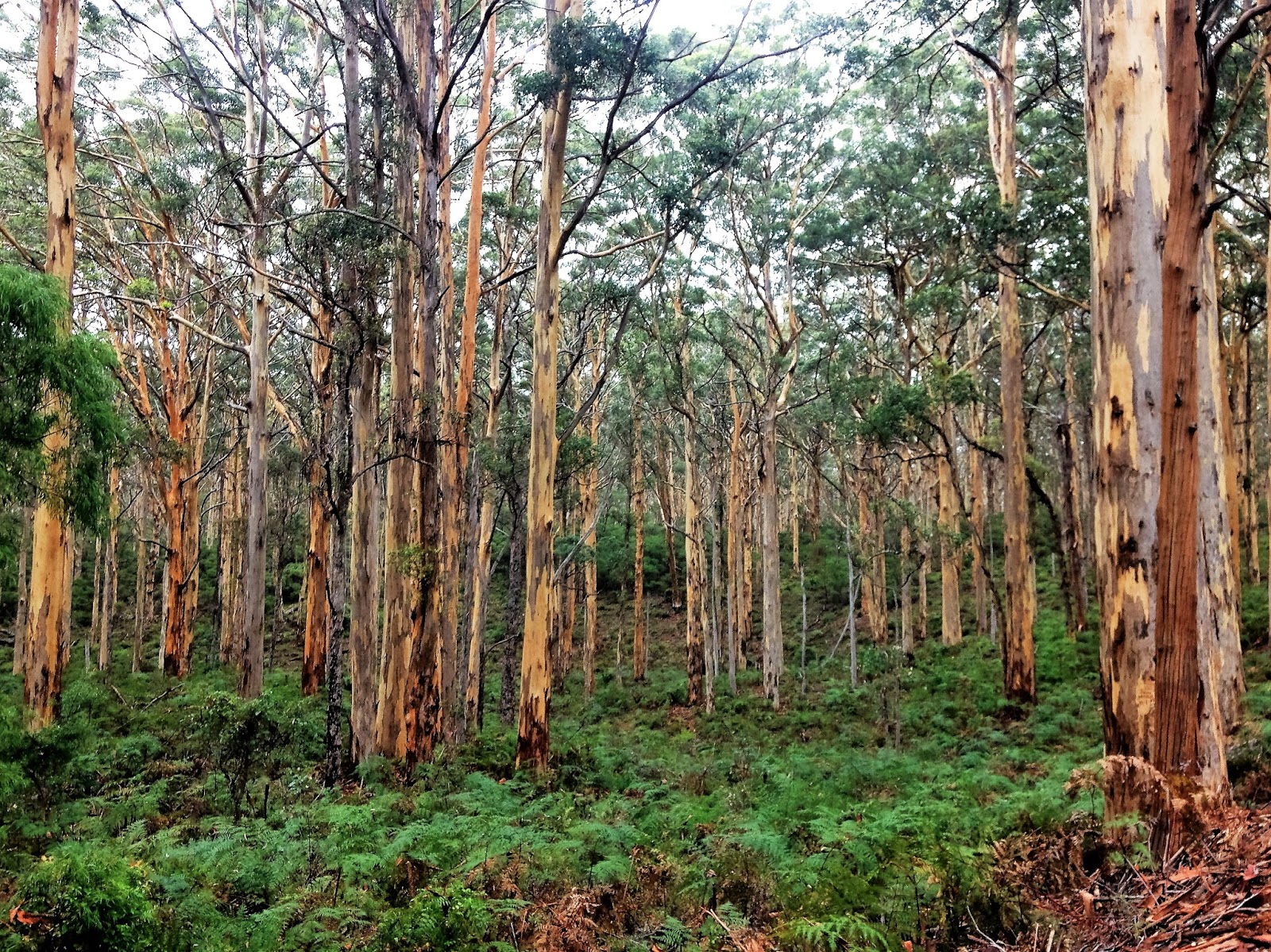
On our way back to Margaret River, we drove through a forest of impressive eucalyptus trees - a sawmiller’s dream - in the Leeuwin-Naturaliste National Park.  We stopped at Hamelin Bay for lunch, and then drove to a place called Surfers’ Paradise.  Unfortunately, the waves weren’t big enough to entice the best surfers.  With a steady horizontal rain pelting us, we decided to call it a day.  But I’ll take a wet, cool day anytime over a scorcher in the Outback!
The three-hour drive to Perth was without incident, remarkable in itself considering I was driving on the left on a freeway and through big city traffic.  I breathed a sigh of relief as I drove into the Avis rental parking lot and handed over the keys.  Only one driver had the nerve to honk at me in five days on the road.
We settled in to our hotel in the heart of the city’s financial district.  Perth is Australia’s fourth largest city and the only metropolis on the west coast.  Like most cities with half a brain, Perth is taking full advantage of its waterfront on the Swan River by filling the space with parks, attractive businesses, and interesting public art.  The photo shows the area around Elizabeth Quay.
We joined our third Intrepid tour in Perth and were greeted by Luke, our guide and driver for the next seven days; the stereotypical tall, blond, charming, able, good-natured Aussie.  Our travel mates are from England, Switzerland, United States, Japan, and Australia.  By the time we’d had our first adventure, sandboarding in Lancelin, we could tell it would be a good group.
We drove north to Nambung National Park and explored the unusual formations of the Pinnacle Dessert.  At this point, we lost sight of the coast and the landscape changed from farmland, to pasture, to scrub.  Soon, we were once again in the middle of nowhere, and we didn’t see much until we pulled into the small, seaside town of Kalbarri and settled in for the night in our modest hostel.
Happiness is barreling down a dirt road to God knows where, going fast enough to skim over the washboard surface, dust flying, bouncing around like beach balls.  At Murchison Gorge in the Kalbarri National Park, we walked the narrow, treacherous path down to the bottom.

Along the way, several members of the group tried abseiling, sliding down a cliff-face tied to a rope.  Elva and me decided to pass, having already done it in Mexico several years before.  The views of the gorges were spectacular.  Another long drive took us to our second overnight stop, Denham, where we feasted on lamb chops and kangaroo steaks.  Yummy!
Our morning activity on Day 3 involved a pod of semi-wild bottle-nosed dolphins who come into the beach at a place called Monkey Mia on Shark Bay.  On most days, the friendly creatures show up for a snack.  We watched and listened as a ranger explained how the tradition began with local fishermen who, being too generous with their catch, spoiled the dolphins rotten.  It got to the point where young dolphins were starving to death, having never learned to fend for themselves.  Things are far more controlled now.  It’s an interesting place, with sea turtles and emus in abundance as well.
Then it was off to see the stromatolites, the principle reason for Shark Bay’s UNESCO World Heritage Site status and one of only two locations on earth where these most primitive of life forms can be seen.  They don’t look like much but, 3.5 billion years ago, the cyanobacteria that create the stromatolites were among the first organisms to produce oxygen.  Without this essential element, we would not exist.  The amazing thing is that they’re still doing their thing, essentially unchanged.
Too soon, we were off again on another long, rather boring drive with nothing but scrub to look at, as far as the eye could see.  We drove into the pretty seaside town of Carnarvon and saw extensive banana and mango plantations along the Gascoyne River floodplain.  Things were looking up!  Our enthusiasm didn’t last however.  Soon, we were back to miles and miles of nothing but miles and miles, with little to do but snooze, kill flies (yes, the goddamn flies are back - with a vengeance), and count road-killed kangaroos.  Finally, we turned west and arrived in Coral Bay, just in time to see a most beautiful sunset.

The two days we spent along the Ningaloo Coast (another UNESCO World Heritage Site) were the highlight of this part of the trip for me.  The snorkeling was amazing.  We booked a three-hour tour with Coral Bay Ecotours.  What a treat it was!  Excellent guide and captain.  I swam a couple of times, seeing dozens of species of fish of every colour of the rainbow, and at least a dozen species of coral.  The highlight was swimming with a green turtle.  It was in no rush and neither was I.  Our second time in the water, we swam out to a channel and saw a group of grey reef sharks circling below.  Beautiful!
The boat had a glass bottom.  Elva got the fright of her life when this creature showed up: the rare great northern uglifish, never seen before outside the Gulf of St. Lawrence.  This one must have taken a wrong turn near Antigonish!
We drove north to Exmouth and entered the Coast Range National Park.  We set up camp for two nights in comfortable tents just outside the Park boundary.  Next morning, we snorkeled at Oyster Towers and Turquoise Bay.  It was magical!  I swam for a full three hours, the longest I’ve in the water in over 40 years!  Elva put on the gear as well and, with a little help, was able to appreciate why people get hooked on the sport.  Ningaloo Reef is the third-longest in the world, at 260 kilometres, surpassed only by the one off the coast of Belize, and Australia’s own Great Barrier Reef.  As I enjoyed this marvel of nature, I thought of friends and acquaintances I’ve lost over the past few years who’d have loved to be doing what I was, and how truly lucky I am.

We stopped in at the Northbrook Farm Stay for our last night on the road and were welcomed by owners Amie and Chad, and by Blair, their charming three-year-old, out for a ride on his pony.  Before supper, the Intrepid gang, including the two family dogs, piled into the back of Chad’s truck and drove to a back field to feed the sow and her litter.  After a delicious meal, Chad shared stories with us of his interesting work and life on the farm.
One last adventure awaited us on the last leg of our journey toward Perth.  On our way to a wildlife sanctuary, we took a detour around a damaged bridge only to bog down in the bottom of a dry riverbed.  We jacked, we shoveled and we pushed, but she wouldn’t budge an inch.  Luckily for us, we found a guy nearby with a payloader, and he had us out in jig time.
Our adventure ended too soon, and we had to say goodbye to one of the best groups we’ve ever travelled with.  Although we were much older than the rest, they all made us feel welcome.  Everyone pitched in with chores to make the experience even better and to take the pressure off our hard-working guide.  Now, it’s off to the northeast, to Port Douglas and the Great Barrier Reef.