Saturday, 18 November 2023


EUROPE – PART 5

After we’d settled into our comfortable hotel in midtown Belgrade, the very friendly staff at the reception desk gave us a map and detailed instructions on what to see and where to eat. Although I was tired from the long drive from Sarajevo and the struggles of finding the car rental drop-off at Nicola Tesla Airport, we set out on foot for the old town which lies close to the mouth of the Sava River where it empties into the Danube. As with every other city we’ve visited on this European adventure, it’s a pedestrian-only zone. Hint! Hint! Charlottetown! The morning rain had stopped by the time we got there, and the place was abuzz with young people and Saturday shoppers.

Serbia has a population of 7 million and Belgrade is its largest city at 1.3 million. It ranks 67th among the 192 countries listed by the International Monetary Fund in terms of GDP, slightly below Montenegro but significantly higher than Bosnia-Hercegovina. Its economy is growing at a steady pace and the country should be accepted for European Union membership by 2030 if it can keep peace within its borders and get over its obsession with regaining the lost territory of Kosovo. Serbia has a history of trying to gain control over areas where Serbs live, regardless of national borders, and eliminating all non-Serbs who happen to live there. It’s a dangerous obsession and one that will surely exclude them from membership in many of the desirable international “clubs”.

Belgrade was the capital of Yugoslavia, a country that existed from 1918 to 1992, first as a monarchy, then, from 1945 onwards, as a Communist state. Slovenia, Croatia, and Macedonia (now called North Macedonia) were the first of the former Yugoslav republics to declare their independence in 1991. Bosnia-Hercegovina followed in 1992. Serbia and Montenegro formed an alliance in 1992 but, in 2006, Montenegro became an independent nation. Kosovo broke away from Serbia in 2008 and, while it is not yet a member of the United Nations, it is recognized as a sovereign state by most European countries as well as Canada and the United States. C’est compliqué!

We walked, city map in hand, past several of Belgrade’s attractions on our first full day there on a beautiful sunny morning, beginning with the National Assembly and the Old Palace, residence of the Emperor in the days of the monarchy. The farther we walked, the better we liked this city. It has beautifully manicured parks, wide open spaces, and broad sidewalks. But whether using an old-fashioned map or Google Maps on my iPhone, the challenge was the same. Not only did I not understand the language, but the alphabet is Cyrillic and not Roman.

We saw the St. Sava Temple long before we reached it. It’s massive, and one of the biggest Eastern Orthodox churches in the world. Unlike many religious buildings we’ve visited, this one is rather new, having been completed only in 2004. The interior is as beautiful as any we’ve seen.

From St. Sava, we wandered down toward the lower part of Belgrade in the direction of the Sava River. We soon picked up a stray dog, one of many in the city, who walked beside us for at least twenty minutes. We’re still not sure whether he was following us or whether we were following him. He finally gave up on us at the bus station. As is often the case, it’s the little things that make a day interesting.

The waterfront promenade is a relatively new addition to Belgrade and, as with others we’ve seen, it has become very popular. From there, we wandered up to the park that surrounds the Belgrade Fortress and booked a sunset river cruise. The pedestrian zone was packed with Sunday strollers, may of them young families out to take in the fresh air. The cruise itself was lovely. We started by sailing to the mouth of the Sava River, then turned into the Danube for a short distance before cruising up the Sava past New Belgrade, an impressive residential and commercial development begun in 1948 and dominated by the soon-to-be-completed Belgrade Tower seen in the photo below. The sun sets early here, at 4:15, so we got a nice view of the cityscape from the boat.

We liked almost everything about Belgrade, except what is shown in the middle of almost every table in every restaurant we visited. People smoke here. A lot!! And it takes some getting used to…

We took the early bus from Belgrade to Skopje, the capital of North Macedonia, the most southerly of the former Yugoslav republics. The country remained at peace during the wars of the 1990s and its only significant dispute in recent years has been with Greece over, of all things, its name. Greece considers that the name “Macedonia” should refer only to the northern part of its territory but, in 2019, it finally accepted that its neighbour to the north be called “The Republic of North Macedonia”. North Macedonia is a stable country politically and, although it contains two main ethnic groups, Macedonians (Eastern Orthodox Christian) and Albanians (Muslim), they seem to have found a way to live together in peace.

It was a long bus journey, but I was content to have someone else at the wheel. Even with Google Maps as a guide, getting in and out of cities in this part of the world can be quite a challenge. Drivers are impatient and aggressive, and streets are narrow and winding. We’d planned to use Skopje as a break in our trip, time to rest and, for me, to get some work done. Also, rather than attempt a long return train trip and an overnight stay overnight in Kosovo, we arranged a day trip there from Skopje.

Skopje has a population of about 600,000 and straddles the Vardar River. The 1963 earthquake destroyed 60% of the city and it was rebuilt in a modernist style. The new urban project, Skopje 2014, was adopted by the municipal authorities to give the city a more monumental and historical aspect, and to transform it into a proper national capital. Several neoclassical buildings destroyed in the 1963 earthquake were rebuilt, including the national theatre, and streets and squares were refurbished. Many other elements were also built, including fountains, statues, hotels, government buildings, and bridges.

We began our four-day visit by walking through Macedonia Square. It features a massive statue of the national hero, Alexander the Great, another man on a horse responsible for much death and destruction. Everywhere you look, there are statues. They might or might not have been important people. It’s hard to tell since all the inscriptions are in Cyrillic! 

The city center is quite compact, and everything is within easy walking distance. There seems to be a nice photo wherever you look. Skopje is the capital city of a developing nation. Some things they’ve done to heighten the city’s profile have worked and others are, well, let’s just say, works in progress. Wander away from the highlights and you soon come across dark alleyways, garbage, and traffic chaos. But it’s not fair to judge a place that’s only been at peace for thirty years, and it’s clear from all the new construction that investors and developers believe there’s a bright future here.

The bazaar is across the river from the main square and is typical of what you see in predominately Muslim communities. It’s much nicer than many we’ve seen. The fortress that overlooks the city is rather neglected; a nice place to walk around, but not much to see.

Our next stop was the Mother Teresa Memorial House located very close to our hotel. She was born in Skopje in 1910 and lived here until she entered a convent at the age of eighteen. The memorial house is built on the site of the former Catholic church where she was baptized and contains cultural exhibits and a photo gallery. Critics have called it a “tactless and tasteless homage to Mother Teresa”. That may be a little harsh and I can understand why some may find the place a bit kitschy. But the fact remains that Mother Teresa is a significant and recognizable figure and one that Skopje has every right to be proud of. Not every city can claim to be the birthplace of a Nobel Peace Prize winner and she certainly is a worthy contrast to all the macho men on horses who carry swords meant to kill people.

Kosovo lies to the north of North Macedonia and is recognized as a sovereign state by 102 of the 193 members of the United Nations. Its population is about 1.8 million and its capital city, Pristina, is home to some 200,000 inhabitants. Most of the population identifies as ethnic Albanian (Muslim) and this helps explain why Kosovo broke away from Serbia (Orthodox Christian) in 2008.

Our Visit Macedonia guide, Sofija, and driver, Stefan, picked us up at the hotel at 8:30 sharp. We crossed the border into Kosovo and drove to our first stop, the Gracanica Monastery in the town of the same name, a Serbian enclave near Pristina. The monastery was built in 1321 and was declared a UNESCO World Heritage Site in 2006. It contains some of the finest frescos we’ve seen but, since we weren’t allowed to take photos inside, I’ve copied one from the web. Remember that the frescoes are 700 years old!

From Gracanica, it was a short drive to Pristina where we parked and walked around the city center, starting with a view of the National Library, as unusual a building as I’ve seen in my travels, built in 1982 during the Communist régime of Yugoslavia. The roof is made of 99 domes of different sizes and the entire structure is covered in what can only be described as a metal fish net. As with other unusual buildings, you either love it or hate it.

The new part of Pristina is rather dull architecturally, consisting of a few new government buildings and many of the ugly multi-storey concrete residential blocks typical of the Eastern European Communist era. But the pedestrian zone has a nice café-culture style to it. The second photo shows Mother Teresa Boulevard with the tall National Assembly building in the top left.

From Pristina, we drove to Prizren, Kosovo’s second-largest city. Along the way, we drove past impressive residential and commercial developments. When I asked where the cash was coming from, the answer was that Kosovo is an easy place to launder dirty money, and a quick internet search seems to support that explanation. I suppose when you’re a developing country, dirty money is better than no money at all!

The old part of Prizren is very charming. What city isn’t with a river running through its center! We had lunch there and spent a couple of hours just wandering around and people watching. Our guide and driver were both excellent and did two things right: Sofija didn’t spend every minute we were together trying to fill our heads with facts we’ll never remember and, in each place we visited, we were given ample time to wander on our own.

Kosovo turned out to be a pleasant surprise. We’d expected to see a poor country, struggling to come into its own after a messy separation from Serbia and a nasty civil war between the majority Kosovars (Muslim) and their Serbian (Orthodox) neighbours. The visit proved to us yet again that the only way to get to know a country is to go there and draw your own conclusions. And we can’t say enough good things about Stefan and Sofija. Because we visited near the end of the tourist season, we were their only guests and so were treated to a private tour. What a day!

On our last day in Skopje, we rented a car and headed out early into the countryside, looking for the Matka Canyon Trail. The canyon, flooded by a hydroelectric dam, looks more like a fjord. The trail leads from the parking lot to the reservoir above the dam where you can take a boat ride or simply follow the path. It’s rough in places but offers lovely views of the artificial lake and the surrounding mountains, and a good trail walk is a great way to start the day.

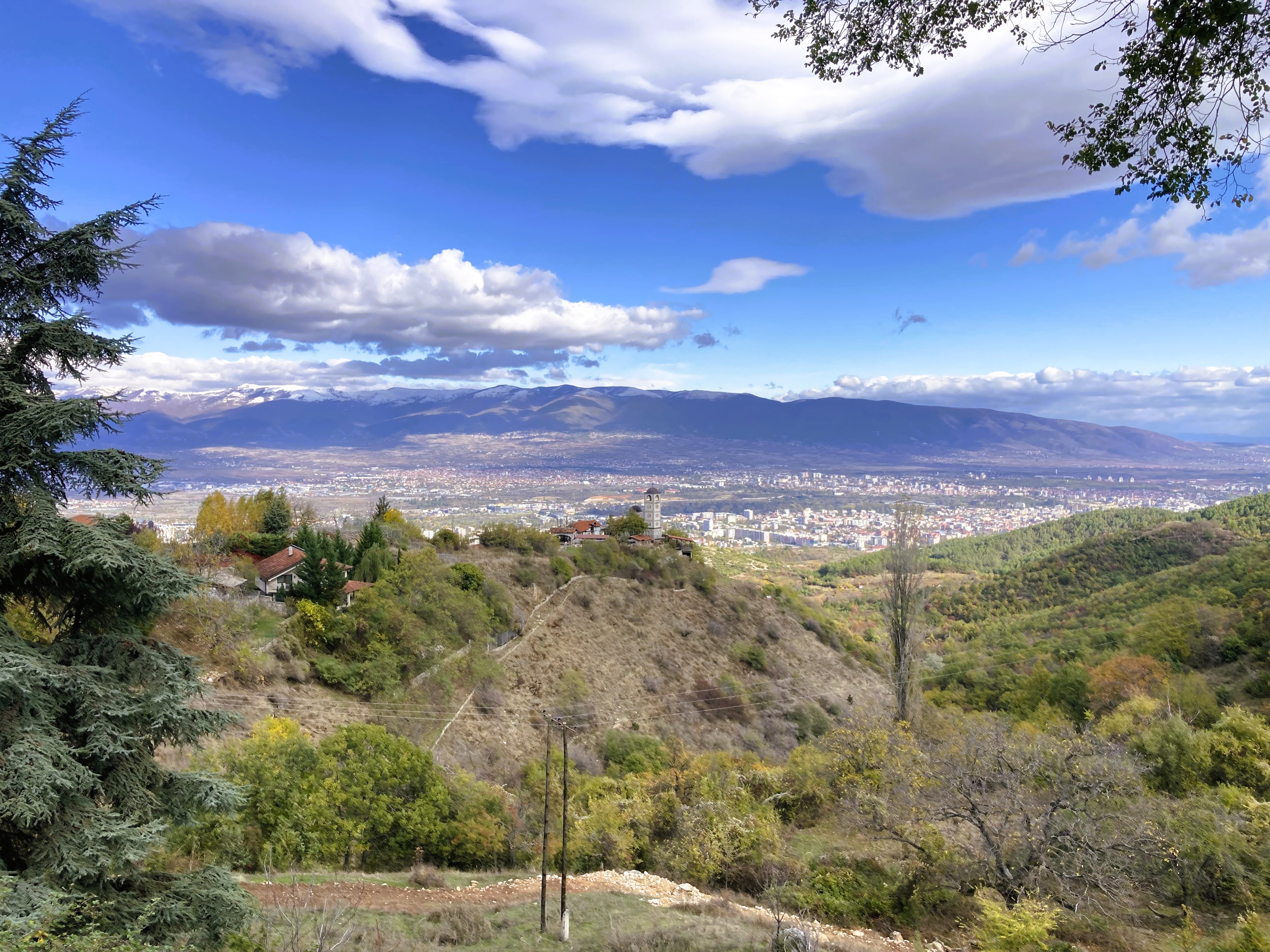
From Matka, we drove through several villages in the hills above the city until we arrived at the church and monastery of St. Panteleimon, the patron saint of physicians. The church was built in 1164, making it more than a century and a half older than the Gracanica Monastery in Kosovo. Since the door was open, we walked in and admired the interior structure, including the well-preserved frescoes. No one was there to tell us not to take photos, so we did and the view of the city from the terrace below the church was magnificent.

We had hoped to make it to the Millenium Cross at the top of Mount Vodno but the road and gondola were closed, probably because of high winds. We really enjoyed our visit to Skopje, a relaxing four days that gave us time to recharge our batteries and for me to get some work done and get a haircut. Tomorrow, we’ll take the bus to Ohrid, a city on the lake of the same name that lies three hours to the west.


Saturday, 11 November 2023


EUROPE – PART 4 

It took us nine long hours to drive 660 km from Ljubljana, Slovenia, to Mostar, Bosnia-Hercegovina, on a combination of modern divided highways and twisty mountain roads. By the time we pulled into our hotel, we were pretty well bushed. Google Maps said it would take us six and a half hours to get here but it hadn’t accounted for a major highway closure that forced us to detour inland and drive through the middle of nowhere.

Bosnia-Hercegovina is a developing country. Its economy ranks far below that of its neighbour, Croatia, placing it 82nd out of the 192 countries tracked by the International Monetary Fund. Although we saw evidence of new investment in factories and commercial establishments on our drive to Mostar, we also saw signs of poverty and of the war that racked the country in the early 1990s.

I don’t know much about the Bosnian War, but its impact seems still very fresh here. You see it in unfinished, abandoned buildings, and on exterior walls riddled with bullet holes. You see it in the faces of those of a certain age who no doubt suffered terribly. And, sadly, you see it in the faces of young people who just want to leave and get away from the never-ending tension. This bullet-riddled façade was less than a block from our downtown hotel.

According to some sources, Bosnia-Hercegovina has been experiencing intensified political and ethnic tensions of late which could potentially break the country apart and slide it back into war once again. Much of this is related to religion and ethnicity. The country is made up of three main ethnic groups: Bosniaks (Muslim), Croats (Roman Catholic), and Serbs (Orthodox Christian). It’s one of those multicultural melting pots that’s never cooled down, and probably never will.

The weather forecast for our one full day in Mostar was not very promising, so we headed out on foot as early as we could to see the famous Old Bridge, Stari Most, and the area surrounding it on both sides of the Neretva River. It being the end of the tourist season and early morning, we had the place pretty much to ourselves. The street and buildings have a Turkish feel to them and the many shops along the narrow streets reminded us of Jerusalem. The mosque is said to be the country’s most important.

We heard the tell-tale sound of someone tap-tapping a pattern on copperware and walked into a shop operated by the same family since 1918. The man in the photo spoke perfect French and told us all about his trade. Elva bought some very nice jewelry from him at a very reasonable price.

The area near the old bridge is a UNESCO World Heritage Site and well worth a visit. The bridge had stood for over 500 years until the Bosnian War. Though the area had no strategic military value, the bridge and the old town were destroyed for, as my mother used to say, “pure devilry”. The UNESCO web page says this about the reconstruction: “The reconstructed Old Bridge and Old City of Mostar are symbols of reconciliation, international cooperation and the coexistence of diverse cultural, ethnic and religious communities.” We can only hope it will survive for at least another five centuries.

Our next stop was Blagaj Tekke, a short drive from Mostar. Here, the Buna River flows right out of a massive cliff. As with the Old Bridge in Mostar, we had the place almost to ourselves. A tekke or tekiya is a dervish monastery (the men with the white skirts and felt hats who twirl as part of their meditation) and the one at Blagaj serves as a place for them to gather for prayer. The dervish orders believe that the surrounding environment is part of the overall worship, not just the buildings themselves. It’s a spectacular location and we just sat there for awhile taking it all in.

From Blagaj, we drove to the Kravica waterfall complex south of Mostar. Again, except for three angry-looking Turkish soldiers who are part of a 600-member European Union peacekeeping force in Bosnia-Hercegovina, we were the only ones there. The falls are horseshoe-shaped and 25 meters high, and they offer a spectacular sensory experience of sound, sight, and mist. In the warmer months, people come to swim in the large pool below the falls. We arrived back at our hotel mid-afternoon, just before the skies opened.

The drive from Mostar to Sarajevo took us three hours. The first half of the route follows the Neretva River through a very mountainous region framed by steep cliffs on both sides. It reminded us of Tajikistan, a country we visited four years ago. Sarajevo, the capital of Bosnia-Hercegovina, is a city of some 300,000 people and is the country’s political, financial, social, and cultural center. Due to its long history of religious and cultural diversity, Sarajevo is sometimes called the Jerusalem of Europe. It is one of just a few major European cities to have a mosque, Catholic church, Eastern Orthodox church, and synagogue within the same neighborhood.

After checking into our modern and comfortable boutique hotel, we wandered down to the nearby old town. Sarajevo is not a world-class city by any measure, but it does have a similar café culture to what we saw in Ljubljana. People seem to love to meet one another in the square and hang around the cafés just passing the time. As with so many cities we’ve visited, the city-center pedestrian-only zone is the key to making this happen.

But you don’t have to go far beyond the touristy areas to see poverty and evidence of war in Sarajevo. The city was hit very hard by the Bosnian War. Its people suffered through the longest siege of a capital city in modern warfare, 1,425 days, from April 1992 to February 1996. Thousands lost their lives during the siege to constant bombing and sniper fire from Serbian troops. One of our more interesting visits was to the local library where we watched excerpts from For the Love of Books, a movie about how the librarian enlisted help from friends to save ancient books and manuscripts from fires that were destroying cultural treasures all around. The group braved snipers and thieves to carry the treasures to safety in cardboard boxes.

As with everywhere we’ve visited in our travels, there is beauty, sometimes in the simplest things, like this young girl surrounded by hungry pigeons in the aptly named Pigeon Square at the entrance to the old city. The other photos are of men playing chess in the park and of the imposing Eastern Orthodox church.

There’s only one road into Lukomir, the highest and most remote village in Bosnia-Hercegovina. The last thirteen kilometers are unpaved and fit only for trucks and four-wheel drive vehicles, so we weren’t sure whether our poor little Ford Fiesta would be tough enough to make it there and back. As it turned out, she passed with flying colours! “How did we end up there?”, you may ask. Well, because Jean-Paul likes going off the beaten track and getting away from the crowd!

Elva and I spend a lot of time looking at YouTube videos of the places we plan to visit. When we saw what little there was to do in Sarajevo, we figured we’d better find a day trip or two, and we stumbled onto the village of Lukomir. After a long and bumpy drive, we pulled up to a house that contained a small restaurant. The nice man told us we could park there, and off we headed to the viewpoint that overlooks the village. The view below was of one of the deepest canyons in Europe. There wasn’t a cloud in the sky, and the air was crisp and pure. It was magical and bucket-list-worthy!

Back at the restaurant, as we drank our coffee and tea, the owner told us that the village is home to about fifty souls; they have electricity and internet (In the middle of nowhere!); and they live there only during the months when the road is passable. Residents either live off the tourist trade or herd sheep. We were thankful that we arrived early because we passed more than twenty cars on our way back to the paved road, many of them containing people who’d paid dearly for the road trip. On these photos, you can see the village laid out behind us and the very rough road, with some intimidating water holes and a shepherd’s cabin in the background.

I remember watching the 1984 Winter Olympics held in Sarajevo. On our way to Lukomir, we drove past the site of the downhill ski events, today an impressive winter resort. What really struck all Canadians that year was the record-setting performance of Gaétan Boucher. After winning bronze in the 500-meter long-track speed skating event, he won gold in the 1,000 and 1,500 meter events, the first Canadian man to win gold in an individual Winter Olympic event.

The war destroyed many of the Olympic facilities in and around the city. Others were simply abandoned and lie in ruins. The long-track speed skating oval where Boucher won his medals is now a cemetery for soldiers killed in the War. 

The abandoned bobsled-luge track has been reincarnated as a tourist attraction. We went there on our third day in Sarajevo. The place has a post-apocalyptic feel. We walked down the two-kilometer track and back up again. You can imagine that, in another thirty years, Mother Nature will have reclaimed more of it than she already has. 

As we went around curve after curve, I couldn’t help thinking how thrilling it must have been for our two Olympic bobsled champions, Heather Moyse and Dave “Eli” MacEachern. Myself, I’d have been exercising some serious sphincter control rocketing down there in one of those flimsy sleds, you can be sure of that!

We really enjoyed our stay in Sarajevo. While there wasn’t that much to do in the city itself, we did find a couple of adventures nearby that were well worth the drive. We learned more about the 1984 Sarajevo Olympics by walking up and down the bobsled run than we would have at a museum and got in a good workout in the process.

We dropped off the Ford Fiesta at Belgrade airport after a slow trip through northern Bosnia-Hercegovina where we drove through heavy rain and had our first taste of snow. It took us five hours to travel 250 kilometers, including crossing the border into Serbia. We’ve settled into our hotel and are ready to spend two days getting to know Belgrade, the capital. After that, we’ll be travelling by bus through four more countries, North Macedonia, Kosovo, Albania, and Montenegro. Stay tuned!


Sunday, 5 November 2023


EUROPE – PART 3

We left the comfort of the Island Princess after twelve days and schlepped our luggage to the National Express bus station, a half-hour walk just to get the blood flowing. Elva puts up with my eccentricities. Most women would find them intolerable or, worse yet, grounds for divorce! It’s one of the reasons we’re together after all these years; because she’s one tough lady. A two-hour bus ride took us to Heathrow where we waited six hours for our flight to Zagreb.

I’d booked a B&B in the center of the city, thinking it would be an ideal location for exploring on foot. I always use booking.com for accommodations when we’re travelling on our own. It provides an excellent service and is reliable 95% of the time. But, when we got to our B&B, the key to open the door to the building wouldn’t work. A nice lady came along and let us in. The elevator wasn’t working, so we had to carry our luggage up four flights of stairs, lit only by our iPhone flashlights. Thank goodness the room was nice and breakfast the next morning was good.

Croatia is not a wealthy country but, compared to some other Balkan states, it has shown considerable improvement since it declared its independence in 1991 after the breakup of Yugoslavia. It has a population of 4 million people and Zagreb, the capital, is home to close to 1 million of those. In a relatively short time, Croatia has joined several of the important international “clubs”: NATO, the European Union, the Eurozone, the Schengen Area, the United Nations Security Council, and others. Croatia’s currency is the Euro. Tourism is a significant source of revenue, with the country benefiting greatly from its long Adriatic coast. It’s GDP per capita is about $40,000, compared to $58,000 for Canada and $50,000 for Slovenia, its neighbour to the north.

Our B&B room overlooked one of Zagreb’s main squares. Like most others in Europe, it features a fierce looking man on a horse… The buzz was impressive. The square was a busy spot all day and a popular hangout for young people all through the late hours.

After visiting the tourism information center, we took a walking tour to see the main sights. Along the way, we ran across many directional signs. This is the first one I’ve seen that points to a Museum of Broken Relationships. A nearby sign pointed to the Museum of Hangovers! The second photo shows the Croatian National Theatre, an impressive structure built of a yellowish stone that glows in the sunlight.

We came across a bomb shelter quite by accident and wandered in. Much to our surprise, where the tunnel broadened, we saw this wonderful example of contemporary art, complete with a sound and light show. On the return trek to our B&B, we walked through several markets selling flowers. The light accentuated this one perfectly, I thought.

Leaving Zagreb after a busy day, we picked up our tiny Ford Fiesta at Thrifty Rent-A-Car and headed north toward Slovenia, country number 94 on our list. We drove through beautiful, pastoral countryside on roadways as smooth as a baby’s bottom for the two hours or so it took to reach Lake Bled. After checking into our hotel, we strolled along the lake, taking in the stunning views. We’d been told to consider taking an electric boat to reach the island in the middle of the lake and its iconic landmark, the Assumption of Maria Church. I went off in the wrong direction and came across a rowboat rental place. “Why not?” So, we did! Best $45 we’ve spent on this trip so far.

The lake was almost dead calm, and my passenger managed to stay in the boat as we rowed to the island, circled it, and came back! She never wiped the smile off her face the whole time. “C’est comme un conte de fée!” (It’s like a fairy tale”), Elva remarked. Lake Bled is all of that, and the fall colours were a bonus. Words cannot describe its beauty. After returning the rowboat, we walked the 6 kilometers around the lake, building up a wicked appetite.

Slovenia’s land area makes it about four times the size of Prince Edward Island. It’s bordered by Italy, Austria, Hungary, and Croatia and has a population of just over 2 million. The country is mostly mountainous and forested and enjoys a stable government and a strong economy. Like Croatia, it declared its independence and is a member of all the important international clubs.

On our second day in Bled, we rose early to get ahead of the forecast all-day rain. We drove up out of the town toward the nearby village of Podhom and took a one-hour hike along the Vintgar Gorge in Triglavski Narodni National Park. The trail wound its way through a forest of European Beech, an iconic example of the continent’s original wilderness. In addition to the beautiful views of the gorge far below, we encountered something that falls into the category: “If I hadn’t seen it with my own eyes, I wouldn’t have believed it!”, a young man blowing leaves off the trail!

Day 3 in Bled began with a steady rain. We waited until it slowed to a drizzle and ventured out with our rain gear and umbrellas, ready to climb to Bled Castle (top left in the photo). Having seen enough castles in Europe, we decided not to venture in but rather to continue our morning stroll around the town below. Everything here is spotless and orderly, all signs of a prosperous place but the people are not the friendlest. Maybe if my hometown was overrun with foreigners every day, I’d feel the same.

After our walk, we checked in with the local tourist information office and were directed to a nearby town called Radolvljica for a day trip. We sat in the car watching the rain fall while we ate our bagged lunch. As soon as it stopped, we saw our chance to walk through the medieval town and were not disappointed. The place is worthy of UNESCO World Heritage designation and a lovely place for a stroll. The sun broke through the clouds just enough to grace the middle photo with a bit of light before the umbrellas came out again.

After spending three days in Bled, we drove the short distance to Slovenia’s capital city, Ljubljana. As intimidating as the name first appears, if you just pretend each “j” is an “i”, you’ll be close enough to the correct pronunciation. After checking into our hotel, we walked to the nearby city center and joined a guided tour. Two things struck me: first, the statue in the main square is not of a fierce-looking man riding a horse but of a poet, France Preseren; second, since 2007, the downtown core has been a pedestrian-only zone. I considered both to be very good omens and the sign of a very progressive society. And the sunshine didn’t hurt our mood either…

Our next stop was the castle that overlooks the city, a bit of a climb on foot but not quite as high as Bled Castle. Along the way, we ran into a two-legged feathered curiosity, someone’s pet emu! Ljubljana is home to 300,000 inhabitants and is the country's cultural, educational, economic, political, and administrative center. It’s a spotless, orderly, and prosperous place and, on Saturday, it was buzzing with people, mostly locals. We attended Mass at St. Nicholas Cathedral and had a very nice meal at an Italian restaurant on the banks of the river that bisects the downtown.

Day 2 in Ljubljana dawned bright and sunny. Since stores are closed here on Sundays (Slovenia has a strong Catholic tradition), poor Elva had to tag along as I visited a couple of national museums. After torturing her for a few hours, we continued our pedestrian wanderings and went back to our favourite places from the day before.

Tomorrow morning, we’ll leave Slovenia and cross again into Croatia on our way to our next stop, Mostar, a town in Bosnia-Herzegovina.