Wednesday, 21 September 2022

 EUROPE – PART 3


Except for two hours on solid ground in Alesund, Norway, we’d spent eight days at sea. In addition to a daily New York Times Sunday crossword, I passed the time working on an old manuscript I’d started many years ago and set aside, never thinking I’d get back to it. Elva read and worked on a couple of jigsaw puzzles. Anyone who knows her would understand how desperate she’d have to be to resort to a jigsaw puzzle. Every evening during our confinement, we watched a movie. Fortunately, Princess offers quite a few good ones.

And another thing. You’re supposed to know when you have COVID. Well, we didn’t!

I spoke earlier of my fascination with Viking history. I won’t bore you with too many details, but you should know that Iceland was founded by Vikings who sailed here from Norway in the year 874. And did you ever wonder where the name and symbol for Bluetooth came from? Well, here’s a bit of Viking-related trivia. Harald Gormsson called “Bluetooth” because one of his front teeth was dead, was the King of Denmark from 958 to 986. His initials “H” and “B” in the runic language were brought together by the clever folks at Intel and the now famous trademark was born. And so, Harald Bluetooth has been immortalized!

The North Atlantic can be angry at times and, although it was a bit rough between Norway and Iceland, I’m sure we didn’t feel her full fury. I thought again of the Vikings, those brave souls who’d sailed from Norway in open boats, carrying their livestock and everything they owned. How had they survived such a journey over 1,100 years ago? How many hadn’t? Eventually, we reached Seydisfjordur, a village of 750 souls with an unpronounceable name. As we sailed into the tiny harbour that sits at the head of a fjord, the winds died and we were greeted by a magical scene, one of the most beautiful places we’ve ever visited in all our travels!

“Sometimes, the best plan is no plan at all.” This is my line and, on our day in Seydisfjordur, it proved to be true. We walked through the hamlet, admiring the lovely houses and the immaculate surroundings before deciding we’d follow a path along the river that runs through its center and try and visit a waterfall we’d seen cascading down the eastern slope of the mountain. We walked past a fisherman standing in the middle of the stream, casting his fly, and found a path running through a farmer’s field that led up to the waterfall. “We’re in luck,” I thought!

It being only two days post-COVID, I wasn’t sure about our stamina, and we hadn’t brought any water. “Just follow the path to the waterfall and see where we go from there,” we agreed. After taking in the beauty of the cascade, we knew we had to continue climbing because the best way to see a place is from the greatest height you can reach. As the photos show, we were right! We didn’t see another soul on the path. Back down in the village, we enjoyed the sun’s warmth and temperatures in the mid-teens Celsius, then took the tender back to the ship. Neither of us can imagine a day on this cruise better than this one, and it reminded us yet again why we travel. It also reminded us why we stay in shape; so that we can walk the path less travelled.

Akureyri, the town we visited next, lies just 100 km south of the Arctic Circle, placing it 300 km further north than Yellowknife. With a population of about 18,000, Akureyri is the administrative, transportation, and commercial center of north Iceland. The Island Princess sailed 60 kilometers up the longest fjord in Iceland to reach it. Our plan for the day called for a visit to the local tourist information center for some ideas on local hikes and attractions. The thing I wanted to see most was the botanical gardens, the most northerly in the world.

Stepping off the ship shortly after 8:00, we started stripping off layers before we’d even walked the first kilometer. The sun had peeked through the early morning clouds, and we were treated to wonderful weather for the time of year and the latitude. The young man at the local youth hostel gave us a map and provided enough local knowledge to get us started on what would prove to be another very enjoyable morning. The botanical gardens were even better than advertised; an amazing collection of plants, well curated and well cared for.

From the gardens, we walked down one of the main drags past neat houses, nice parks, and a first-class outdoor heated pool complete with waterslides, and made our way to the small river that flows though the town, the Gesla. We followed a trail that climbs out of the town. The ‘trail’ turned out to be of the paved, multi-use variety, as nice as we’ve seen anywhere. It was laid out so that you had the impression of not being in a built-up area at all. Other guests on the ship paid a fortune to see the botanical gardens and drive to a waterfall. We had this trail to ourselves with a deep gorge and a few nice waterfalls to look at as well. And we'd never left the town! After 20,000 steps, it was time to get back onboard before the rain hit.

Akureyri is a good example of clever land use planning, and it’s not something I was expecting in this part of the world. While I’m sure the winters can be long, cold, and dark, I can see why people would want to live here. The standard of living is obviously quite high, and the town offers everything one would need for a happy and productive life.

Our third day in Iceland was spent walking around the village of Grundarfjordur, population 872. It’s surrounded by misty mountains and guarded by Mt. Kirkjufell, Church Mountain. Grundarfjordur was one of the first places settled in Iceland and is today a successful fishing and trading center. We walked through the tidy village and on the three-kilometer trail toward Kirkjufell. The weather alternated between rain and dappled sunlight as we tried to capture the mountain framed by a rainbow. There were cascades and waterfalls along the way. Like the other places we’ve visited in Iceland, this village is neat, tidy, and orderly; people are obviously proud of their place. Before boarding the tender that took us back to the Island Princess, I took a photo of the local seiner fleet and the handsome Icelandic flag.

Speaking of the fishery, in 1972, Iceland declared a 200-mile limit on its territorial waters to protect its main industry, effectively banning foreign fleets. European nations, especially the United Kingdom, refused to accept the decision, and many confrontations took place on the seas between Icelandic and British vessels. It was called the Cod War and, long story short, Iceland won. Today, the fishery remains the country’s most important industry. And, by the way, Iceland has neither army, navy, nor air force; just the Coast Guard to protect the fishery and come to the rescue of those in distress.

Imagine if Canada had done the same. I still remember that day in the summer of 1992 when the Hon. John Crosbie, Newfoundland’s representative in the federal cabinet, announced the cod moratorium on the dock in Saint John’s. Heckled mercilessly by the locals, he finally said out of frustration: “I didn’t take the fish from the goddamn water, so don’t go abusing me.” It was a memorable line but a poor excuse for a government that had done nothing to protect the East Coast’s most important fishery. Thirty years later, the cod have not come back, and they probably never will. By contrast, Iceland’s cod fishery remains healthy and vibrant, as are the coastal communities that depend on it.

The capital city of Reykjavik was our final stop in Iceland. We’d decided to rent a car to do the Golden Circle, a route that takes in three of the island’s most popular attractions. This time, we were well served by the agent at Enterprise Rent-a-Car, quite a contrast from our experience in Stockholm. Our first stop was at Thingvellir National Park, a UNESCO World Heritage Site protected for two reasons: because it’s one of the best places in the world to see where two of the earth’s tectonic plates meet, and because it’s the location of Iceland’s original parliament, the Thing, which met first in 930 AD and is considered to be the world’s oldest. 

The European and North American tectonic plates meet at Flosagja, and the two plates are actually drifting apart at the rate of 2.5 cm per year. The first photo shows where they are separating from one another. As for the Thing, it was where the Law Council met every year, beginning in 930, to make laws and resolve legal disputes. Everyone was free to attend the annual gathering and it probably turned into a pretty great party when the formalities were done with. The other photo shows the Prime Minister’s rather modest summer residence and the small church that stands beside it.

Stop number two was the Great Geysir, the most impressive hot spring in the geothermal area known as the Haukaladur Valley. The geysir is supposed to erupt every five or ten minutes or so, shooting a jet of hot water high into the air. We watched patiently for about a half hour but the best the Great Geysir could do for us was a mediocre belch. The attraction is free, so sometimes you get what you pay for. The lunch we ate there wasn’t free however: $57 CDN for two sandwiches, an orange juice, and a slice of cake. Yikes! On the bright side, the day cost us less than half what Princess passengers paid for their Golden Circle excursion, and we got to do it on our own time and at our own pace; always more satisfying.

Stop number three was Gullfoss Waterfall, one of Iceland’s most popular tourist attractions. Even for one who’s seen Niagara Falls, Kakabeka Falls (near Thunder Bay, Ontario), and Helmken Falls (near Thompson, B.C.) in Canada, I did find Gullfoss impressive. Elva said the best thing about it is the lack of development nearby; quite a contrast from Niagara Falls, also known as “Every new bride’s second-biggest disappointment.”

Back in Reykjavik after seven long hours on the road, we visited the city’s signature landmark, the Hallgrimskirkja, the towering Lutheran Church. Completed in 1986, the building is undergoing much-needed repairs to its outer cladding. The statue out front of Leif Erickson was donated by the United States of America to mark the thousandth anniversary of the first meeting of Iceland’s Parliament. And we loved the stylized viking ship, one of many examples of public art to be found throughout the city.

During our one-day driving tour around Iceland's southwest corner, we saw more agriculture than we'd expected to see, including large herds of sheep and Icelandic horses, and even a couple of golf courses. We certainly made the best of the four days we had here and are thankful for decent weather. Iceland is a country full of surprises! And it's a place we'd like to return to someday for a more extended visit.


Friday, 16 September 2022


EUROPE – PART 2


We had a good plan for our first day in Stockholm, but it started out rather badly. The route from our dock to the Slussen subway stop seemed simple enough and I had Google Maps to guide me. Unfortunately, a construction project put us off course. We finally did find a nearby station though and rode the subway to the central hub as planned.

From there, the route to Budget Rent-a-Car should have been easy, but Google Maps doesn’t work nearly as well when you’re walking as when you’re driving, and definitely not when you’re walking through different levels of a building. Long story short, after asking for directions a couple of times, we stood at the counter across from a rather stern-looking young agent who told me that my credit card wouldn’t work as four of her useless co-workers played with their phones, looking very much like a Charlottetown Public Works crew!

I asked them whether the car had Apple Car Play: “Don’t know”, they answered. “So, where’s the car?”, I asked politely. “Somewhere out in the street”, she answered. “So where do I drop the keys when we get back,” I asked, again politely. “We don’t have a drop box here; you’ll have to drop it off at our other office”, she replied coldly. “Can we use your washroom before we go?”, we asked. ‘It’s only for employees”, she said, rolling her eyes at me. “You’ll have to go inside the mall next door, go into the restaurant and ask for a code”. Sheesh!

Guided by our trusty Hortense, we headed out of the city toward our first stop, the town of Sigtuna, founded by Vikings in 980 AD and one of their most important cities in its heyday. It’s a pleasant place for a walk, featuring a lake, the oldest intact street in Sweden, numerous rune stones, and several churches, the most interesting one being St. Olaf’s.

I’m a student of Viking history and have been since I first heard the story of Eric the Red and his son, Leif the Lucky, in my two-room schoolhouse in Wellington. As we now know, the saga was more than a legend. In fact, the Vikings landed in l’Anse-aux-Meadows almost five centuries before Columbus “discovered” America. The little town museum traces the history of Viking religious belief. Before being Christianized between 900 and 1050, Vikings had their own pantheon of gods: Odin, Thor, and Frey, to name but a few. I like their “pagan” gods better than the Christian one but, without the saints, we wouldn’t have had any church ruins to look at in Sigtuna. St. Olaf’s looked striking in the afternoon sun.

Next, we drove to Uppsala, home to the oldest Nordic university, founded in 1477 and home to 50,000 students. Along the way, we saw some impressive dairy farms; it was harvest time for their cereal crops. Our stop in Uppsala was a short one, just enough time to enjoy tea and coffee on a nice south-facing terrace. From Uppsala, we headed to Mariefred, a small town on Lake Malaren and home to Gripsholm Castle. A stroll through the town featured the railway station, served in the summer months on a narrow-gauge track. The castle itself is massive and magnificent, brilliant in the late afternoon sun. We were back in Stockholm by 7:00 pm, returned our car, and took the subway and bus back to the Princess. A long day for sure but well worth the effort. No favourable review for Budget though!

Day two in Stockholm dawned bright and sunny though a bit cooler. We took the shuttle into the heart of the city and walked around a bit to get our bearings. Tip for travellers: if you need to “go” when you’re downtown, find the swankiest hotel you can, walk in like you own the place, and do your business there. You’ll be treated to the best bécosse you’ve ever sat on, and no one will ask any questions. And, on the way out, ask the doorman for directions to wherever you want to go. They’re always helpful and they always know.

My goal for the morning was to see the Vasa Museum. Elva, not being a museum person, chose to walk around Djurgarden, one of the many beautiful islands that make up Stockholm. The story of the warship Vasa is a rather sad one. She was launched on August 10, 1628 and sank less than 1 kilometer into her maiden voyage. After spending 333 years on the seabed, she was raised and sits preserved for all to see in a magnificent museum. The Vasa is the best-preserved 17th century ship found anywhere, she’s adorned with hundreds of carved sculptures and she’s 98% original.

Our last stop before heading back to the ship was the changing of the guard at the Royal Palace, an impressive ceremony featuring disciplined soldiers and a large marching band. Stockholm is a world-class city, certainly a cut above anything we’ve seen to date on this trip. 

Gotland, a Swedish island in the Baltic Sea, is about half the size of Prince Edward Island and home to 60,000 people. We docked in the town of Visby next to the USS Arlington, in the Baltic Sea to participate in an amphibious training exercise with other NATO nations, in other words, to keep Vladimir honest.

Visby contains the medieval town of Dalmansporten, a UNESCO World Heritage Site featuring an intact wall and narrow cobbled streets. There are ten church ruins, but the town skyline is dominated by the impressive Cathedral of St. Mary, built in the 12th century as a Roman Catholic church and now a Lutheran place of worship. While the town is a popular tourist destination during the summer months, it was practically empty except for the 1,400 or so passengers on the Island Princess

Elva and I left the ship early and were among the first to wander through this magical place. We were struck by the small, tidy homes, many of them with roses and hollyhocks planted at their front doors. They had a whimsical character, and I could only imagine happy people living inside them. I’d never seen houses made of creosoted wood and the smell reminded me of the railroad ties of my youth in Wellington.

Our next stop, the town of Ronne on the island of Bornholm, Denmark, proved to be a bit of a disappointment. It’s a nice enough place, very clean and orderly, but not much to see or do there. Its main claim to fame is the role its port plays as the assembly area for huge offshore windmills that will be installed off the northern coast of Germany. We took a stroll through town and stopped for a coffee and a tea at a café on a nice cobble-stoned street. We chatted with a young couple from Nuremburg and two musicians who play every evening onboard the ship. When it came time to pay the bill, I gulped a bit: $12 CDN!

“The best laid schemes o' mice an' men gang aft agley”; so wrote Scot Robbie Burns in his poem To A Mouse, On Turning Her Up In Her Nest With The Plough. I remembered the words from our Grade 11 Great Poems book. On the morning of day fourteen, a sea day before some passengers were to disembark in Copenhagen, we were summoned to a mandatory COVID test. While neither of us had symptoms, we both tested positive and were confined to our room for six days.

We knew we'd miss out on at least Copenhagen and Fredericia in Denmark, and the Norwegian ports of Kristiansand, Haugesund, and Alesund. Hopefully, we’d be OK when the ship docked at Lerwick on the Shetland Islands. Had we known about this mandatory test and the consequences of being positive, I’m not sure we’d have booked with Princess. But it’s too late for that now. Thankfully, we have a window and wifi. And this was the only thing worth seeing during our six-day confinement: the bridge between Denmark and Sweden as seen through a very dirty porthole.

Being cooped up in a 250-square-foot room for six days is no picnic. Our cabin has a toilet, a shower, a bed, and a TV. We order our meals from room service and have learned that it’s better to order something cold since it’ll be cold by the time it gets delivered to us anyway. The first day’s oatmeal reminded me of the Lepage’s glue we used in la petite école! It was all I could do to get it down. Dinner is late two days out of three; my bottle of Heineken 0 arrives with no bottle opener; my oatmeal arrives with no spoon; a nice, chilled bottle of wine is delivered to our door one evening; I don’t drink and there’s no corkscrew to open it if I did! We’re not impressed with Princess, not in quarantine anyway.

It’s a good thing Elva and I get along. She has never “rested” for six days in a row and, as for me, it did happen once when I was eight years old. Diagnosed with pneumonia and with no one to look after me at home, I spent a week in the old Prince County Hospital with a wardful of sick kids. I remember watching the Lobster Carnival parade from a window as it went past. I can’t imagine how people in community care and nursing homes must feel, being confined because of COVID.

We’d been told what would happen if we tested positive on Day 7. “You’ll be tested every subsequent day until you come up negative and, if not, we’ll let you out on Day 10.” Needless to say, we were nervous as hell as Day 7 approached. Most puzzling was the fact that neither of us had felt sick before the test. Our symptoms never changed through the entire six days we spent in our cabin.

The nice nurse arrived at our door promptly at 8:00 am on Day 7, stuck Q-Tips up our noses and disappeared. It was a long half-hour before the phone rang. I’d asked Elva to answer because she’s luckier than I am, and I’m superstitious as hell about these things. “We’re both negative,” she said, jumping up and down. We hugged one another and got out of the GD room as quick as our little feet could carry us.

It reminded me of the 1992 First Ministers’ Conference that led to the infamous Charlottetown Accord. I’d been asked to accompany the Québec delegation, led by Robert Bourassa. I stood outside the meeting room at the Delta Prince Edward and waited for the Premiers and the Prime Ministers to announce they’d reached an agreement. The doors burst open, and Frank McKenna was the first one out, waving his hands in the air, borrowing the famous line from Dr. Martin Luther King, Jr.: “Free at last! Free at last! Thank God Almighty, we are free at last!”

The captain had announced the day before that we’d be staying overnight in Alesund, Norway, instead of landing in Lerwick on the Shetland Islands, because of forecast high winds. We put on rain gear and warm clothes and got off the ship. I jumped in the first puddle I could find, and Elva did a bit of jumping of her own. Alesund is a beautiful town with a lot of history and some beautiful cityscapes. We only had a couple of hours to visit but we made the best of it. Next, we’re off to Iceland!


Monday, 5 September 2022


EUROPE – PART 1

There’s a difference between a risk and a gamble. A gamble is a bet on an uncertain outcome; you either win or lose and there’s no allowance for a Plan B. A risk involves the possibility of loss or failure; buy a stock and you take a chance that you’ll lose money, but you might also make some. We took a risk by leaving Charlottetown barely twenty hours before our cruise was to leave Southampton in the south of England. One of our two flights could have been delayed; our luggage could have been late arriving at Heathrow or lost altogether; or we could have missed our bus to Southampton. We could have tested positive for COVID and not been allowed to board the Island Princess at all. All of these were risks.

Admittedly, I like to push the envelope a little when we travel, and this time was no different. Had we missed the boat, I’d have had to figure out a way to catch up with it at its first port of call, Skagen, Denmark. Funny enough, when we docked there on Tuesday morning, August 30, we saw three people and their suitcases sitting outside the tiny cruise terminal; they’d missed the boat, but they’d also figured out how to catch up with it. We would have too, but not without a little cursing on my part, mind you!

We boarded the Island Princess, our first cruise with a company other than Holland America, about ninety minutes before they hauled up the gangplank. The ship felt like home as soon as we got on: lots of wood; lots of carpet; lots of leather; a bit of brass; and several well-appointed lounges. Turns out Carnival Corp. owns both cruise lines and has branded them to appeal to similar clienteles, older folks like us. Having emptied our luggage, we headed for the Lido buffet, half-starved after being served nothing but a dry croissant and a small yogurt, what passes for breakfast on Air Canada these days.

Jet lag always gets me, and this four-hour time difference was no exception. After a restless night, I enjoyed a quiet sea day, exploring the ship and taking in a presentation on the next days’ ports. We docked in Skagen on Tuesday mid-morning, and I spotted rental bikes on the dock. Perfect! We knew where we wanted to go and what we wanted to see, and I figured it would be easier to navigate the city on two wheels than on foot. The young woman said $20 US for two bikes for the day, and I wasn’t long paying her. Nearby, passengers who’d taken the ship’s cycling excursion had paid $90 each for the same thing! We knew they’d be herded like sheep for a few hours and wouldn’t see nearly as much as we would.

We pedaled through the pretty little town and headed toward Grenen, the northernmost point of Denmark. We parked the bikes at the end of the road and walked along the dune-lined shore past German World War II bunkers to the very tip of the peninsula. It’s where the North Sea meets the Baltic Sea, more precisely the bodies of water called Skagerrak to the east and Kattegat to the west. I remembered their names from the TV series, Vikings. A nice Danish couple took our picture, and we returned the favour, straddling the two seas where the waters meet. It was a neat experience!

Back in the town, we enjoyed riding through the streets, impressed at the cleanliness and order of the place, with houses all painted the same colour of yellow and topped with red tile roofs. Unlike Charlottetown, Skagen puts the safety of cyclists first; many sidewalks are wide enough for both cycling and pedestrian lanes. 

After lunch on the Princess, we headed back through town and pedaled in the opposite direction to see the sunken church. All that’s left of the structure is its white tower, the rest having been demolished after the parish stopped fighting the encroaching dunes in 1795. Skagen reminded us yet again that the smaller places we visit on a cruise can be just as interesting.

Day four was a sea day, with the ship sailing through the straits separating Denmark and Sweden, crossing the Baltic Sea headed toward Lithuania. Early on day five, we docked at Klaipeda, a decent-sized city of 150,000 in the southwest corner of the country, located just north of the Russian exclave of Kaliningrad. It was a beautiful sunny day, coolish but perfect for walking. Klaipeda is not a popular tourist destination but it’s worth a visit. A busy shipping port split by the river Dané, it features a very attractive river walk. The old part of the city needs a bit of sprucing up and one can imagine former factories like the one shown below one day being transformed into high-end condos.

Before Russia attacked Ukraine, making itself a pariah among the free nations of the world, most Baltic cruises featured an overnight stop in St. Petersburg. Unfortunately, we missed out this time but will visit three of the former Soviet republics, Lithuania, Latvia, and Estonia. Interestingly, the last President of the USSR, Mikael Gorbachev, he of glasnost (openness) and perestroika (restructuring) and winner of the Nobel Peace Prize, had passed away on August 30. He oversaw the breakup of the USSR in the early 1990s, not long after President Ronald Reagan uttered his famous line: “Mr. Gorbachev, tear down this wall”, meaning of course the Berlin Wall. In 1990, Lithuania was the first of fourteen former Soviet Socialist Republics to declare its independence. We’ll have visited nine of the fourteen by the end of this trip; only Armenia, Georgia, Moldova, Ukraine, and Belarus remain.

It poured rain on day six as we walked from the ship to downtown Riga, the capital of Latvia. “There’s no such thing as bad weather, just the wrong clothes”, I repeated to myself, enduring a chilly morning stroll through its historic old city, a UNESCO World Heritage Site. Riga has a population of close to one million, making it the largest city in the three Baltic states. We admired the beautiful art nouveau buildings and the quiet cobblestone streets. The locals we met were very friendly and helpful, and the best measure of that is invariably the response to tourists like us who ask for directions or to use the washroom.

Freedom monuments are common in the city, reminders of how far the country has come since the years of occupation by Nazi Germany and the USSR, from 1940 to 1990. The three Baltic states are members of both the European Union and NATO, and all have adopted the Euro as their currency. Ukrainian flags fly everywhere, statements of solidarity and reminders of how fragile democracy can be. Outside a war museum, we studied a series of panels outlining NATO’s battle presence in Latvia. The enhanced forward presence battlegroup in Latvia is led by Canada; it made us proud to be Canadian. Latvia is a prosperous and stable country. We can only hope it will stay that way.

The Princess sailed past dozens of islands as we made our way into Helsinki harbour on Day eight of our journey. I was fighting a bad cold and wasn’t sure whether to board the hop-on-hop-off or set out on foot; I decided on the latter. Twenty-two kilometers later, we stepped back on the ship after spending an enjoyable five hours touring central Helsinki. As was the case in the other cities we visited, we got our information on where to go and what to see from whatsinport.com and the destination guide onboard ship.

We also found an excellent tourist information office in the market square. The young woman who served us said the fortress at Suomenlinna was a must. So, we bought tickets for the short ferry ride and toured the sprawling site on foot. Construction of the fortress began in 1748 when Finland was part of the Kingdom of Sweden. The last Finnish military garrison left in 1973 and Suomenlinna was added to the list of UNESCO sites in 1991. While we didn’t have enough time to take it all in, the visit was worthwhile, and the ferry ride afforded stunning views of Helsinki’s inner harbour.

We visited the Orthodox Cathedral called Uspinski as well the Lutheran Cathedral, toured the train station, and walked to the city’s central library, the Oodi. As the third photo shows, the Oodi is an impressive calling card for Finnish architecture, a combination of flowing lines, wood, glass and steel. 

As with so many other European cities, Helsinki is laid out in such a way as to favour pedestrians and cyclists over cars. The main thoroughfares do not allow on-street parking and sidewalks are broad enough to allow safe passage of pedestrians and cyclists. Our laziness and our addiction in Canada to revenue from parking meters are damn poor excuses for the chaotic system we put up with day in and day out.

The next morning found us docked in Tallinn, the capital and largest city of Estonia, third and last of the Baltic countries on our list. Tallinn is the financial, industrial, and cultural capital of this former Soviet Republic. It’s one of the main IT centres in Europe and is where Skype got its start. But we weren’t here to see the financial district.

We took the shuttle into the city and walked to Old Town, a UNESCO World Heritage Site, complete with gates and walls, a defensive system dating to the 13th century. Of all the places we’ve visited thus far on this trip, Old Town Tallinn is the most walkable, the most interesting and, arguably, the most beautiful. After shopping for local amber, we made our way to the tourist information centre and were told that a “by donation only” two-hour tour would leave from there shortly. By the time Marko, the tour guide, showed up, we were a crowd of forty or so. Elva and I have taken dozens of tours on our travels and have had many guides along the way. Marko, a history teacher in the local school system, beat all others by a mile; he was knowledgeable, friendly, and engaging. He told us that a teacher only makes $25,000 CDN a year in Estonia. We all made his two-hour tour worthwhile.

By the way, if we look chilled, it's because it was a damp 8 degrees C in Tallinn when a young couple from Arizona caught us sitting next to M. Cochon.

Old Town Tallinn has many beautiful buildings, cobblestone streets, enticing eateries, and spacious squares, but the one thing that stands out is the number of Ukrainian flags. The Baltic States in particular feel a great affinity with the Ukrainian people. This photo was taken at Independence Square showing both flags side by side; the Ukrainian flag also flies above the door to the Parliament Building, flanked by the Estonian and European Union flags. While I’m sure President Zelenskiyy would prefer soldiers and weapons, these expressions of solidarity are both genuine and meaningful.


Thursday, 30 June 2022


ÎLES-DE-LA-MADELEINE

COVID restrictions deprived Elva of the thing she wanted most for her 70th birthday on February 4; a gathering of family and friends. To make matters worse, we awoke that day to a howling snowstorm, so bad that I had to cancel dinner plans and make a mad dash to Sobeys for a couple of lobster and a store-bought cake. A Plan B emerged as Elva and her friend, Lise Journault, opted for a few days of hiking on the îles de la Madeleine’s (ÎDM) long-distance walking trail, Entre vents et marées. Ferry and accommodations were booked, and they left on June 18.

Elva’s good friend, Martha LeBel, passed away on June 24, 2014. She owned a summer house in her home village of Bassin on Île-du-Havre-Aubert, and Elva and her Prince Edward Island friends visited her there several times. Elva and Lise spent five days on foot, averaging 18 kilometers per day. I joined them on June 24, accompanied by Lise’s husband, Barry Hunt, and friends Betty and Ivan Bordage. The photos below show Elva and Lise and Martha's house.


I’d been to the ÎDM twice, the last time at least fifteen years ago. It has changed a great deal in that time. The archipelago sits in the middle of the Gulf of Saint Lawrence and consists of eight major islands, all inhabited except île Brion: île du Havre-Aubert, île du Cap-aux-Meules, île du Havre-aux-Maisons, île de la Pointe-aux-Loups, Grosse-Île, Grande-Entrée, and Entry Island. All are connected by bridges and causeways except Entry Island, accessible only by boat. Route 199 runs from La Grave on île du Havre-Aubert to Grande-Entrée, a distance of 84 kilometers, with nice, wide shoulders for we cyclists.

When I travel, I try to understand what makes a place tick; what are its vitals. In the case of the ÎDM, it has a land area of less than 4% of Prince Edward Island’s and is home to some 13,000 people. The population must surely double in the summer months as tourists flock there, mostly from Québec. The main industries are fishing and tourism. A salt mine operated by Windsor Salt provides employment as well.

The principal fishery is lobster with Magdalen Islanders holding 325 licenses, compared to 1,200 on Prince Edward Island. Many islanders work in the lobster and snow crab fisheries as well as in the associated processing plants, although the jobs are seasonal. This year, the average lobster fisher will catch 50,000 pounds and sell at $8.00 a pound or so. An attractive return, yes, but, with a license, gear, and boat going for 1.5 million dollars or so, fishers must work hard and smart to make a go of it.

We arrived on a typically rainy and foggy day and met up with Elva and Lise at Martha’s house in Bassin. Over the next two days, we were entertained and fed by Martha’s extended family: Marie-Berthe and Martin; Ghislaine and Céline; Denise and Martin; Jacqueline and Gérald; and Louise, who’s husband, Jean-Yves, was cycling from Val d’Or to Bassin as a fund-raiser. Spending time with them couldn’t have been more pleasant. They are friendly and genuine people who appreciate the true meaning of hospitality. We marveled at how close they are as family and friends and how well they've adapted to the sometimes-harsh climate and the winter isolation.

On Saturday, I pedaled from Bassin to Laverdière and back to La Grave, near where my uncle, Dr. Raymond Reid, was born. Elva had prepared a meal of chili for the gang. On Sunday, Elva and I played tourist, visiting l’île du Cap-aux-Meules, l’île du Havre-aux-Maisons, and the beach at Sandy Hook. We learned that the Tim Horton’s in Cap-aux-Meules is closed on Saturdays and that the nearby Subway and A&W are closed permanently, all due to a shortage of labour. My, how our world has changed! The photos below were taken at Étang-du-Nord.


The photos below show La Grave and the beach at Sandy Hook with Entry Island in the background.


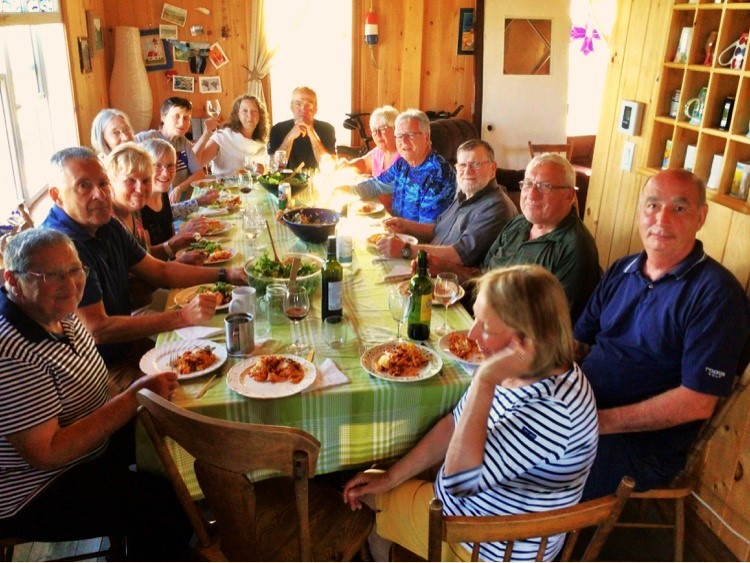
We visited Estelle Thériault and Marcel Eloquin at la Dune-du-Sud. We knew Estelle from time she spent working on our Island as a teacher assistant. That evening, we’d invited members of Martha’s family and friends for a supper of lasagna. As the photo shows, it was une belle tablée!

Elva and I left Bassin the next morning, but not before having breakfast at the home of Martha’s sister, Denise. She lights a fire in the back yard and invites family, friends, and neighbours to coffee every morning at 5:30! Stuffed, we said goodbye to Martha’s family and headed north on Route 199 toward our destination, Grande-Entrée.

Along the way, we stopped at the Cap-Dauphin wharf in Grosse-Île and at Old Harry, one of my favourite spots on the islands. The harbour at Old Harry was abandoned several years ago but on a clear, windy day, it offered  spectacular views of the capes and La plage de la grande échouerie, one of the islands’ many beaches, 300 kilometers or so of white sand as far as the eye can see. On a far sadder note, we came across two dead gannets half-buried in the sand and, to my shock and amazement, a nearby front-end loader holding a bucketful of the poor creatures, all dead from avian flu.


Our host for our last two nights on the island was Lucie Coulombe, a woman we’d met on a South Pacific cruise in the fall of 2019. She’s spent summers in Grande-Entrée since buying a house there some eight years ago. We drove to the wharf and watched lobster boats ride the pounding surf as they came into port with the day’s catch. Some 130 lobster boats fish out of Grande-Entrée, making it one of the largest commercial small craft harbours in Canada.

We drove down the Pealey Road and walked out to the point to watch wind and kite surfers and took these pictures, bracing against the wind.


Lucie and her partner, Jean-Rock, laid on a feast for us and three other friends from Québec, Josée, Jocelyne and Roger: smoked salmon and scallops and, of course, all the lobster we could eat, topped off by a dessert made of bread soaked overnight in maple syrup. All of that enjoyed in the comfort of Lucie’s gazebo as we watched the sun set over the Havre de la Grande-Entrée.

The next morning, Lucie gave us the grand tour of the community, including the ÎDM’s only roundabout, located strategically at the northern terminus of Route 199. Why? God only knows. We visited the Catholic church and the business where Jean-Rock works and saw a monstrous 50-foot fibreglass lobster boat being built there.

The neighbouring community, Grosse-Île, is English-speaking, one of only two on the ÎDM, the other being Entry Island. The English make up only 5% of island residents but they have their own school, their own lobster and crab processing facility, and Grosse-Île has its own municipal government.

We stopped at St. Peters Anglican Church and admired the display featuring photos of all the Magdalen Islanders lost at sea. Next, we visited the Little Red School where our excellent guide told us about island life as it was in the past. Then she led us to the Veterans Museum, the best display of its kind I’ve seen anywhere. It features photos and stories of all the Magdalen Islanders who served in the two World Wars. Next on Lucie’s list was a stop at Holy Trinity Anglican where we took in the beauty of the stained-glass windows above the altar. The churches, the old school and the museum are all projects of CAMI, the Council of Anglophone Magdalen Islanders. I wondered what impact Québec’s Bill 96 might have on a minority like them with such deep roots on the islands.


After enjoying a hearty lunch at the Fish Shack, I pedaled through the village and back along Route 199 through the Réserve faunique de la Pointe-de-l’Est and the village of Grosse-Île, past the Mines Seleine and the islands’ two lone windmills before turning back for home. We said our goodbyes to Lucie and Jean-Rock and thanked them for their amazing hospitality and for educating us on the realities of island life.

The next morning, we got up bright and early for the drive for the ferry at Cap-aux-Meules, where we rejoined Lise, Barry, Betty, and Ivan for the trip back to reality. The Madeleine II is an impressive ferry; very smooth, well-appointed, and with an excellent cafeteria.

We packed a lot into the days we spent on the ÎDM, Elva especially. It is a wonderful place to visit, better still if you know someone there. To the wonderful people who hosted us, laughed with us, and taught us about life on the islands, un gros merci et à la prochaine!