Wednesday, 24 February 2016


DOWN UNDER – PART 2

A day and a half was hardly enough to do justice to Melbourne, but we gave it our best.  It’s a very busy city, and the Sunday crowds on the sidewalks reminded us of rush hour in Manhattan.  We left early Monday morning, glad to get out into the countryside again.  Our fellow travellers hail from Scotland, France, Germany, Switzerland, Sweden, Austria, The Netherlands, Belgium, England, and Australia.
Our first destination on Day 1 of the Melbourne to Alice Springs Intrepid tour was the Great Ocean Road, billed as one of the world’s most scenic seaside drives.  It runs for 243 km along the coast and was built between 1919 and 1932 by 3,000 returned World War I servicemen as a memorial to fellow soldiers killed during the War.
We made several stops along the way to take in the highlights, including the Twelve Apostles, a collection of limestone stacks created by the powerful erosive action of the Southern Ocean waves.  Only eight of the original apostles remain, the others having presumably left the Church to follow someone else.  The photo below shows a few.

The unrelenting crowds were a real turnoff, especially the Chinese tourists who push and shove, their singular mission being to take pictures of themselves.  One can only wonder why.  We watched in amazement as six helicopters buzzed around, ferrying gawkers nonstop on ten-minute rides at $100 a shot!
Down the road from the Twelve Apostles, we came to Loch Ard Gorge, an enticing pocket beach reachable only by a flight of steep stairs.  Elva and I watched as the young members of our group were photographed by tour guide Dave while doing “The Jump”.  The photo below illustrates why we enjoy travelling with a younger crowd!
I compared the Great Ocean Road to ones we’ve travelled in Eastern Canada: the Cabot Trail; our own Gulf Shore Parkway; the Gaspé Peninsula; the Port-au-Port Peninsula in Western Newfoundland; and any number of scenic coastal drives on mainland Nova Scotia.  Australia’s is nice, but not as good as what we have on offer.  For me, the most compelling feature of the Great Ocean Road is rather the story of how it was built.

Dave promised we’d see kangaroos before arriving at our destination that first night.  As we hit the foothills of the Grampian Mountains, we saw groups of them in almost every field.  As we climbed, several ran across the road.  By the time we’d arrived in the village of Hall’s Gap, our destination for the night, they were everywhere.  Hall’s Gap has a human population of some 318 souls, and some 35,000 kangaroos!  You really have to watch where you walk!

Next morning, we rose bright and early for the drive up to a mountaintop lookoff.  The sight of the valley below was quite impressive, as were the howling wind and the 10 degree C temperature!  We walked down into a gorge to see the magnificent MacKenzie Falls before visiting an aboriginal cultural centre in Hall’s Gap where we learned the sad story of how the country’s original inhabitants were treated by European settlers.  In the early days, aborigines were considered non-human, and treated as such in every way.  Their story is an all-too-familiar reminder of how we treated our own First Nations in Canada.  And all of the present-day challenges our two countries face are the same.
After a six-hour drive through countryside that looks a lot like our Prairie Provinces, rolling past enormous herds of cattle and sheep, we arrived in the capital of the State of South Australia, Adelaide, a city of 1.25 million.  We checked into the YHA Hostel, our first official stay in a hostel.  There’s a first time for everything!  Actually, we spent a little extra for a private room with ensuite.  We’d heard too many horror stories from fellow travellers, unable to sleep a wink when forced to bunk in a dorm with an inveterate snorer.

We took it easy on our ‘off’ day in Adelaide, opting to take a walking tour of the city and hop on the free bus to get our bearings.  We had lunch at the cavernous Central Market and spent part of the afternoon people-watching on the pedestrian Rundle Mall, entertained by street musicians, buskers, and this couple who offered free hugs.  It was fascinating to see people come up to them.  Everyone smiled and left feeling better.  Adelaide ranks as our favourite city in Australia to this point in our journey.
I’d always wanted to go to William Creek.  There’s something about a place with a population of 12 that appeals to my curious and adventurous nature.  It wasn’t easy getting to William Creek.  We left Adelaide early and drove through wine country until we hit the prairie - vast fields of wheat as far as the eye could see.  Next came scrubbier land as it became drier and drier; the kind of stuff that supports only beef cattle and sheep.


Finally, we entered the Flinders Ranges National Park.  The bus turned into our campsite and our guide, Wayne, directed us to pick up our swags and select a place to sleep.  Reading the Intrepid trip notes, I naturally assumed that ‘camping’ meant in a tent.  Mistake!  A ‘swag’ is a heavy canvas bag - a bedroll, essentially - with a thin foam mattress inside and a plastic underside.  No tent?  No problem!
Picture La Reine du Barachois faced with the reality that she’ll have to sleep à la belle étoile!  I arrive with two sleeping bags to put inside the swag, at a cost of $30 each.  She says  spontaneously: “So much for the upgrade!”  Yep, c’est ça voyager avec Intrepid!”, I reply.  We shared a laugh and had to explain to our neighbours what was so funny.  It didn’t take her too long to adapt though.  You can’t be too fussy if you want to see the real Outback.
We went for a long walk around Wilpena Pound and climbed to a lookout that provided a spectacular view of the former cattle station.  The temperature hovered near 35 degrees C.  After a late supper, darkness was soon upon us and we crawled into our swags, not quite sure what to expect.  I stared at the stars, brighter and more numerous than I’d ever seen, and marvelled at the immensity of the universe.  It was the first time I’d ever slept without a roof of some kind over my head.  To my great surprise - and Elva’s - we got a decent night’s sleep.

Next morning, we saw wild kangaroos by the hundreds and emus by the dozen.  They were everywhere!  Most of our long 500-kilometre drive to William Creek was on a dirt road, the Oodnadatta Track.  The only time we saw pavement was in one of the small towns: Leigh Creek, deserted since the coal mine closed; Lyndhurst, home of an eccentric sandstone carver by the name of Talc Alf who’s declared his own republic; and Marree, where guys pass the time drinking beer in the only air-conditioned building in town, the Marree Hotel.  This was the Outback - the ‘Vastness of nothing!’, as our tour guide described it.
After a brief stop at Lake Eyre - dry, of course, for most of the year - we drove through more desert and arrived at the tiny hamlet of William Creek around suppertime.  There may have been a William, but there is no creek.  It was 42 degrees C!  We grabbed a cool drink at the iconic William Creek Hotel which features a dining room built of old railway ties.  After supper, it was time to slip into our swags for a second night under the stars.  We almost died with the heat until a slight breeze mercifully arose.  Both of us slept like babies.  I had to wake Elva!  Who would have known?
 
The flies woke us up.  Ah, yes, the flies!  Australia is as famous for its flies as my hometown of Wellington is for its mosquitoes.  These critters, slightly smaller than a housefly, are incredibly persistent, stopping at nothing to get at their target.  Not surprisingly in such an arid environment, it’s moisture they want, and they’ll get it from any available orifice.  A good reason to keep your clothes on and an even better reason to keep your mouth shut!  Like most of our fellow travellers, we had nets to wear over our heads.  Hellish hard to eat through though!
A short three-hour drive brought us to Coober Pedy, billed as the opal capital of the world.  On the way, we crossed the dingo fence, a 5,000-kilometre-long barrier that prevents dingos, a type of wild dog, from crossing between the north and the south of Australia.  The dingo is very destructive to sheep.

I think we should build a Trump Fence between Canada and the United States to keep ‘you-know-who’ out!

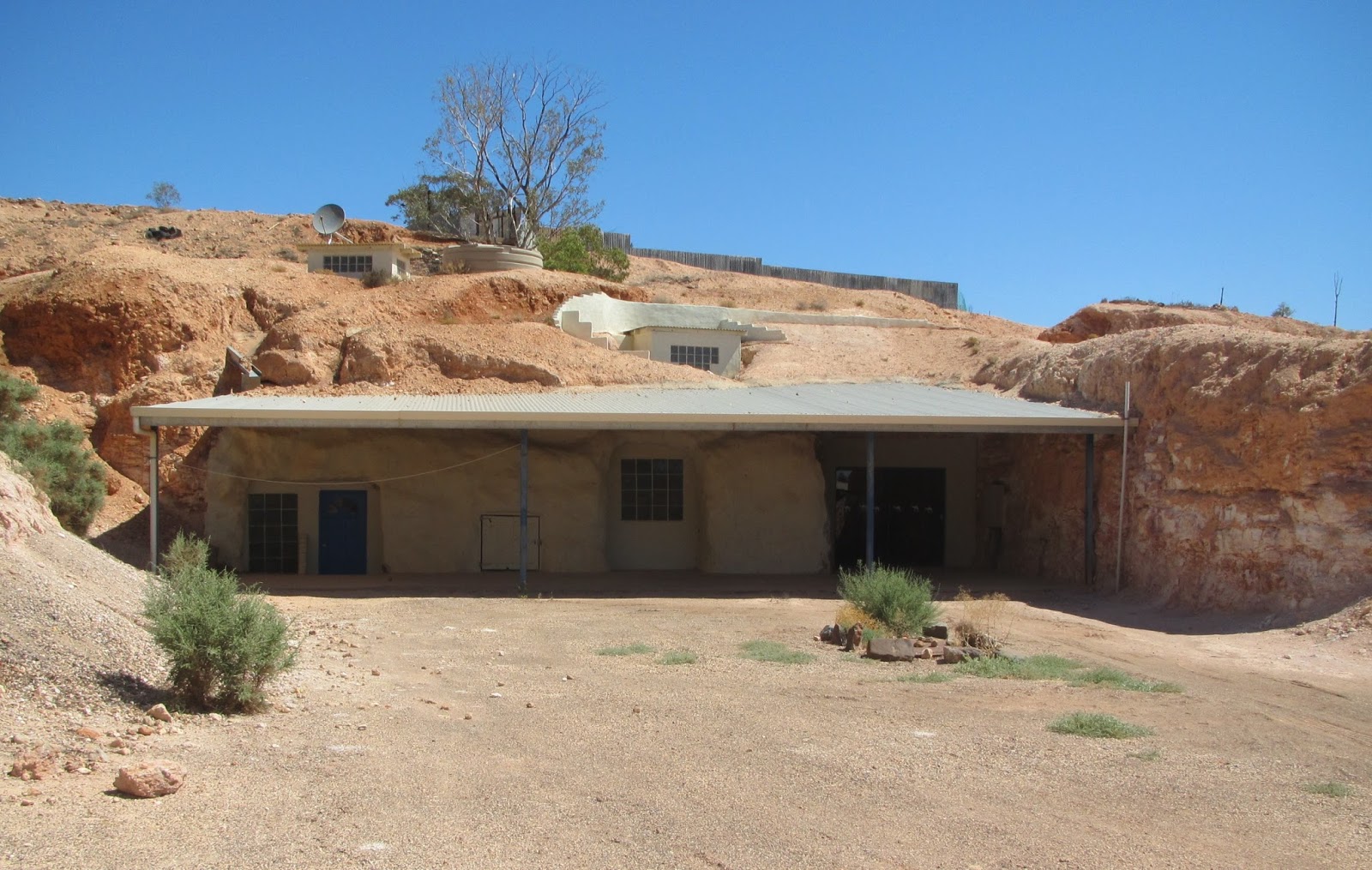
Because of the oppressive summer heat, more than half of the Coober Pedy’s residents live underground in abandoned mining shafts.  So, of course, intrepid travellers that we are, we slept underground too, in a bunkhouse carved out of the rock where the temperature is a comfortable 22 degrees C, summer and winter.  Again that afternoon, the mercury topped out at over 40 degrees.  Our tour guide explained that it has been a ‘mild’ summer, cooler than the normal 45-50 degrees C!  We were literally melting away, urged on by our guide to drink four litres of water a day to avoid dehydration, more if we’re active.
We travel in a sturdy four-wheel-drive diesel bus.  It’s hot and dusty and the road never seems to end.  We seldom meet a vehicle.  This proves to be a plus when someone needs to go to le petit coin.  Our meals are very basic since our driver is also tour guide and chef.  Everybody helps out with meal preparation and cleanup, and no one seems to mind the long days on the road.

Next morning, we rose early enough to see the sun rise over the desert at a place called the Breakaways Scenic Reserve, and made our way towards the iconic Uluru.  Back on blacktop again, we made good time, crossed into Northern Territory, and got our first glimpse of Uluru late in the afternoon.  Along the way, we passed through Australia’s largest cattle station, at 6 million acres almost four times the size of Prince Edward Island!

It almost never rains near Uluru, but it did the day we got there and through the night.  Creepy-crawlies like this poisonous ten-centimetre centipede I spotted in the men’s washroom leave their burrows to avoid drowning.  We were told that a sting from one of these things is like being seared by a hot poker.  I was mindful of this as I sat down to do my business, and got the hell out as quick as I could!
It’s best to get to the base of Uluru early: to see the sun rise; to beat the heat; and to beat the crowds.  It is a spectacular gift of nature; the World’s biggest monolith; the ancestral home of the Mala people; and a UNESCO World Heritage Site.  We walked the 11-kilometre trail around the base of the rock, watching its colour change depending on the angle of the sun.  Our guide took us on a cultural walk, explaining the significance of the sacred site to the Anagnu people.  This proved to be just as interesting as the views of Uluru itself.  We spent eight hours at Uluru and saw it from all angles.  It is magnificent.
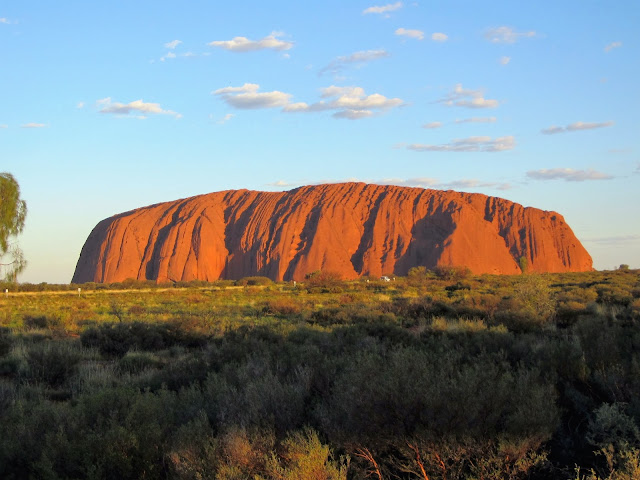
Up at 4:15 next morning to walk at Kata-Tjutu, Uluru’s next-door mountain cousin.  We did a six-kilometre hike and, by the time we got back to the parking lot at 10:00, the temperature was in the high 30s.  The trails close when the mercury hits 36 degrees C.  I’ve never drank as much water in my life: five or six litres a day!
A long drive brought us to Kings Canyon where we settled in for our last night of camping, and our last group dinner.  Our campsite couldn’t have been much farther from civilization.  We saw dingos (wild dogs) on the way in and had to keep our food away from them.  We had a really rough night.  The temperature didn’t drop below 27 degrees and it was humid.  We tried to sleep but, with no ventilation of any kind, it was stifling.  No one slept more than an hour.

Never mind, breakfast was at 4:45.  Then, the drive to the Canyon and our six-kilometre hike up to the rim where the views were spectacular.  After an early lunch and a six-hour drive, we finally arrived in Alice Springs, a nice city of some 28,000, right in the heart of the continent.  We checked into our hotel and turned on the air conditioning.  No alarm clock tomorrow.  Time to get some clothes washed and rest up before beginning our West Coast adventure.

Saturday, 13 February 2016


DOWN UNDER – PART 1

We left Fort Myers on January 31 and drove the four hours to Orlando, boarded our flight to Toronto and finally hit the sack around 1:00 am.  Lucky for us, we spent a very pleasant one-day layover in Toronto with old friends, Joanne Best and Del Zelmer.  I’d worked with Del in the mid-70s during our Toronto adventure, and Elva and I spent many memorable weekends at his dude ranch north of the city while there.  Although we hadn’t seen them in years, we picked up where we left off, as if time apart meant nothing.
After a gruelling twenty-two-hour flight from Toronto, via Vancouver, we set foot on our sixth continent and forty-sixth country on the morning of February 3.  We lost a day crossing the International Dateline but will get it back in March.  We were amazed by the efficiency of the new E-Passport system at Sydney Airport.  The journey from aircraft to arrivals hall - with our luggage - took no more than fifteen minutes.  “Like shit through a goose!”, as they say.
Australia is a huge country, about the size of the continental United States, and is home to some 23 million people, about two-thirds the population of Canada.  the continent’s first inhabitants, the Aborigines, arrived here by sea more than 60,000 years ago.  The first European colonists came in 1788 on eleven ships: 750 convicts, 201 British marines, and 40 women and children.  It must have been one hell of a place in the early years!
No sooner checked in to our hotel, we donned our walking shoes and set out to explore downtown Sydney.  On our first jet-lagged day we at least wanted to make it to the waterfront and see the iconic Sydney Opera House.  It was worth every step!  We found Sydney to be a very busy city, not surprising given that it has five million people - just a bit smaller than Toronto.  It is also very expensive: $5 for a coffee, and most meals near double the Canadian price!
On Day 2 we awoke to a steady rain.  But, as they say: “There’s no such thing as bad weather, just the wrong clothes!”  We took a walking tour of the city, presented masterfully by an ambitious young woman who knew and loved her city.  By mid-afternoon - Elva’s birthday - we’d seen most of the highlights and knew what we wanted to visit our second time around in March.  That evening, we ate at a busy Thai restaurant and thoroughly enjoyed their spicy fare.
Next morning, it was on to Hobart, the capital of Tasmania.  Driving in from the airport, we were struck by how the topography and vegetation reminded us of the Okanagan Valley of southern BC.  The city’s 200,000 residents make up about 40% of the island state’s population.  After checking in to the luxurious Grand Chancellor Hotel, we explored the waterfront as well as the old neighbourhood called Battery Point, admiring the many charming cottages overlooking the harbour.
On our second day in Hobart, we once again explored on foot, going first to the war memorial, then to the Royal Tasmanian Botanical Gardens where we witnessed beauty rivalling that of Vancouver Island’s Butchart Gardens.  Elva spent part of the afternoon wandering through the bustling Salamanca Market.  It was a long weekend in Hobart, with plenty to see and do and lots of people around.  We’d have liked to rent bikes to see more, but ran out of time.
Next morning, bright and early, guide Jerry of our tour company Under Down Under, picked us up at the hotel.  I could tell right away from her beautiful smile that we were in for a good trip.  She would be our driver, tour guide, and cook - and good at all three!  We drove up the Derwent River Valley and followed it all the way to its source, Lake St. Clair, crossing into Lake St. Clair – Cradle Mountain National Park where we walked to Russell Falls.
Our route, the Lyell Highway, was built during the Great Depression as a public works project.  The terrain is rough and hilly - said to be one of the largest temperate rain forests left on earth - and it reminded us of the Cape Breton highlands.  Tasmania has put a premium on conservation, and 45% of its land area is under some form of state or national protection.  The National Park we visited is listed as a UNESCO World Heritage Area.

After a very long day on the road, we arrived at our destination, a charming, isolated seaside town called Strahan (pronounced Stron) on the rugged, sparsely-populated west coast.  That evening, we enjoyed a barbecue and took time to meet our fellow travellers.  As is usual with Interpid tours, they hail from all over the world: Ireland, England, Wales, Australia, United States, Taiwan and China.
After our meal, we made our way to the little brook a short distance away and looked for the resident platypus.  Although he (or she) didn’t show up, a lady I met showed me a video she’d made the evening before.  The duck-billed platypus is a strange creature, with the body of a beaver, an otter’s paws, and a bill just like a duck’s.   The platypus and its cousin, the echidna (shown below), are the only mammals that lay eggs instead of giving birth to live young.  And that’s the answer to today’s trivia question!


On day 2 at Strahan, we set out for Montezuma Falls, at 150 metres, the tallest in Tasmania.  We walked about 5 kilometres along an old railway bed to get there, crossed over a swing bridge, and took in the impressive sight of the cascade.  There were only two other people there.
On the way back to Strahan, we stopped at the Henty Dunes, and climbed the 30-metre sand wall on all fours to capture a spectacular view of Ocean Beach.  That evening, we attended a play, The Ship That Never Was, where I finally received much-craved recognition and took my rightful place in the captain’s chair!
Our next destination was Cradle Mountain, the main attraction in the northern sector of the National Park.  Jerry suggested we climb to the top of Marion’s Lookout where we’d have the best view of the valleys and lakes below, and of Cradle Mountain itself.  The last fifteen minutes or so was a tough scramble.  I arrived at the summit, only to meet a group carrying huge knapsacks; on a six-day hike, complete with tents, sleeping bags, and food.  Next thing I knew, a father strolled up the path carrying his one-year old daughter in a sling.  Humbling!
After a couple more stops, we arrived in Launceston, the end of the line for day 3.  It’s Tasmania’s second-largest city.  Our guide could have hyped it up to the max and it wouldn’t have made any difference.  We were just too tired to take much of it in.

Next morning, we were off again, heading towards the East Coast and our destination of Bicheno.  Along the way, we stopped in the pretty farming town of Sheffield, walked down to St. Columba Falls, Tasmania’s second-highest waterfall, and went for a swim at Bay of Fires.
We saw a couple of wallabies spring across the road in front of us.  The crows here are very well fed.  There’s roadkill everywhere.  One of my all-time favourite animals, the fearsome Tasmanian devil, just loves roadkill, and sometimes pays the price for its gluttony!

The first highlight of day 5 was Freycinet National Park, where we hiked a beautifully-built trail up over an isthmus and down to Wineglass Bay.  Its picture-perfect beach is reachable only on foot.
Next, we visited a place I’d been looking forward to: the Bonorong Wildlife Sanctuary.  It features a number of uniquely Tasmanian species, including the devil himself!  Like most people my age, I first became acquainted with this fearsome fictional creature through the Bugs Bunny cartoons.  Only later would I learn that the Tasmanian devil really exists.

Bonorong is home to some twenty devils, some of them hand-reared from birth.  In the wild, they are carrion eaters, consuming any dead animal they come across - hair, bones and all.  Unfortunately, a cancer called Devil Facial Tumour Disease has spread through natural populations and threatens the animal with extinction.  I sincerely hope they will develop a natural resistance before it’s too late.
On the last day of our tour, we drove from Hobart to the Tasman Peninsula, home of Tasman National Park and the UNESCO World Heritage Site of Port Arthur.  From 1833 until 1853, its penitentiary housed the hardest of convicted British criminals, namely secondary offenders who re-offended after their arrival in Australia.  Rebellious personalities from other convict stations were also sent here.  In addition, Port Arthur featured some of the strictest security measures of the British penal system.

On the eve of our departure, as we sat on the Hobart dock eating fish and chips and the best calamari I’ve had in a long time, Elva and I reflected on another amazing experience.  Yes, the days were tiring, but we’d seen and done so much, and met interesting people along the way.  Every day, we logged over 12,000 steps on Elva’s Fitbit - two days over 25,000.  We kept up with the younger ones and had a great time.

Next, it was onto Melbourne, Australia’s second largest city, where we spent a day and a half taking in as much as time would allow.  On our first day there, we boarded the Circle Tram and toured the downtown area, getting our bearings.  The Saturday crowds were buzzing.  We watched the sunset at Federation Square, a beautiful public space beside the Yarra River.
The next morning, we set out on foot to visit some of the attractions we’d seen from the Tram.  Melbourne doesn’t have as nice a harbour as Sydney, but Port Phillip Bay is quite nice and Middle Park Beach is a great spot for people-watching.  There are public parks and gardens everywhere, all of them lovely places for a stroll.  We enjoyed Melbourne and would have stayed longer.  But, it was time for our next adventure: the Intrepid 10-Day Melbourne to Alice Springs Explorer.

Sunday, 31 January 2016

FLORIDA

Old Man Winter held us in his grip for as long as he could!  We left home at 6:00 am on December 28 - in a snowstorm.  I forked over my $45.50 to cross the Confederation Bridge, secure in the knowledge that, thanks to the good offices of our intrepid Senator Percy Downe, I’d never have to pay again!  By the time we got to the Port Elgin roundabout, things were looking grim - drifting snow and not a plow to be seen - and we considered stopping in Moncton until the weather cleared.  

But the forecast said an intensive system would pass through New England the next day.  What to do?  By the time we hit Magnetic Hill, things were better, a little slush on the Trans-Canada, but nothing too serious.  I carefully picked my way through the slower traffic.  I’d thought we’d be lucky to make Hartford, CT, that first day, and split the trip into three more or less equal segments.  But we decided to go another three and one-half hours to Wilkes-Barre.

Morning came too early after our long first day, and it looked none too promising.  Sleet was on the menu, for at least the first hour.  Our objective for day two was Savannah, GA.  That would mean a relatively easy day three, with an ETA of mid-afternoon in Fort Myers.  Alas, as the poet Robbie Burns wrote: "The best-laid plans of mice and men gang aft agley!"

Things had cleared up nicely as we neared Charlotte, NC.  We’d experienced a 25-degree change in temperature in the space of eight hours!  Then, the traffic jam to end all traffic jams!  Bumper-to-bumper for 40 km or so until it finally broke.  Then, more of the same as we drove through Charlotte at rush hour.  After another hour or so, we’d had enough and called it a day.

Day 3 started rainy, but traffic was light.  For a while, at least.  Not long after we rejoined Interstate 95, we were down to a crawl again.  And it was that way for most of the day.  Who would have thought that so many people would be on the roads on December 30?

We arrived in Fort Myers around 8:00, found our condo and unlocked the door, only to find somebody was already there!  Could it get any worse?  Due a communications mix-up, the owner’s son was staying a few days in Fort Myers.  So we staggered into another hotel room, hoping it would be our last for a while.

Next morning, we drove to Sanibel Island and spent a good part of the day there.  The island is an up-scale haunt for the rich and for well-heeled vacationers, reminding us of Hilton Head Island, SC.  But the place was so crowded that we couldn’t find a parking spot at any of the beaches.

After loading up on groceries at Costco, we hauled our belongings to the condo, spent the New Years Eve getting things in order, and were both in bed by 9:00.  Over the next few days, we explored downtown Fort Myers on foot, locating our favourite hangout, Starbucks.  One day, we cycled on Pine Island, a funky, toned-down version of Sanibel.  Another, we pedaled along broad boulevards with nice bike lanes.

We’d wondered how big a bite the plunging Canadian dollar would take out of our budget.  Well, the cheapest gas we bought on the way was about $0.60/litre Canadian; here it’s about $0.65.  Compare that to the $0.90 it costs at home.  Groceries are definitely cheaper here, especially fruits and vegetables, but accommodations are way more expensive because of our low dollar.  Bottom line, enjoy the weather and forget about the exchange!

I met up with a group of local cyclists, the Caloosa Riders, soon after we arrived.  Most of them are here for the winter, although there are a few year-rounders.  I’d be about average in age for the group.  Many riders are over 70, and still in very good shape.  Some like to ride hard - very hard - often in the 35 to 40 km/hr range.  The fastest I clocked was 49!  That the terrain is flatter than the Miscouche swamp makes it easy to pedal aggressively.  Since we ride early in the morning, wind is not usually a factor.  

I’d planned to ride 400 km while here but had met that goal after only eight days!  All told, I racked up about 1,200 km while Elva put in a very respectable 500 or so.  Only bad weather prevented us from doing more.

Elva joined us for several rides and, despite some initial trepidation, became quite accustomed to the routine.  Riders here are generally quite experienced and know how to ride in a group.  Everyone uses flashing lights, front and back.  We’d gotten our own, from Santa, and so fit right in.

Mid-month, we participated in the Tour de Cape ride in nearby Cape Coral.  Elva did the 50 km circuit and I did the 100 km.  It was a tough day, with winds gusting to 50 km/hr, but we did it.

The condo we’re staying in is centrally located and close to downtown Fort Myers.  It’s a modern building, quiet and well equipped, and folks here are friendly.  The city actually has a historic downtown.

Other places we’ve visited are indistinguishable from one another - just a long, continuous strip of malls, condos, fast food joints, and gas stations.  Nothing to make you want to stop and take a stroll.  We’ve been to the motorcycle show on the main drag, and a festival featuring all things ‘bacon’; some of them good, some hardly fit to eat!  There’s a wonderful exhibit of outdoor art, featuring 25 metal sculptures by a Columbian artist.  All part of the experience.

Point is, there are things to do here and the place has a nice, gentle buzz.  Between cycling, walking, beaching, exploring, and going to the cinema (Concussion, The Revenant, Brooklyn, Room), we’ve kept quite busy.  We took a few road trips to visit relatives and friends in Largo and Fort Lauderdale, and to do a little exploring in nearby Naples.  The routine here reminds us of Island living in the summer, and it’s a hell of a lot better than shoveling snow.

One fine Saturday, we parked the car and walked across the bridge to Fort Myers Beach.  There were more people on the beach than I’ve ever seen, anywhere.  More than Union Corner, or even Red Rock Beach in its heyday!
It didn't take us long to figure out that Fort Myers is the "Poor Man's Naples".  The mansions we saw on our day trip to Naples make Mary Jean Irving's place look like a baby barn!

And the guy putting up this tar-paper shack ain't on EI, that's for damn sure!

A Spaniard by the name of Juan Ponce de Leon explored and named Florida in 1513.  It’s said by some that he was looking for the ‘fountain of youth’, a spring supposed to restore anyone who bathes in or drinks its waters. 

He didn’t find the elusive fountain, but I’ve seen proof of it here with my own eyes: the guys I’ve been riding with these last couple of weeks.  The oldest one I know of is 81!  He rides the 55 km route at least twice a week.  Another guy looks older still.  Elva and I regularly see 80-year-olds out for brisk walks.  Those I’ve spoken to, including Cousin Noëlla, swear by the restorative powers of the Florida winter.  I now believe it!  

None of us has the power to stave off death but we might, through our choices, delay the aging process.  I think we'll be back!

Thursday, 17 December 2015

REFLECTIONS ON CHRISTMAS

Jean-Paul

It started early every year for me.  While I recovered from the shock of the end of summer freedom, that long-awaited event arrived: the coming-in-the-mail of the Eatons and Simpsons-Sears Christmas catalogues! 

Even before I stopped ‘believing’, Mom let me choose one gift from the catalogue and fill out the order before sending it off.  When the precious parcel finally arrived, I’d unwrap it, just to make sure they’d sent the right thing.  Then look adoringly at the unopened package every day, barely able to contain myself.

Cousin Aubrey exploded the Santa myth for me when I was nine.  One day, he casually told me: “Santa Claus isn’t real, you know!”  Because he was four years older, and seemed to know everything about anything, it was enough to sow doubt in my mind.  When he showed me his presents from Santa Claus in Cliff and Tina’s attic, well, the jig was up!

In this blog, I’ll explore my own reflections on childhood Christmases, adding wonderful vignettes from Elva’s early years.  As adults, we’re all marked by childhood experiences, whether we want to admit it or not.  And so it is with Christmas memories.

My maternal grandmother died when I was six.  After that, Mom and I spent Christmas alone.  As the manager of the Wellington Coop, she worked long hours in the weeks leading up to the Holiday Season.  By the time it came, she was usually exhausted.  While she kept on a brave face, I could always tell it was a hard time of year for her.  Especially on Christmas Day, when we sat at the dinner table, just the two of us.  I could tell she was missing loved ones who weren’t there.

Now, I had my own theory on why she was so tired: too much damn church!  Yes sir, the Catholic Season of Advent was the price a little boy like me had to pay before enjoying the rewards of Christmas.  There was just no getting around it.  As if Sundays, first-Fridays and Holy Days of Obligation weren’t enough, it seemed like we were parked in a pew every day for the whole month of December, listening to Father MacDonald drone on about prayer and penance!

December also brings back fonder memories of recipes made on the kitchen table and of things baking in the oven.  Mom was a good cook and especially liked to get things ready for Christmas: pâtés, gum drop cake, fruit cake and, my favourite, shortbread (she called them ‘Scotch cookies’).  I can still smell them, and I’ve never tasted better!

When Christmas Eve finally came, the wait was worth it.  After supper, Wilfred Arsenault, my godmother Fedora’s husband, brought me one of my favourite gifts.  Our tradition had us opening gifts before Midnight Mass.  As soon as the dishes were done, to the parlour we went, the two of us, and dug in to the pile under the tree.

Mom always got me something special, “from Santa Claus”, she’d say.  There were always presents from my aunts and uncles - clothes, mostly - and a book from Aunt Josie.  “Why couldn’t she get me something I like,” I’d think as I tore the paper off the tell-tale package.  And, every year, the box of Moirs Pot of Gold chocolates from Linus MacDonald.  Seems my father, when he’d been in politics, had helped Linus land the job of postmaster in Richmond.  Whatever!  Chocolates never tasted so good!

Then it was off to Midnight Mass, where Mom and the Gaudet Girls, sisters Bernice and Tina, sang in the ladies’ choir.  I hated getting there early.  It meant I’d miss seeing the ‘heathens’ who occupied the back row - “Christmas and Easter Catholics”, a saintly neighbour called them.  If I was lucky, some would make their way up to Communion, and I’d be able to guess who’d “Had a few.”

Then came Mom’s turn to sing her solo, O Holy Night.  Aunt Tina played the organ and Aunt Bernice directed the choir.  Yvonne had a beautiful voice.  With Communion over, everyone sat quietly while she sang the verses in English and French while the full choir repeated the chorus.  The memory of it still gives me goose bumps.  That, to me, was the best part of Christmas!

Elva grew up in a very different environment,with loving parents, making those childhood Christmas memories with brothers and sisters, two grandmothers and a great-aunt.

Elva

I have such wonderful childhood memories of the Holiday Season; engraved in my mind’s eye, as if from yesterday.  I’d like to share with you my collection of images of Christmases past, from the years before my youngest brothers and sisters - Carmen, Lionel, Lucille, and Alice - were born.  (The photo below shows Marie-Rose à Félicien, Mémé Lalie, Maman Aline, Rose, me, Mémé Mélanie, Albin, Félicien, Alfred, and Papa Joseph.)


The Christmas concert at Saint-Chrysostôme School in 1958

Scene 1    Beautiful drawings of Christmas scenes, in coloured chalk, decorate the blackboard in the ‘big school’, la classe des grands.
Scene 2    Grade 1 pupils chant enthusiastically: C’est Noël, c’est Noël, la fête la plus belle…  From left to right are my classmates: Maurice à Frank à Xavier, Marcel à José à Philimon, Peter à Théodore à Pierre, Albina à Alphonse à Pierre, Yvonne à Alyre à Théophile, Barbara à Elzie à Gil, and me, Elva à Jos Denis.
Scene 3    Near the front door, Santa Claus, surrounded by children, hands out small brown paper bags filled with candy.  Mémé Lalie, Mémé Mélanie and our neighbour, Eufrida à Victorin, also appear in this scene.

Picking the Christmas tree in 1959

Scene 1    Hitched to the two bob-sleighs, our horse, Prince, stands quietly on the trail in our woodlot.
Scene 2    My father, Joseph, cuts the balsam fir; the one I like the best.
Scene 3    The bob-sleighs are piled with logs and we sit atop them.  Sitting in front, my father holds the reins, while Alfred and me hold the tree.
Scene 4    My mother, Aline, and my grandmother, Mélanie, who lives with us, greet us at the door.

Presents from Santa Claus in the early ‘60s

Scene 1    Alfred, Rose, Albin and me lie on our stomachs on our toy sleighs as we speed down the snowbank in front of our house.  The full moon lights the way on this Christmas night.
Scene 2    From left to right, Albin, Rose, me, and Alfred, sit impatiently on the ice of the little brook near our neighbour’s, Étienne à Jack.  My father helps us lace up our brand new Christmas skates.
Scene 3    Alfred carries his little hammer, his saw, and the newspaper rack he’s made.  The pattern includes scrolls that were hard to cut out.  Alfred is very proud of his accomplishment and happy to show it to us.
Scene 4    Rose and me, wearing high heels and cradling our dolls, attend mass in Albin’s bedroom.  He wears his little chasuble and prayer shawl, both gifts from Santa Claus.

The lesson: Appearances can be deceiving!

Scene 1    My father arrives home from the Post Office in Richmond, carrying the big box sent by Honoré.  Honoré is my mother’s adopted brother.  An orphan, he was raised by my grandparents.
Scene 2    On either side of the big box, my mother places many other presents under the tree on this Christmas Eve.
Scene 3    Albin, Rose and me examine and shake them, trying to guess what’s inside.
Scene 4    Rose and me are crying.  We’re sad because we’re getting a very small present from our parents.  Albin and Alfred, them, have a big present from Maman and Papa.
Scene 5    After supper, we open several gifts, including those that made us cry.  What a surprise!  Rose and me proudly hold our new embroidery kit.  As for Alfred and Albin, we can read the disappointment on their faces.  On my grandmother’s too.  She didn’t know what my brothers would get as their joint present.  It’s a piss pot!
Scene 6    Standing in the doorway of the living room, my mother explains: “I just wanted to make sure there were lots of presents to open this Christmas!”
Scene 7    Christmas morning, we discover that Santa Claus brought us more presents.  Everyone is happy!

I don’t remember all the presents we got from Santa Claus that Christmas.  But I do remember the lesson: Appearances can be deceiving!

At Saint-Philippe-et-Saint-Jacques Church in the early ‘60s

Scene 1    It’s New Years Day!  Even Prince has his best bridle on for the drive to church.  “Did you put on his bells?”, my mother asks.  “Of course!  We have to start off the year right”, answers my father.  Mémé Mélanie climbs into our red sleigh first.  Next, the children, then Maman and Papa, all snug under the ‘buffaloes’.  Serenaded by the sound of the bells, we enjoy this wonderful sleigh ride.  Just before we get to Gus à Clovis’, the majestic and beautiful Egmont-Bay Church comes into view.

Scene 2    Upstairs in the choir loft, Jos Manuel, Cyrus à Jos Manuel, Eddy and Amand à Arcade, and Alyre à Philippe Marc, sing Christmas carols.
Scene 3    I place pennies in the angel bank that stands at the front of the crèche that Christmas morning.  I’m fascinated because he thanks me by nodding his head.  The figures in the crèche rest comfortably on what look like big boulders.

Holiday Season, from December 24 to January 6, Feast of the Kings

Scene 1    A card party.  From left to right, Albin, Aunt Madeleine, Benoît Cormier, Zélica à Étienne, Alfred, Délina à Benoît, Étienne à Jack, and Uncle Gus.  We don’t have electricity.  A big lantern lights the kitchen.

Scene 2    Uncle Franky, Uncle Léo, Uncle Albert and my father play crokinole in the kitchen this New Year’s Eve.  (In the photo, Uncle Franky is second from the left in the back row, and Uncle Léo is next to my father in the middle row.  Others in the back row are Uncle Willie, Aunt Hélène, Mémé Lucianne and Pépé José, and Uncle Levi.  In the front, Uncle Peter, Uncle Albert, and Uncle Edward.)

Scene 3    The table overflows with food for the evening’s ‘lunch’.  There are different kinds of sweets: doughnuts, date squares, cranberry squares, sugar cookies with icing on top, a fruit cake.  Delicious pâté is also on the menu for this special occasion.
Scene 4    Our neighbour, Corinne à Alyre à Théophile, and her three daughters, Yvonne, Edna, and Bella, admire our Christmas tree and our presents on this beautiful winter afternoon.

In our home, when I was a little girl, the days leading up to Christmas and all during the Holidays were filled with joy.  My parents, Joseph and Aline, loved this time of year.  It was the same for my grandmother, Mélanie.  Since they loved company, we always had a houseful.  Neighbours, friends and relatives came to visit during the Holidays, and we did the same.

From a young age, we children were involved in all of the family’s daily activities.  Our contributions to household and farm chores were much appreciated.  Come Christmas, presents from Santa Claus were our parents’ way of thanking us.


The Holiday Season is a time for enjoyment.  And, yes, Santa Claus always brings a surprise for child and adult alike.  Even if Christmas is more commercialized these days, this time of the year continues to amaze me!