Sunday, 24 November 2013


EUROPEAN VACATION – WEEK 9

We’ve gone from warm to cold, from dry to damp, and from ship to shore, all in the space of one week!

Last Sunday, we were basking in the 26-degree sunshine of Analya, Turkey, climbing to the top of the walled fortress and strolling along the beautiful seaside promenade.  Analya is on the “Turkish Riviera”, a beautiful stretch of coastline on Turkey’s southwestern Mediterranean coast.  A stretch of sand there called Cleopatra Beach is considered one of the most beautiful in Europe.  I must admit that it ranks right up there with Basin Head, number one on my list.

 
As we strolled along the main drag by the bay after I’d taken a dip, Elva ducked into a few hotels to check out the prices.  To our great surprise, we could have stayed in one of the best hotels in Antalya for about $85 that night, including breakfast and dinner!  Definitely a place to consider, if we ever come back this way.  The people are friendly and we didn’t get the impression they were out to get our money any way they could.

 
After Antalya, we had a quick stop in Cyprus.  We didn't see much of interest in Pafos, except some intricate and beautiful mosaics from the 2nd century A.D.  I snapped a photo of this fit-looking tour boat.  The sign says: Luxury Unforgettable Sailing.  I can just imagine!
 
 
Our last day aboard was a sea day.  We made the best of it, taking a tour of the massive galley, and dining à la grandeur in the luxurious dining room on our last evening.  Being on board for forty-two days, we got to know many of the crew members on a first-name basis, and many of them reciprocated.  The kitchen staff are almost all Filipino, and the rest of the crew is Indonesian, many of them from the Island of Bali.

All crew members are highly skilled at what they do, and very friendly to boot.  We got to know our cabin stewards best: one was from Bali; the other from the Island of Celebes in Indonesia.  They work 11 hours a day; 7 days a week; 8 months on; 4 months off.  I didn’t dare ask how much they made; I’d probably have been shocked at the number.  Suffice to say we left them a generous tip.

On average, the ship carries 1,300 passengers and has a crew of 600.  Of these, 100 work in the kitchen and about the same number work as servers in the various restaurants.  Each week, passengers and crew consume 1,700 pounds of meat, fish and seafood; 12,000 pounds of fresh vegetables; 18,000 pounds of eggs; 2,900 pounds of flour; and 20 pounds of caviar!  It’s no wonder people gain weight!

We ended our cruise on Wednesday morning when the MS Rotterdam docked in Athens.  We hung onto the rails on the gangway by our fingernails, but the crew threw us off!  We flew from Athens to Rome, arriving mid-afternoon, and took the train and the subway to our comfortable apartment near the Vatican.  We were met by our host, Fabianna, and settled in for eight nights here.

On our first full day in Rome, we started by putting on a few extra layers of clothes and walked around Vatican City, arriving eventually in massive Saint Peters Square.  Vatican City State was established as an independent country in 1929 and, at just over 100 acres, is the smallest country in the world.  Pope Francis is not the President; Cardinal Giuseppe Bertolo holds that position.  The Pope is considered however to be the Head of State, and the Vatican is an absolute monarchy.

The Vatican has a permanent population of 800, 450 of whom hold citizenship, and a staff of 2,500 or so.  It has its own post office, publishing house, bank, Corps of Gendarmes, state department, and department of international relations.  The Pontifical Swiss Guard (those funny-looking soldiers with the orange and navy blue vertical stripes) has been guarding Popes since the early 1500s.  They must be Catholic, unmarried males with Swiss citizenship to qualify.

From the Vatican, we walked past the massive Castel Sant-Angelo and across the Tiber River, heading in the general direction of Piazza Navona.  Along the way, we entered several churches to take in the magnificent interiors, each one containing several chapels with ornate sculptures, frescoes and gilded moldings.  By far the most impressive was the Church of Saint Ignatius of Loyola.  Like many churches in Rome, we considered this one ‘over the top’.

 
Then, it was on to see one of my favourite buildings in the whole world: the Pantheon.  This magnificent structure was completed during the reign of the Roman Emperor Hadrian (my favourite Roman Emperor) about 126 A.D.  It is one the best-preserved structures from the Roman era and has been in continuous use for almost 1,900 years.  Its dome is still the world’s largest unreinforced concrete dome, measuring an astounding 43 metres in diameter, and 43 metres in height.

 
The next day, we walked to the district of Trastevere.  Unfortunately, the weather didn’t cooperate, and so we didn’t see the place at its best.  We did visit a few churches, including Saint Bartholomew, Saint Cecelia, and Santa Maria in Trastevere.  The steady rain that began on Friday dogged us for the next two days.

On Saturday, it was time to visit the Vatican Museum.  We bought a guided tour and set off with a group of 23, trying like hell to keep up to our guide through the most incredible crush of people I’ve ever been in; worse than the New York subway at rush hour!  In fairness to our very capable guide, she had to squeeze a three-hour tour into two hours because the Basilica was closing early that day.  We did our best to take it all in and did get a few nice pictures; not allowed in the Sistine Chapel, unfortunately.


This morning, we awoke to clear skies for the first time in five days!  But, it was only 8 degrees and ‘raw’.  We knew the Pope was saying Mass in Saint Peters Square at 10:30 and we wanted to be there in time to get a good seat.  As it turned out, we got to the square at 8:30 and took our places, trying our best to keep warm before the ceremony started.  The square filled up quite quickly.  Judging by the many flags in evidence, people were there from all over the world; even a contingent from the war-torn country of Eritrea.

 
Those of you who’ve read my blogs may find it surprising to learn that I’d wait two hours in the freezing cold to attend Mass.  Well, the only way I can explain my motivation is to say that, curiously, it’s one of the things on my bucket list.  Being there, in the presence of as many as 60,000 people, all of them quiet and respectful, all of them wanting to see Papa Francesca in person, I found quite moving.  

Since it marked the end of the year of the Faith and the day Saint Peter’s remains were put on public display for the first time, most of the Cardinals were there, as well as representatives of allied faiths such as the Greek and Russian Orthodox Churches.  I’m not a great admirer of the Catholic hierarchy, but I do like Francis I, and I wish him well.

In the afternoon, we walked to Piazza del Popolo, and down the Via del Corso toward Piazza Venezia.  Along the way, we visited the Spanish Steps and the magnificent Trevi Fountain.  Along a three-block stretch between Piazza del Popolo and Via del Corso, we counted five churches!  We counted three more on the way to the Spanish Steps.  When in Spain, the boys and I decided Spain has too many roads.  Elva and I decided Greece, Turkey and Cyprus had too many ruins.  Well, Rome definitely has too many churches!

 
After seeing as many as we have in the past four days, we’ve concluded that these churches were not built for the right reasons.  How does one justify eight magnificent churches in an area measuring six blocks by six blocks?  Were the old ones at capacity?  Were they ready to fall down?  More likely, they were built to glorify a person, somebody who wanted his name above the door. 

To illustrate my point, on the face of the Trevi Fountain, one finds the engraved names of three Popes: Clement XII, Clement XIII, and Benedict XIV.  Did they pay for the privilege, I wonder?  Not likely!  There are buildings, statues and arches with the names of Popes spread all over Rome.  They remind me of dogs marking their territory!

 
Still, Rome is a city of wonders, and the food is great.  We have a few left to see, including one of the Seven Wonders of the Modern World, the Colosseum.  I’ve seen it before, but I can’t wait to show Elva.  And then, later this week, it will be off to Paris and home; the end of our magnificent adventure!  Along the way, we've visited 15 countries and 21 UNESCO World Heritage Sites.


Saturday, 16 November 2013


EUROPEAN VACATION – WEEK 8
 
Every day, the crew changes the floor mats in all the elevators.  The mats tell us what day of the week it is; otherwise, we might not know.  This week began in Athens when the third leg of the cruise ended and our last one began.  We decided that our theme for this leg would be: ‘independent travelers’.  In other words, we’d search for things to do on our own as opposed to opting for the generally overpriced Holland America excursions.
 
We started by taking the subway into Athens from the port city of Piraeus.  In the city centre, we visited the National Gardens, took in the finish of the Athens Marathon, and visited the Temple of Zeus and Hadrian’s Gate.  The photo below shows the temple of Zeus with the Acropolis in the background.
 
 
On our way back to the square where we were to pick up the subway, we came across a tiny Greek Orthodox chapel, tucked in under a modern office building, on the corner of a busy street.  A plaque on the little church said it had been built in the sixteenth century.
 
 
We sailed that evening for Volos, on the north coast of the Aegean Sea in that part of Greece known as Thessalonica.  Volos is where Jason and the Argonauts are purported to have sailed from, according to the legend.  We had decided to find the bus station and see if we could take a bus to the mountaintop village of Makrinitsa.  It cost us less than $10 for two round-trip tickets.
 
 
The village is literally at the end of the road, built on a steep hill overlooking Volos.  It is absolutely beautiful, with its own unique charm and character.  The roofs, the streets and the narrow pathways are all made of slate.  Although it had started to rain by the time we got there, we made the best of our visit and walked all through the place, settling eventually in a restaurant where other cruise ship passengers had taken refuge while awaiting the arrival of the next bus.  We had a delicious lunch and met some interesting people who gave us valuable tips on how to find the best cruise deals.  They’re true independent travelers; rarely, if ever, taking a Holland America excursion.
 
When the time came, we trudged down the hill to the tiny concrete-block bus shelter in the pouring rain.  By the time the bus showed up, there were at least a dozen of us huddled in the tiny space, and it reminded me of the old contest: “How many adults can you squeeze into a Volkswagen Beetle?”  Proof once again that misery loves company.
 
From Volos, the MS Rotterdam sailed east toward the Dardanelles, the strait that separates the Aegean Sea from the Sea of Marmara; then across the Sea of Marmara, and through the Bosporus to Istanbul.  We looked forward to visiting Turkey’s largest city and its many attractions.  When the ship tied up at 4:00 pm, we went ashore and walked across a bridge toward the centre of the old city.  Istanbul has somewhere between 14 and 17 million people, depending on who you talk to; perhaps no one knows for sure.
 
That first evening, we walked to the area which contains the best-known tourist attractions and managed to get into the Blue Mosque.  This incredible structure was built under the reign of one of the Sultans who wanted to out-glitz the nearby Hagia Sofia.  The Hagia Sofia was built during the sixth century on the orders of the Byzantine Emperor, a Christian, and was later converted to a mosque when the Ottoman’s conquered Istanbul.  The Sultan was kind enough to leave the old church alone, but had to have a better one.
 
We arrived at the Blue Mosque just after prayers, took our shoes off, and were stunned by what we saw.  Besides being massive, the building is absolutely beautiful.  The whole of the interior is covered in rich carpeting, and the walls and ceiling are glazed in ceramic tiles.  The ones on the huge central dome are predominantly blue, hence the name.  Since there are no seats in a mosque, one sits on the floor.  Or, like I did, lie on the floor and just look up.  The sacred place I was expecting to find in Jerusalem, I actually found in Istanbul.  You could feel it.  It was so quiet and peaceful there that Elva and I could speak to one another in whispers.
 

The next day, we hit the ground bright and early and walked to the Topkapi Palace, home of the Sultans during the Ottoman Empire when Turkey was a world power.  The Ottoman armies brought home great quantities of riches captured from their defeated enemies, much of them on display in the Museum Treasury.  It is an astounding assemblage, consisting of diamonds, precious stones, clothes made of silk and gold thread, cradles made of gold, and thrones made of all kinds of exotic materials.  One section of the Palace holds numerous relics considered sacred by Muslims.
 
Finally, we came to the part of the Palace which most interested me: the Harem.  Our audio guide explained that each Sultan had his harem, or collection of concubines.  One had between 400 and 500!  Unfortunately, they’re all gone.  Otherwise, this might have been one to strike off my bucket list!
 

So, as usual, I let my imagination run a bit.  I wondered, for example, how any man would manage to keep so many women in shoes?  How good a cook would a concubine have to be to rise to the top of the heap, as it were?  What did the concubines do to pass the time while they waited for a booty call?
 
The audio guide explained that the concubines were guarded exclusively by an elite military corps of eunuchs.  I was tempted to ask one of the guards on duty in the Harem: “The qualifications for getting into the eunuchs’ core must have been pretty stiff, eh?”  But I thought better of it and kept my question to myself.  You see, Turkish men don’t strike me as having a sense of humour, certainly not similar to mine at least.  They’re aggressive-looking brutes for the most part, at first sight anyway.  Still, I did wonder where eunuchs went on vacation, and what they did on their nights off.
 
Before leaving Istanbul, we spent a short time in the magnificent Hagia Sofia, still resplendent after more than 1,500 years.  The church, now a national museum, is undergoing extensive restoration but was worth the visit nonetheless. 
 

And we walked through the Grand Bazaar; a mesmerizing maze of shops selling all manner of goods that makes the West Edmonton Mall look like a convenience store.  A day and a half was insufficient to do justice to Istanbul, but we did the best we could.
 
The weather has changed since November 11, and it’s feeling a lot more like the fall here in the Mediterranean.  We’ve been so spoiled thus far.  Next stop on our journey was the small Turkish port city of Dikili.  I don’t really know why we stopped here, except that it happens to be the nearest port to the ruins of ancient Pergamon, an important Greek and Roman city.  Why is it so important?  Well, as near as I can figure, it’s because the Roman theatre’s steps are the steepest yet discovered. 
 
Seriously!  Ruin-wise, we’re running into the law of diminishing returns here.  Elva and I are almost ‘ruined-out’.  We see others scrambling to see every last fallen marble block and stone column and we admire them, but the ruins are starting to look the same to us.  Besides, we’ll see more when we’re in Rome in the next couple of weeks.  So instead of Pergamon, we walked along the pretty sea wall in Dikili in the morning and headed back to the ship before the rain started.
 
On our second visit to the port of Kusadasi, we’d opted for a guided tour with John and Cheryl with a company called Ephesus Shuttle.  Our guide and driver took us to two ancient cities: Priene and Miletus.  Because we were the first to arrive and crowds were light, we had plenty of time to discover and learn how Greek and Roman cities were laid out and organized.  In spite of being ruined-out, we did learn a few things!
 
 
Next, we visited a village called Domitia.  Greeks living there were encouraged by the Turkish government to emigrate to Greece in 1933, and most of the houses were abandoned for decades.  Some are being renovated, and the place has a haunting beauty to it.  Finally, we had lunch at a roadside country restaurant, and feasted on fresh bream; the best fish I’ve had since we arrived in Europe.
 

On Saturday, we arose to bright sunshine and warm temperatures in the beautiful harbor city of Marmaris.  We’d decided to just stroll around the place to see if we could fill the day.  As it turned out, we found ourselves in the midst of a first-class resort town, featuring a gorgeous waterfront promenade, hotels, restaurants, and outdoor cafés.  We walked for 90 minutes before stopping for some tea and, for me, a dip in the warm harbour water on a nice sandy beach.  The temperature must have hit 25 degrees.
 

For the rest of the day, we just people-watched as the locals and cruise ship passengers strolled by.  Many local men and boys were fishing along the waterfront, and the place just had that pleasant, relaxing feeling.  Marmaris is now on my top-three among places we’ve visited, and we may just come back here someday.
 
143
 

Saturday, 9 November 2013


EUROPEAN VACATION – WEEK 7

 We’ve had a couple of sea days this week, sailing between Crete and Cyprus, and between Haifa and Antalya, Turkey.  Sea days give us time to relax a bit, do laundry, take in some entertainment, and read.  I’ve read more books in the past eight weeks than in the past two years; a dozen at least.  Most of them were forgettable, but I do remember In One Person by John Irving, Bay of Spirits by Farley Mowat, and The Book of Unholy Mischief by Elle Newmark.

Newmark’s novel is set in Venice at the turn of the sixteenth century, and most of the action takes place in and around the Doge’s Palace.  It reminded me of our visit there and gave context to what we saw on our museum tours.  As for the works of Irving and Mowat, I just like both authors, and they seldom disappoint.  Probably for the same reason I like Coen Brothers movies: you know what you’re going to get; you either like it or you don’t.

Television on board ship is limited to CNN International and BBC World News, both of which are pretty good, and ESPN2 and Fox News, both of which are terrible.  I do miss watching a few of my favorite programs, and the weekly NASCAR race, but you can’t have everything.

Our week started off on the Greek Island of Crete.  Our ship docked in Iraklion, and we boarded a municipal bus with John Cox and Cheryl Stead of Charlottetown, bound for the impressive ruins of the Palace of Knossos, principal centre of the Minoan Empire.  Our guide told us the story of the Minoan civilization which flourished in the area from 2,600 B.C. to 1,500 B.C.  This is where the mythical Minotaur, half man and half bull, resided.


Next, it was off to Limassol, the principal port city of the Republic of Cyprus.  Cyprus is a divided island, the southern 60% being an independent country, and the other 40% under the iron rule of Turkey.  The island has been divided since 1973, and the disputed border is patrolled by United Nations Forces. 

Our tour guide explained that many Cypriots in the north fled from the Turks in 1973, with nothing but what they could carry in one suitcase.  The same applied to Turks living in the south: they were rounded up and sent to live in the north under Turkish rule.  On our way into the divided capital city of Nicosia, we drove past an area that housed many thousands of refugees in the early 1970s who had to live in tents for one year before rudimentary housing was built for them.

In Nicosia, we walked to the dividing line: barbed wire on both sides, with a no-man’s-land patrolled by the UN in the middle.  Very strange!  Canadian soldiers were the first UN contingent to patrol the border when hostilities ceased after the 1973 war.

We also visited a Neolithic archaeological site, Khirokitia, the remains of a village about 7,000 years old.  It is a UNESCO World Heritage Site and includes three reconstructed houses and their contents.  They reminded us of igloos.


Elva and I spent a couple of hours walking around Limassol.  The old part of the city is nothing to write home about, but construction is underway on an impressive seaside promenade, including beautiful parks and beaches.  Cyprus is relatively cheap and enjoys a very nice climate during the winter months; maybe a place to come back to?


This leg of our cruise is called the “Holy Land Sojourn” and included two days in Israel.  Many people opted for an overnight whirlwind tour of all the religious sites in the country, at $800 a head!  Those of you who may have read my blog entry “Religion for Atheists” will not be surprised that I was not among this number.  Besides, Elva had done her own Holy Land tour four years ago with a group from the Maritimes led by Father Albin.

I did, however, sign up for a tour to Jerusalem and the Dead Sea.  Falling as I do somewhere between atheist and agnostic, I didn’t have great expectations for the visit to Jerusalem.  I realize this divided city is considered to be a holy place by three of the world’s major religious groups, Christians, Jews and Muslims, and I respect that.

We stopped first at Gethsemane, site of the olive garden where Jesus spent time before he was crucified, as well as the Church of All Nations.  I looked forward to a moment of quiet contemplation in the church.  But as soon as we got off the bus, we were bombarded by hordes of people and a thunderous cacophony of blaring horns as impatient drivers crawled along the congested street in front of the church. 


People pushed their way through the narrow entrance of the lovely church and scrambled to the front to take pictures of the altar while a poor, haggard-looking priest whispered “Silence”, “Silencio”, “Silence”, “Please!”; alas, to no avail.  I proudly observed the section of the church ceiling that acknowledges Canadians’ financial contributions, and got the Hell out.

Next, it was on to the walled section of old Jerusalem, where our guide pointed out the Wailing Wall and gave us a description of the four main quarters of the Old City: Muslim, Roman Catholic, Armenian, and Jewish.  I tried to get into the spirit, but the large plaza leading to the Wailing Wall failed to impress, bringing to mind rather the parking lot next to the Claddagh Room!  But, who am I to argue.  I understand the significance of the Wall to the Jews in the same way that I understand the significance of Grand-Pré to Acadians.  So I stood before the Wall and watched as men prayed; I was moved by the emotion that poured out of them.

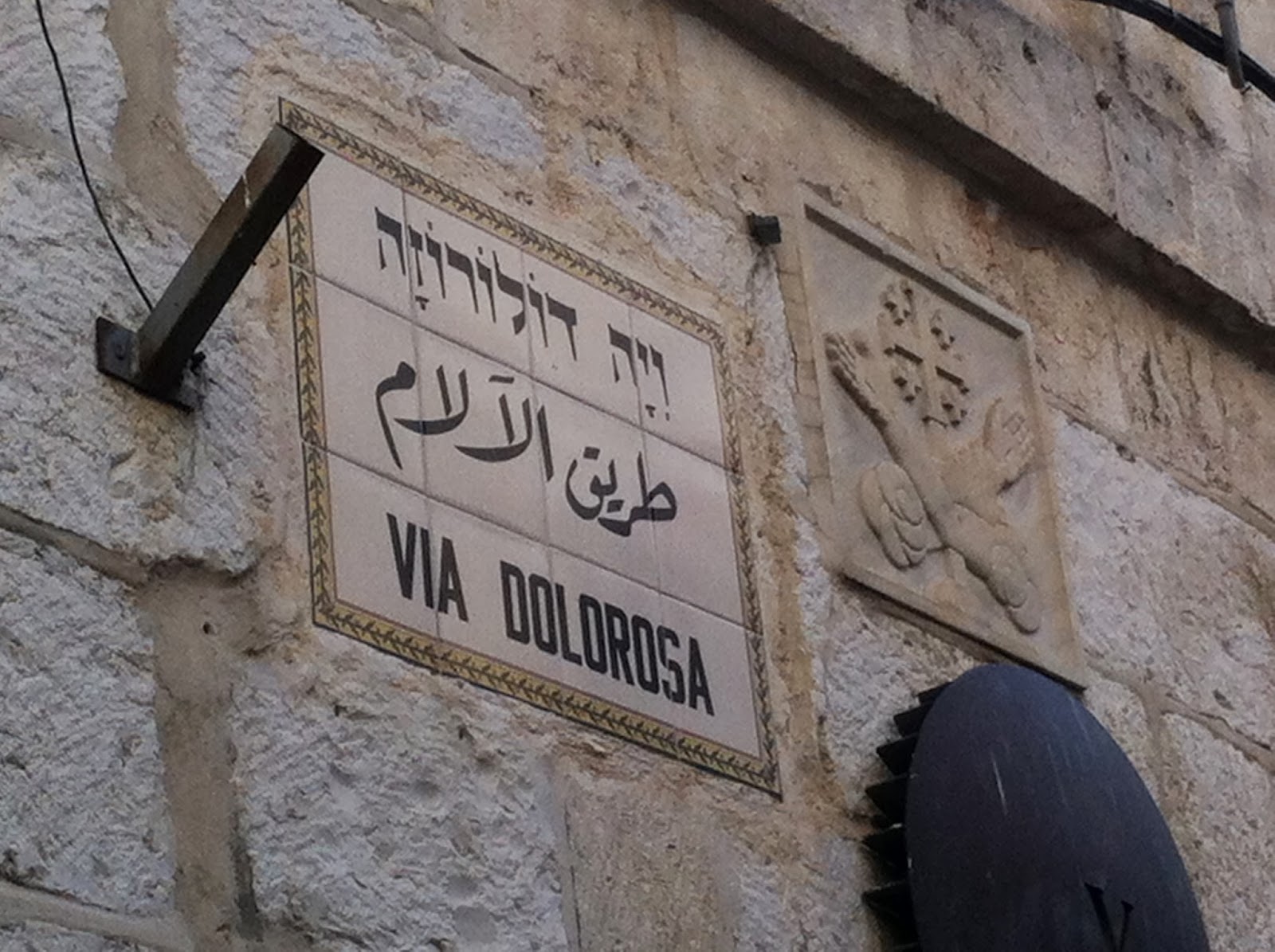
Since non-Muslims are not allowed to visit the Dome of the Rock, we rushed through the narrow alleys of the Muslim Quarter to the Via Dolorosa, beginning at the fifth Station of the Cross.  I reminded myself: Jesus Christ, one of the most important humans to have walked the face of the Earth carried a cross uphill on this path.  And what does it look like today?  A rabbit warren, lined with shops and barkers selling all manner of crap, roofed over so that it never sees the light of day.  Failing to find inspiration and trying to see the humour in it, I thought: “What a great place to play hide-and-seek!”


Finally, we got to the Church of the Holy Sepulcher and, by then, I knew what to expect.  I entered and watched as devotees pushed and shoved for their chance to kneel before and to touch or kiss the place where Jesus is said to have been crucified.  And then, as I had at Gethsemane, I got out of there as quickly as my little feet could carry me!  Soon, we were walking through the narrow streets again, headed toward the Jaffa Gate and our waiting bus.  Along the way, more shops, more people trying to sell us cheap goods, and, just like in the Bible: real, live money changers.


So, how much do I hate myself?  Not enough to go back to Jerusalem: too many people, too many guns, too much simmering conflict, and too much noise!  Gawkers and fanatics may find some meaning there, but it’s no place for the spiritual or the contemplative.

We left Jerusalem, driving east toward the Dead Sea.  Just outside the Holy City, we entered the Judean Desert and saw the ramshackle homesteads of Arab Bedouins.  Although these people live in Israel, in the most primitive conditions possible, they are citizens of neighbouring Jordan: yet another example of the oddity that is the Jewish State.

Our guide told us that the area around the Dead Sea is the lowest place on land, almost 400 metres below the level of the Mediterranean Sea.  It is ten times saltier than the ocean and, because of this, nothing can live in it.  She told us not to put our faces in the water, not to swallow any, and to avoid getting it in our eyes.


I wouldn’t go so far as to say that floating in the Dead Sea was on my Bucket List, but I was excited at the prospect, and it didn’t disappoint.  You’re like a cork!  Your feet and shoulders literally pop out of the water, and you have to struggle to touch bottom.  It’s the weirdest feeling!  As for the saltiness, the water is so salty that it stings your tongue!  And I have a confession to make: I peed in the Dead Sea.  I figured that, since nothing lives there, what harm could it do?

Surrounded by a group of Sri Lankans dressed in their finest, I watched as they went into the water, slathering themselves in the green mud that’s purported to have healing properties.  Frolicking like a bunch of kids, they filled bottles with the murky water and plastic bags with balls of mud to take home.  Good luck with airport security!  As the women came out of the water, fully clothed in their beautiful multi-coloured sarongs, I witnessed my first Sri-Lankan wet T-shirt contest!

Our next port of call was Haifa.  Elva and I decided to explore the city on foot, and we’re glad we did.  Once again, warmed by a cloudless 25-degree day, we made our way to the lower entrance to the Baha’i Gardens, yet another UNESCO World Heritage Site on our journey.  The Gardens, one of Baha’I faithful’s holiest sites, drapes the west-facing slope of Mount Carmel.  The terraced gardens are spectacular, the finest we’ve ever set eyes on.  Unfortunately, we happened to be there on one of only two days in the year when the site is closed to visitors.  We climbed through the streets to the top of Mount Carmel to see the Gardens from above, and they took our breath away.  The contrast between the beauty and peacefulness of this holy site and what I saw in Jerusalem is striking.
 

I won’t be going back to Israel.  I can identify with the Jewish people, and I understand why they feel so threatened by almost every country that shares a border with them, and even by countries like Iraq and Iran that are within striking distance.  They face an internal threat from the more radical Palestinian element.  But for me, a mere visitor, were it not for the attraction of the Holy Land and the Dead Sea, I’d have no more reason to want to go there than to North Korea.

Our next port of call was Antalaya, Turkey, a modern city of 1.2 million which is a major tourist centre.  The beaches are beautiful.  We took a guided tour to the ruins of Aspendos and visited a Roman theatre that is still in use today and seats over 20,000 people!  Next, it was on to Perge, another major Roman centre in the region.  The ruins of this city are more complete, and the site has been restored to the point where we could get a sense of where things were located and how people lived almost 2,000 years ago.  Rather well, actually; at least the ruling class.
 

On our last day before reaching Athens, we visited the island of Rhodes, and the main town of the same name.  Elva and I were among the first to set foot in the old city, another UNESCO World Heritage Site, home base for the Crusader Knights of the Order of St. John for a couple of hundred years until they were driven out by the Ottoman Turks in 1523.  The shops and restaurants were not yet open when we walked through the narrow streets.  It’s a charming place and on my ‘top three’ list of the places we’ve visited thus far.
 

We walked along the sea wall past the mouth of the old harbour where the statue known as “The Colossus of Rhodes” is said to have stood around 300 B.C.  It was one of the Seven Wonders of the Ancient World.  Continuing along the shorefront, we arrived at the beautiful beach which stretches at least two kilometres.  I couldn’t resist taking a dip, and Elva snapped this picture of me in the water, showing a huge diving platform in the background.
 

Had we not decided to buy an extra ten days, tomorrow would be our last day on the MS Rotterdam.  We’re not ready to get off!  It’s too much fun!


Saturday, 2 November 2013


EUROPEAN VACATION – WEEK 6

 
Elva and I are by no means experienced ‘cruisers’, but after visiting several cities on this trip, we’ve come to appreciate what makes us feel interested, welcome and satisfied.  It has left us wondering what cruise passengers’ impression is of Charlottetown and Prince Edward Island.  From our new digs downtown, we see cruisers wandering around, maps and cameras in hand, and we now have a better idea of what they’d be looking for.

First impressions are based on the view of the city from the ship as it comes into the harbour and arrives at the dock.  Here, we have no doubt that passengers would be very impressed by what they see.  The cruise terminal itself is a rather drab building, but most of them are. 

By the time the ship ties up, passengers have decided what they’re going to do for the day: excursion, self-guided tour, or a local guide hired on-site.  Excursions on the Island include the visit to Green Gables and the National Park, the Confederation Bridge, and perhaps a visit to a beach.  Others that would interest me would be a matinée at the Confederation Centre, a round of golf, a trip out on a lobster boat, and a farm tour.  Another interesting cultural experience would be a trip to Abram-Village, including a lunch featuring Acadian cuisine, and a performance by local artists.

Since excursions organized by the cruise line tend to be quite expensive, in the $150 range per person for a full day and $90 for a half day, passengers often opt for a self-guided tour.  For a small city like Charlottetown, the prospect of walking around is certainly attractive.  So, what would a visitor like to see, and what is needed to make the day interesting?

Well, for starters, we need to find the Tourism Office.  It needs to be open when the shop arrives, be staffed with helpful, enthusiastic people who aren’t wishing for the tourist season to end, and the staff need to be knowledgeable about their city.  We found, for example, that staff tend to stereotype cruise ship passengers, assuming we are old and decrepit, and that we have mobility problems.

Next we need to be able to find a good Wi-Fi connection.  Our cruise line, Holland America, offers an on-board internet service, but it is expensive, slow and unreliable.  So, we wait until we get ashore.  While many cruise terminals advertise their Wi-Fis, none we’ve tried was much good.  The better option is finding a café, ordering a drink, and asking for the password.  Usually, this works fine, but in Capri, a coffee and a tea cost us $15!  We wonder how many businesses in Charlottetown offer Wi-Fi?

There need to be public washrooms available; clean public washrooms.  While I wouldn’t hesitate to walk through the lobby of the Delta Hotel in Charlottetown to find my way to the washroom, hotel staff in the cities we’ve visited are on the lookout for people who try to do this.  I don’t know if public washrooms are marked on the city map given to passengers visiting Charlottetown, but they should be.  When travelling, I always bear in mind the wise words of Jack Nicholson from the movie Bucket List, when he recited his three rules for older men: “Never walk past a bathroom; never waste a hard-on; and never trust a fart!”

Finally, people need to have nice places to just hang out.  Here, Charlottetown is in very good shape, with its abundance of parks and public places.  However, recent attempts to create ‘café-style’ spaces by extending patios out into the street just don’t do it.  Only Victoria Row and the restaurants with a view of the harbour offer the kind of experience cruise passengers expect.

This week started with a visit to Kotor, Montenegro, the third port we visited on the east coast of the Adriatic Sea.  Kotor is a small city, probably about the size of Summerside, the perfect size for walking around.  The harbor is spectacular, framed by mountains, and its old town is a UNESCO World Heritage Site. 


As soon as we stepped on the dock, we picked up a map and headed for Fort Saint John, the fortress guarding the old town.  We’ve learned through experience that the best way to get the true sense of a city is to see it from above.  This time, we had to climb a tough and winding staircase to the partially-restored fortress which sits at 260 metres above sea level.  But it was well worth it!

The view was spectacular, and I even captured the flag of Montenegro!  From our vantage point, we could trace the fortress wall from the summit, down into the old town, and around to the seafront.  It’s the best example we’ve seen of a fortified town.  The old town itself is spotless, featuring a host of cafés, shops, and restaurants with reasonable prices.  We found the people there very friendly and accommodating, and we hated to leave.


Next, it was off on an excursion to a country visited by few North American tourists, Albania.  This small country lies on the Adriatic Sea, between Montenegro to the north, and Greece to the south.  We boarded a hydrofoil on the island of Korfu for the trip to the small port city of Saranda, on the south coast of Albania.  Saranda was a small fishing village until about twenty years ago when the money and the tourists started rolling in.

Albania was governed by a repressive and paranoid régime, not unlike North Korea’s, from 1945 until 1990.  For much of that time, the country was completely isolated from the rest of the world, its closest ally being communist China.  As a result, the people suffered greatly and are just now emerging from a long nightmare.  A good annual salary is $10,000, about one-third the European average.  Yet, these people pay twice what we do for fuel!

Officially, we were there to see the ruins of Butrint, a UNESCO World Heritage Site which features four distinct periods of occupation: Greek, Roman, Venetian, and Ottoman.  While I had some interest in the ancient history, I was more curious about what has happened to the country since 1990, and how things are today.


Fortunately, we were accompanied by a very knowledgeable guide who explained that the country is trying to attract foreign investment and build a tourist industry similar to that of its Adriatic neighbours.  It’s clearly got a good start on things, judging by the pace of new construction in and around Saranda, but the 2008 recession has resulted in many projects being delayed or cancelled.  As a result, the place has a half-finished look to it.  I’d like to visit again in ten years.  At this point, I feel things could go either way; boom or bust.


We sailed south along the Adriatic coast to the town of Katakolon, gateway to Olympia, site of the ancient Olympic Games.  While most people opted for a visit to the ruins, we went to Magna Grecia, an agriturismo featuring home-grown organic olive products.  After receiving a detailed explanation of how the olives are harvested and processed, we had a delicious lunch, complete with Greek music and dancing.

Next, we rounded the Peloponnese, the large peninsula that forms the southernmost part of mainland Greece, and landed at the port of Nafplion.  Most of those who took the excursion route went to Mycenae, the golden city referenced in Homer’s epic poem, The Odyssey, or to Corinth to visit the Temple of Apollo or the Tomb of Agamemnon.

While I do know the difference between Zeus, Athena, Poseidon, and Apollo, I confess that the Greek gods don’t do much for me interest-wise.  As for ruins, one set looks pretty much like the other to my eyes.  My impression of Greece is that people here are too focused on the past.  Because of the country’s chronic economic problems, infrastructure is falling into disrepair. 

Nafplion’s beautiful seaside promenade is lined with expensive streetlamps, most of which have been smashed, and there’s graffiti everywhere.  The same is true of the stairway leading to Palamidi Castle: all the spotlights have been smashed as has the electric panel.  It’s a shame, because the town’s setting is beautiful.  I took advantage of a pretty little pocket beach to go for a swim.


Next, it was off to Athens, capital of Greece, and the birthplace of democracy.  We only had a short time to spend in the city, but did get to see the Acropolis and its centerpiece, the Parthenon.  This major tourist attraction is absolutely crawling with people.  The Parthenon is perpetually under repair, so there are scaffolds and cranes everywhere.  It’s hard to make head or tail of the various temples located on the Acropolis, and without a guide, the whole thing is mass confusion.


A major demonstration was underway in the centre of the city the day we were there.  People are unhappy with the drastic measures taken by the Greek government to keep the country from being kicked out of the Euro Zone.  I understand their frustration, but they’ve been living the dream for too long; now it’s time to get real!

We then sailed across the Aegean to Kusadasi, Turkey, the port closest to the ancient city of Ephesus.  We took a tour and visited the site of a house where Mary, mother of Jesus, is thought to have lived for a time.  From there, we went to visit the ruins of Ephesus.  The iconic image of the city is, of course, the façade of the library.  But there’s much more to see: a theatre which sits 15,500 people, various temples, the marble streets, and even a brothel.  Our guide told us that only 10% of the city has been excavated to date. Imagine a city of 200,000 souls at the time of the Roman Empire, 2,000 years ago!

Elva and I took a ‘selfie’ in front of the library façade.  For those of you who haven’t been to this part of the world, prepare to encounter many stray cats and dogs, some of them living in pretty pitiful conditions.  But not these three; they were as snug as could be, sleeping in a sink in the men’s washroom in Ephesus!  Finally, I couldn’t resist snapping this sign, which shows that the Turks are nothing if not honest. 

 
After the history lesson, our guide took back to Kusadasi to visit a store, a co-op actually, that retails carpets made in villages in central Turkey.  We were treated to a demonstration of how silk is made from cocoons of the silk worm, and how the carpets are made.  Next, our host and his staff rolled out at least thirty carpets of all sizes, colours, and patterns.  Amazing!  The most expensive ones were over $20,000…
 
Yesterday morning, as we were having breakfast, who walks by our table but Cheryl Stead and John Cox of Charlottetown.  Imagine!  Actually, they're the second couple we've met on the MS Rotterdam from the Island.  We also ran across Ted and Gail Lewansky from Stratford last week in Split.