Sunday, 13 October 2013


EUROPEAN VACATION – WEEK 3

We are now officially part of the cruising scene, having spent our first three days aboard the MS Rotterdam, a medium-sized ship owned by Holland America, very similar to the ones that call in Charlottetown.  She began this voyage in Ipswich, England, and arrived in Barcelona on October 9.
We spent six days in Barcelona, one of the most beautiful cities we’ve visited.  The Greater Barcelona area boasts a population about the same as Toronto’s but the place has a far different feel to it.  Friends and family members who’ve visited here raved about it and we can see why.  It is definitely world class. 

It’s the cleanest big city we’ve seen.  Municipal workers are constantly at work, armed with brooms and various motorized cleaning devices, even on a Sunday evening.  They all wear the same colourful fluorescent uniforms.  Construction workers also seem to pay particular attention to cleanliness and order when they’re jack-hammering sidewalks; all refuse is placed in large bags and is stacked neatly, to be picked up the very next day.  Cleanliness and order have become part of the Barcelona culture and a noticeable feature of its brand.
Every part of the city centre is designed for walking.  There are broad boulevards along the waterfront and other main thoroughfares, and parks everywhere.  Vehicle traffic is strictly controlled on the narrower streets to insure pedestrian safety.  Barcelona has five kilometres of beachfront, all of it easily accessible by foot or public transportation.  Our room was located in the Gothic Quarter, near La Rambla, a tree-lined pedestrian walkway with a buzz that makes you want to be there every day, especially in the evening, when artists and buskers are on full display.

 
But one cannot truly experience Barcelona without seeing the works of Antoni Gaudi, its most celebrated architect.  Elva and I spent a morning exploring his masterpiece, the church of La Sagrada Familia, a structure begun over a century ago and still far from finished.  It is more sculpture than church, however, with a truly unique design.  Gaudi’s imagination and genius are incredible! 
 
As impressive as the exterior is, the interior is awe-inspiring.  With its massive dimensions, incredible columns and stained glass windows, it is a veritable kaleidoscope of light and colour.  I’ve seen Notre-Dame in Paris and Saint Peter’s Basilica in Rome; neither compares with La Sagrada Familia.  All of the work is financed through private donations: no money comes from the Catholic Church, the Government of Spain or the City of Barcelona.

 
Before leaving Barcelona, we visited Parc Guëll, another example of Gaudi’s work, this time consisting of buildings, walkways, stairways, and plazas, all in a peaceful, park-like setting.  We also toured the churches of Santa-Maria-del-Mar and the Barcelona Cathedral.  One evening, we saw a spectacular fountain show that makes the Bellagio in Las Vegas look like a fountain with poor lighting and an enlarged prostate!

 
I’m not a particularly religious person, but when I visit a new village, town or city, I like to tour its church.  Each usually features a historical plaque or panels that explain when it was built, added to and renovated.  Some of the churches are plain and stuffy; dark and dank even.  Others are more ostentatious.  But each is the heart and soul of the community, regardless of how many people attend religious services, and a source of pride for residents.
Each one evokes in me the sad memory of the church where Elva and I were married, the regretted Saint-Philippe-et-Saint-Jacques of Egmont Bay, needlessly destroyed a few years ago by small-minded parishioners who neglected their duty to save it.  All over Europe, one finds churches in far worse condition.  But they are not being demolished just because the present congregation lacks the needed imagination and vision to breathe new life into them.  People here have too much respect for the sacrifices made by those who came before to even think of making such hasty decisions.

Our first port-of-call on the MS Rotterdam was Marseille, an overnight sail through rough waters from Barcelona.  With apologies to my friend, Denise, I was not much impressed by the city.  It has a very hard and tired look to it, not nearly as welcoming as Barcelona. 
We rode the shuttle into the city centre and walked from there up to the highest point in the old city, the Basilica of Notre-Dame-de-la-Garde.  From here, one enjoys a very impressive view of the city, including the Château d’If, the Vieux Port, and the two fortresses that guard the harbour entrance, Fort Saint-Jean and Fort Saint-Nicholas.  After strolling along the inner harbour watching fishermen clean their catch, we visited Fort Saint-Jean and took in a very informative audio-visual presentation on the history of Marseille.  We finished our day’s visit with a tour of the Cathédrale-de-la-Nouvelle-Major.

 
On Saturday morning, we ate breakfast just as the sun was rising over the harbour in Monaco.  The Principality of Monaco is barely four square kilometres in total area, and every square inch is utilized to the fullest; no wonder, what with real estate running at about $53,000 per square metre!


We walked from one end of the country to the other and from side to side, all in the same day.  The place reminds me of Disneyworld; everything is so modern, perfect, and orderly.  We toured the Cathedral, the Prince’s collection of vintage cars, and saw the changing of the guard at the Palais du Prince.  Then we walked through the city of Monte Carlo, along the waterfront and through the tunnel where the Monte Carlo Formula 1 race is held each year, and up to the Casino de Monte Carlo.

The cars on the street here are a sight to behold: BMW, Mercedes, Rolls-Royce, Bentley, Porsche, Lamborghini, Ferrari, Audi, Range Rover, Jaguar, Maserati, Aston-Martin, etc.  They’re everywhere.  And what to say about the yachts; one was so big it had to be moored outside the harbour.  As you can see from the picture below, it even has its own on-board helicopter!
 
For a snot-nosed kid from the streets of Wellington, it’s all just too much!  Elva and I were reminded of Antonine Maillet’s character, the washer-woman named La Sagouine.  Too poor to ‘buy’ a pew in church, she could still stand at the back and watch the rich people flaunt their style.  Like my idol Jed Clampett would say: “We’re too poor to paint and too proud to whitewash!”

Tomorrow, we’re off to Corsica.  The Captain says it will be 22 degrees Celcius!  After just three days aboard, we’re enjoying ourselves so much we’ve decided to extend our cruise by a further ten days, allowing us to see more of Turkey and, in particular, Istanbul.

Saturday, 5 October 2013


EUROPEAN VACATION – WEEK 2

Well, my batching days are over for a while as Elva and I met up last Thursday evening after a three-week separation.  She walked half the length of the Camino de Santiago, about 400 km., all by herself.  I’m very proud of her!  She got along great and, after a few good nights’ sleep, is as good as new!

We spent five days with our friends, Ira Birt and Liz Kays, and travelled a lot across northeastern Spain.  Saturday was spent touring the city of Girona where Ira and Liz had rented an apartment for the week.  In the morning, we strolled through the massive outdoor market, stocking up on fresh fruit at ridiculously cheap prices.  Later, we walked through the old part of the city, along narrow alleyways and cobblestone streets, lined with shops, cafés and restaurants, and countless churches and religious buildings.


On Sunday, we drove to the Mediterranean coast to visit the area around L’Escala, a seaside town we’d cycled to the previous week.  While there, we toured the ruins of Empúries, a major military and trading post established originally by the Phoenicians, and occupied successively by the Greeks and the Romans. 
That afternoon, we toured the Salvador Dali Museum in Figueres.  While I’m not the art gallery type, Dali, judging by his art, was a fascinating character.  He was either high on something most of the time or suffered from some sort of psychological disorder.  Even so, I couldn’t help but wonder at the genius of his creations: fantastic and bizarre, yet strangely beautiful.


We eventually made it to Andorra, a small country located in the Pyrénées Mountains between France and Spain, after a harrowing ride through narrow mountain roads and a five-kilometre tunnel.  The country, about one-twentieth the size of Prince Edward Island, depends on tourism, financial services and tax-free shopping for its economic survival.  We spent an afternoon there touring around and getting the lay of the land.  It is a very modern and prosperous place, but with hardly a piece of flat ground anywhere to be found.  The houses and many apartment buildings, especially the newer ones, perch on impossibly steep hillsides and must cost a fortune to build.


Wednesday was our day to ride.  We rented bikes and helmets from a shop in Girona called Bike Breaks, and headed toward the nearest town, Banyoles.  After a few detours involving steep hills and hairpin turns, we decided there was no easy way to get to our lunchtime destination, so we headed out to the highway.  With big trucks whizzing by, we pedaled nervously until we reached the first exit to Banyoles and found our way to the centre of the old city.  After sandwiches and cold drinks, we pedaled through the city traffic to the lake and a more relaxing coffee and croissant. 


On our last day with Ira and Liz, we drove to Montserrat, a mountain refuge of the Benedictine order of monks that has become a major tourism destination.  The drive from the valley to the main monastery, 1,000 metres up, is a bit hairy but worth the effort.  We had scouted the place beforehand and knew that the 1:00 boys’ choir performance in the basilica was a must-see.  We took our places at 12:15 and watched as the space filled with visitors; there was not a square inch to spare by the time the boys came out on the altar.  They were worth the wait.  We watched as other pilgrims lined up to see the ‘Black Virgin’, one of the monastery’s major attractions.


Next, we rode the funicular to the very top of the mountain, high above the main monastery.  Here, we found a very interesting display that explained the natural and cultural history of the mountain, and we walked a couple of the trails along the summit.  The most interesting discoveries for me were the ruined monasteries of Sant Joan and Sant Oneffre, carved into the side of the bare rock face.   They were occupied for centuries by monks who sought the most isolated and harsh lives possible, and they surely give meaning to the word ‘ascetic’.

We’ve left comfortable surroundings near the small village of Serinya for bustling Barcelona.  It’s time to share a few observations of my two weeks in Cataluña:

1.    I haven’t seen a Spanish flag since I left Barcelona airport.  The old Catalonian flag and the flag of the independence movement are everywhere.  Catalans are a proud and independent people with their own language, culture, cuisine, and political aspirations not unlike those of our neighbours in Québec.

2.    Litter is almost non-existent here!  The ditches are clean and, in every village, town and city we visited, one could almost eat off the streets.  In Girona, we saw a man standing on a ladder, cleaning the lights at a pedestrian crossing, and another scrubbing the walls of an underground parking garage!  On Saturday mornings, crews are out sweeping sidewalks and pressure-washing streets.

3.    Each village and small town has its central square, dominated by the church and bounded by restaurants, shops and benches.  They become the centres of activity, especially in the early evening, and bustle with the sounds of children at play, and neighbours chatting and quaffing their beverage of choice.  What a contrast to our neighbourhoods back home, so sterile and impersonal.

4.    Spanish food is better than ours in one important respect: there are no fast food joints to be found.  People eat a healthier diet than we do and it shows on their waistlines.  However, the cuisine here does not compare with what one would find in France.  It’s bland and uninteresting to say the least; the meat is sub-par, but the fish is not bad.  My best restaurant meals thus far have been two dishes I’d never eaten before: cuttlefish and pig’s cheek.

5.    Catalans are industrious, friendly, good-humoured people.  While I don’t speak the language, I was never made to feel uncomfortable when I asked for something, especially if I made an effort to communicate in the local language.

6.    The coffee here is to die for; none of the codswallop that passes for coffee in Canada.  Also, no drive-thrus = no litter!  And, finally, if you don't like olive oil, this is not the place for you!

Friday, 27 September 2013


OTHG – GIRONA VACATION

Just back from a solo ride this morning.  John and Ira are climbing 1,000-metre Rocacorba and Russ is exploring à pied.  No climb for me, alas, after a four and one half hour ride out to the Mediterranean coast and back yesterday.  I’m very satisfied with the 340 km. I’ve ridden these past five days since we arrived in Serinya.
I rode part of yesterday’s route this morning, out to Terradelles and back, through farmland and small villages, some of whose names I remember, others not: Centenys, Vilavenut, Balliners, and Vilademuls.  I wonder where they got their names and when.  Each one features an ancient church.  Everything is quiet as I cycle through narrow streets; hardly a soul is about.
 
I listen for sounds of activity and hear little, except for the odd farm tractor, a barking dog, or a crowing rooster.  I smell freshly spread hog manure, plus the sweet odour of figs, fallen from a roadside tree and crushed by passing traffic.  I see what looks like an early-morning mist rising from the ground, and realize just soon enough to close my mouth that it’s a cloud of insects!
I take my time going up and down the hills and round the endless turns, not like yesterday when there were four of us in a row.  The back roads I’m riding are hilly and curvy, and pass through gorgeous farm country where no land is wasted.  The road is well paved, but barely wide enough for two vehicles to pass.  No one seems in a hurry, a good lesson for those of us continually rushing to get to God-knows-where.
The farms are like the villages, orderly and well cared for.  People here take great pride in their properties.  I stop to take a few pictures along the way of things that will remind me of these special places.  As I turn around and come up the steep hill to Terradelles, I watch a paddock-full of horses lazily munching on a stack of hay.  I pedal past a van parked on the side of the road; the appliance repairman talking to a woman.  Next, I come upon two men changing a tire by the side of the road. 
 
My legs begin to feel soft and I try not to push too hard.  For once, I tell myself, try to just take it all in; enjoy the moment.  I remember now that the ride back is mostly uphill, and notice that it’s getting hotter by the minute.  I’m glad I brought two water bottles this morning.  I begin to feel the dull pain of the saddle sores I developed yesterday (Note to self: bring own saddle next time!).  I see my shadow in front of the bike, urging me on.  I keep climbing until I reach the small village of Centenys; I know it’s flat or downhill from here.
When I get back, I find new guests arriving at Mas Pelegri, being checked in by our hosts, Fiona and Garrett.  Their son, Eli, is playing in the yard.  Russ, John and Ira are still out somewhere, enjoying the day as much as I am, I’m sure.  We’ve been here six days and, tomorrow, I’ll drive Russ and John to Barcelona for their flight home.  While there, Ira will pick up Liz, and I’ll drop them off to their lodgings in Girona. 
The week has gone by very fast.  We got here on Saturday and had a nice meal, served outdoors under a beautiful evening sky.  The next morning, Garrett got us fitted with bikes, not the best, but adequate.  He gave us a map for a 75-kilometre ride and we set off for Banyoles.  From there, we hit our first hills and rolled eventually into Santa Pau, ready for a strong coffee.  (The latter is reason enough in itself to visit Europe.)

 
From Santa Pau, the road features a five-kilometre downhill run to Olot, a fair-sized city.  We stopped for water and some fresh figs and made our way through the city and back toward Serinya, arriving here mid-afternoon, just in time for an afternoon nap by the pool.

On Monday, we were tempted by the climb up Mare de Déu del Mont but thought better of it, deciding instead to repeat the previous day’s ride in reverse.  It proved to be a good decision.  The next morning, a day off from riding, we drove up the mountain in question and noted the wisdom of our choice; the descent is just too narrow and dangerous.  We made our way to the Mediterranean coast and stopped at a small resort town called Llança, definitely a place I’d like to return to.
Yesterday morning, armed with copies of Garrett’s infallible maps (NOT!), we headed for the coast through beautiful countryside, eventually finding the sea at the resort town of Sant Pere Pescador.  From there, we pedaled south along the coast until we reached L’Escala, our lunchtime destination.  The seaside town is a tourist haven, but has a certain traditional charm to it nonetheless; another place to go back to someday.
 
Fortified with a bit of food and some strong coffee, we headed back toward Serinya, hoping to get there by the shortest route.  We got off to a good start, but took a turn that sent us a bit too far north.  Eventually, we figured out how to get back to Mas Pelegri by the same way we’d come out; we’d done 130 km., a pretty good day.  For supper, we had our best meal to date: steak and sausages, potatoes, tomatoes with mozzarella, fresh bread, and a damn fine chutney prepared by Russ from dates, pears and peaches, with a pinch of curry thrown in for flavour.


Which brings us back to today, the end of another enjoyable week for OTHG.  May there be many more to come!

And now for my nap…

Monday, 16 September 2013


GRANFONDO NIAGARA FALLS

According to my cycling companion, John MacQuarrie, who claims to know such things: “Niagara Falls is every new bride’s second biggest disappointment!”
GranFondo means, literally, a big ride.  It’s the label used by GranFondo Canada for its organized rides, the most notable being the Vancouver-Whistler GranFondo which attracted 4,000 cyclists this year.  The 2013 Niagara Falls event was the inaugural edition.
As is the case every year, the Over the Hill Gang chose an out-of-province event to train for and to keep us motivated.  Building on last year’s excellent experience with the Louis Garneau GranFondo in Québec, we settled on Niagara Falls.  Four of us flew from Charlottetown to Toronto and rented a van for the drive to our destination; the fifth chose to drive.

We arrived mid-morning, drove through the seedy back door of the city and checked into the luxurious (NOT!) Days Inn.  It was a cold, misty, miserable day as we walked down to register, past the Ripley’s Believe-it-or-Not Museum, the Upside-Down House, and the Criminals Hall of Fame Wax Museum.  I wanted to visit each one, but the boys would hear nothing of it.  For those of you who haven’t been there, Niagara Falls’ downtown core is incredibly tacky, except for the falls themselves and a few nice public parks.
 
GranFondo Niagara Falls was set up in the luxurious Crowne Plaza.  “How come we never get to stay in anything above two-star?”, I thought to myself.  It was plain from the start that this was a first-class event, organized by people who knew cycling and who knew what they were doing. 

After a hearty lunch at Kelsey’s we reassembled our bikes and chatted across adjoining balconies with a group of drunks from Sarnia who had gotten kicked out of a baseball tournament for alleged bad behaviour.  This naturally confirmed our belief that our choice of hotel was the right one!  We hoped they wouldn’t keep us awake all night.
 
After feasting on our obligatory pre-race pasta meal at Mama Mia’s, a decent restaurant surrounded by discount t-shirt shops, we retired for the night.  The alarm went off at 4:45 on Saturday morning!  We walked groggily to the all-night Denny’s, past a couple of Head Shops and a guy who’d passed out sitting in a chair on the sidewalk.  Half the people in the restaurant were on their way to bed after a long, hard night, while the rest were like us: preparing to endure four hours of pain.  Alas, I’ll take tired legs and a sore butt over a hangover any day!
Since the ride was scheduled to start at the ungodly hour of 6:45, we had to ride down to the marshalling area from our hotel in total darkness.  At the sound of the starting gun, thousands of wheels rolled forward, and we were soon speeding along the Niagara Parkway, headed for Niagara-on-the-Lake, our intrepid leader, Ira, on the front, making sure we stayed with a group of riders just fast enough to challenge us.

 
The Parkway is a beautiful stretch of road, and like the entire route, it had been closed to all traffic except cyclists.  What a treat is was to have the whole road to ourselves, with police controlling traffic at every intersection, directing us at every turn.  While it’s tempting to look at the scenery, to ride safely in a large group, one must focus intently on wheels, Spandexed butts, and the road in front, hoping like hell that riders on the left and right will hold their lines.  As we climbed up a hill on our way back from Niagara-on-the-Lake we came across a pool of blood in the middle of the road, no doubt the result of a nasty crash where someone was not so lucky.
 
The five of us eventually teamed up with a group of from ten to twenty riders, some of them very good at riding in a group, some less so.  All of the riders were younger than us and no doubt assumed we would peter out eventually.  I’m sure they chuckled to themselves when we each took a turn at the front of the line, thinking: “Those old guys won’t be around long!”  It’s the same in every ride we do though: eventually, other riders begin to understand that we’re disciplined and careful, and tougher than we look!
We stopped for the first time at the 83-km mark, still feeling pretty good, and filled up with some fluids and a bite or two to keep us going to the end.  Next, we rode through Short Hills Provincial Park and suffered a bit on our way up Effingham Hill (I have another name for it!)  Back out on the highway, we wheeled through the 840-metre long Thorold Tunnel which runs under the Welland Canal and back toward the finish line in Niagara Falls.
I took a long pull up front and ‘buried’ myself, not remembering that we were about to hit another nasty little hill, topped off by a 14% grade over the last 200 metres or so.  Big mistake!  But, I made it to the top and caught up to John and Richard before the pace line re-formed.  As soon as we got back on the Niagara Parkway, all hell broke loose as riders started to smell the finish line.
The last twelve kilometres or so were fast: 35 km/hr +.  There was a lot of jockeying for position, especially when we got inside the city limits.  It was kind of exciting, actually, even for an old guy like me.  Guys would pass us, and we’d pass them again! 
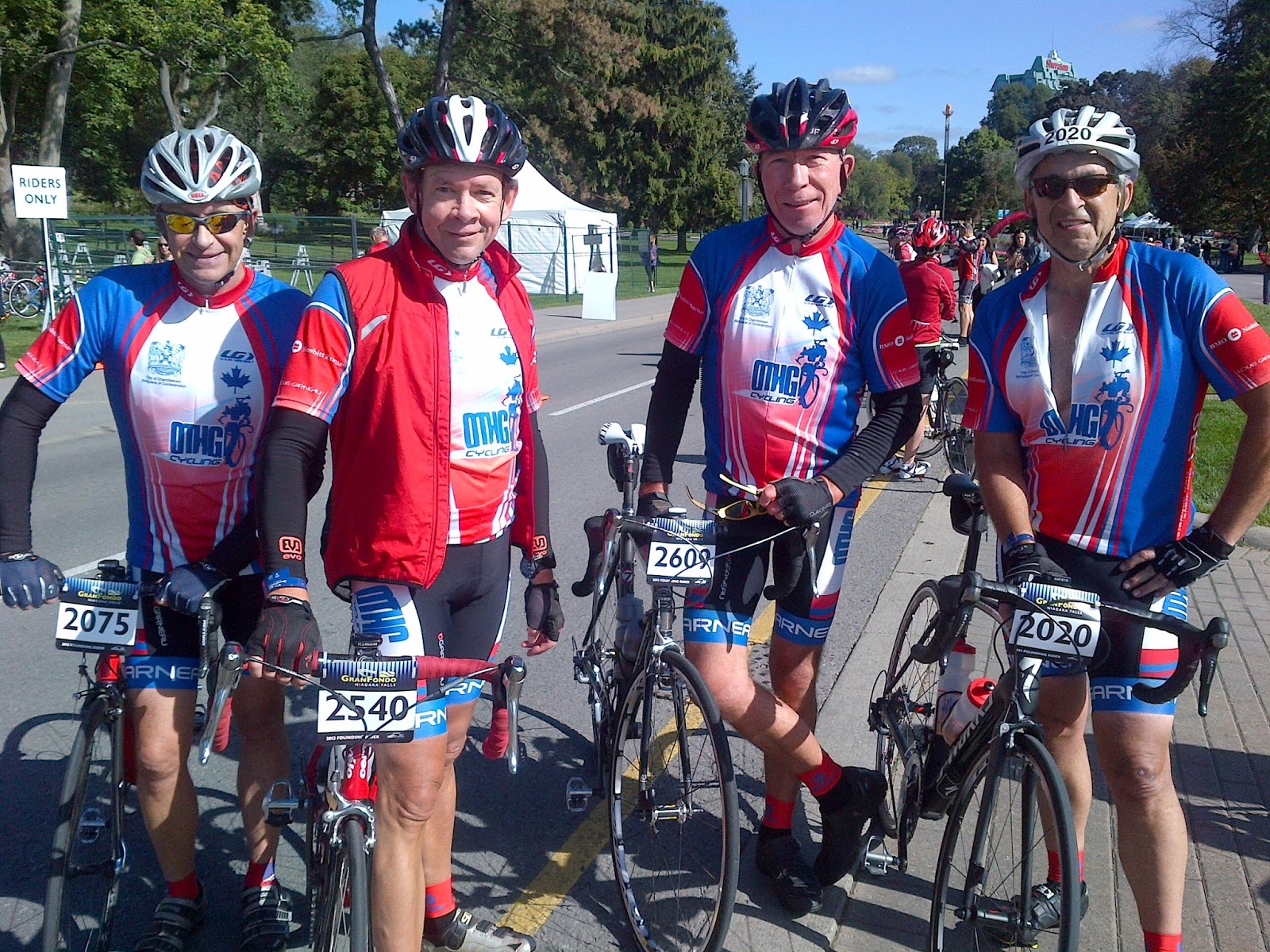
Russ, whom we’d not seen since the last hill, caught up to the three of us, and we just ‘gave her’ as we sped toward the finish line at over 40 km/hr.  Together, we passed a bunch of guys and one cute hard-body with a braided blond pigtail in the last kilometre.  The four of us crossed at the same time, 3 hours, 50 minutes and 30 seconds, an average speed of 33.4 km/hr according to my computer.  Ira came across the finish line a few minutes later. 

The photo below was taken by the event organizer who met riders at the finish line; unfortunately, Ira had not yet arrived.
 
We parked our bikes, strode gingerly up to event area, and demolished plates of vegetable jambalaya, and as much as we could drink.  A local band called The MadHatters came out on stage and started to play some damn good tunes.  Feeling grubby and stiff, and needing a shower, we straddled our loyal mounts and rode back up the hill to the Days Inn.
Next thing we knew, Ira was knocking on the door with the exciting news: we were the fastest team and had to hurry back to the events area to pick up our awards!  Holy jeezus!  We’re the fastest team!  Us five old guys!  What’s that all about?  After picking up our very nice Thule daypacks we parked our tender butts on the grass and listened to Barney Bentall and Jim Cuddy belt out many of their best-know hits.  It was a great concert.
I lay on the warm grass of Queen Victoria Park, looking up at a gorgeous blue sky, feeling the music vibrate through the ground under me, endorphins coursing through my body, enjoying the best rush there is.  I could see the American Falls just off to my right and feel the rumble of the Horseshoe Falls, less than a five-minute walk away.  I was surrounded by good friends; felt good about what we’d accomplished together; and was thankful we’d chosen to train for and participate in a first-class event.
 
After leaving the Park, we had just enough time for a bowl of soup before driving to Hamilton to link up with Ira and Richard’s friend, Mike.  After drinks at his house we feasted on a proper post-ride meal at Montana’s Cook House and enjoyed Mike’s well-told tales about cycling, and life in Poland before he emigrated to Canada thirty years ago.  By the end of the meal we were more than ready for some well-earned sleep.

One day later, I look back on a great day, one that offered everything I could ask for: companionship, challenge, exhilaration, relaxation, and satisfaction.  In six days’ time, Ira, Russ, John and I will pick up where we left off in Girona, Spain, where we’ll spend a week cycling together: a fitting end to a great summer!

Friday, 5 July 2013

THEM NEW PHONES

THEM NEW PHONES

Elva and I picked up our new IPhone 4s this week and are in the process of weaning ourselves away from the familiar land line we’ve known since we were kids.  Her number before the dial phones were introduced was 132 ring 2, and mine was 8.  Her family, living as they did in the ‘sticks’, was on a party line while ours was on a private line.  Families in the village of Wellington were the first to get phones in the early 1900s, and customers willing to pay a little more got their own private lines.

When the time came for me to register for university classes at UNB in the fall of 1971, the lady behind the counter asked me for my phone number.  I told her: “8".  She looked at me kind of strange and asked: “8 what?”.  “8 Wellington”, I answered, trying to make her feel as stupid as I could.

 
I wondered as I was setting up the mysterious and wonderful IPhone 4 what the older generation I grew up with might have thought of “them new phones”.  I imagined myself at Rufus MacLure’s barber shop on a Saturday morning in 1963.  Rufe is giving Clayton Barlow a trim and Steve ‘Ro’ MacNeill just walked in the door.  Émile Clovis is sitting in his customary corner chewing on a fig of Hickey & Nicholson’s twist and Sylvère Perry is talking politics, as usual.  George Bishop is hitching his horse to the rail beside Arsenault & Gaudet’s store.

 
Astute observer that he is, Rufe decides he’d better get the conversation on a different track before Syl and Steve get into it over who’s more crooked: the Tories or the Grits.  So out of the blue he says.  “Tillie was telling me about them new phones, IPhones, I think she calls them.  They say those things can do just about anything.”

 
“What’s an eye-phone?”, asks Steve.  “Is it some new gadget Dr. Reid uses to examine your eyes?”  “No”, says Rufe, “it’s a telephone, for God’s sake!”  “What’s wrong with the telephones we have now?”, asks Syl.  They’re a hell of a lot better than what we had in the War.  Those damn things never worked right.”

 
“Well”, says Rufe, “Tillie says Edmund Fidèle just bought a new one for the store and was showing it off the other day to some customers.  It’s not connected to anything and you can carry it in your pocket wherever you go.  You can even see the person on the other end of the phone if you set it up right.  They call that ‘Facetime’.  And it has maps on it so you can see where you’re going.”

 
“What in hang would I need a map for?”, says George Bishop.  “I’ve never been past Miscouche with the horse, and when I need to go any farther, I take the train or the bus.  That’d be no good to me!”

 
“Tillie says you can even get mail on your IPhone”, says Rufe.  “What kind of mail?”, asks Clayton.  “They’re called ‘email’.”  “Well”, says Clayton, “I bet Fidèle at the Post Office won’t like that too much.  People gettin’ their mail off their phone.  If that email catches on, pretty soon Harold and Hilda won’t have any mail to deliver out in the country.”

 
“Who makes them there IPhones?”, asks Syl.  “Tillie says it’s a company called ‘Apple’”, Rufe replies.  “The apples are no good this year”, pipes up Émile Clovis.  “My August apples are full of worms”.  “Not that kind of apple, for Christ’s sake Émile”, growls Steve.  “Why don’t you get the batteries changed in that old hearing aid of yours?”

 
“Tillie says the women won’t be buying any of the new phones because they don’t want Delima to lose her job at the telephone office”, Rufe continues.  “Like hell”, roars Steve.  “That’ll be the day the women don’t want the latest thing around here.  Our lane is too long to get the wires up to the house, but if them new phones don’t need to be hooked up to anythin’, I bet Kathleen will be wantin’ one.”

 
“How in hell are you going to charge up the battery, Steve?”, asks Syl, with that snarky look that tells everybody he’s got one up on somebody.  “You ain’t even got the ‘lectricity up there!”  Syl slaps his knee, and even Émile Clovis is in on the joke.  He has a good laugh at Steve Ro’s expense, and sends a well-aimed gob of black tobacco juice toward the spitoon.

 
On and on it goes until the men eventually tired of this subject and turn to the more familiar topic of the summer weather and how it was affecting the crops.  I sit in the corner and wonder how these new phones will change things for my generation.  I can’t wait to get home, and start working on Mom to see if I can get my own IPhone.

 
Elva and I fall somewhere between old-fashioned and new adopters, probably closer to the latter.  We were the first family in Wellington to buy a family minivan in 1987, but we were slow off the mark when it came time to buying a flat-screen TV.  As for cellphones, I’ve only had one for work since 2006, and Elva’s had hers for about five years.

 
I remember reading an article ten years or so ago about the advent of computers – how they’d affect our lives, and the lives of our parents’ and our children’s generations.  The feeling was that, for our parents, computers would be nothing more than a curiosity.  For our generation, they would become a tool, a means to an end.  For our children, they would become a way of life, an essential element of almost everything they’d do.

 
Today, we’re presented with an infinity of choice when it comes to computing and communication devices: desktops, laptops, tablets, and smartphones.  We’re expected by our family, friends and co-workers to be ‘on’ all the time, 24 / 7.  As our dependence on these gadgets increases, we spend more and more time looking at screens, and less and less time talking to one another.

 
But, they’re not all bad.  I wouldn’t trade Skype time with my children and grandchildren for a phone call.  I love my wireless printer.  I like being able to do my banking over the internet, so much so that I haven’t been face-to-face with a teller in God knows how long. 


Soon, we won’t even know what a ‘teller’ was!  It’s another of those old-time occupations destined to disappear.  Just like the telephone operator who answered: “Number please?”, when I turned the crank on the old phone in Wellington. 
 
 
That old phone hangs on my son, Clément’s, wall in Edmonton.  It’s a shame he missed out on the conversation in Rufus MacLure’s barber shop that Saturday morning in 1963.  The old crank phone would mean so much more to him if he had.

Sunday, 16 June 2013


THE BIG ONE!


Last Sunday, Ira Birt, Rus Melanson, Kent Wood and I headed east on Route 4 toward Pooles Corner, intending to cross over on Baldwin Road to the 48 Road, and back into town.  The other members of our group, the Over the Hill Gang – John MacQuarrie and Richard Birt – were absent; fortunately for them.  I was on my third pull, feeling strong, when my front wheel slipped off the edge of the pavement.  The shoulder was quite wet and soggy, and I lost the front wheel right away.  The bike flipped and I slid along the pavement, falling on my left side.  Imagine jumping out of a car moving at 35 km./hr. and you’ll get the general idea!
 
As I came to a stop, I saw Rus flying through the air out of the corner of my eye.  He landed heavily and rolled in the middle of the road, coming to a stop on his right side.  I got up, cursing at myself for being so stupid, and ran over to where Rus was lying.  He was unconscious, and having trouble breathing.  Blood was dripping from a cut on his left cheek, just below the eye.

 
We looked back to see that a fire truck had been following us just as the crash happened.  Ira and I went up the road to make sure no traffic was coming while Kent, a certified first responder, stayed with Rus.  The fireman called an ambulance and the RCMP, and I knelt beside Rus, hoping like hell he wasn’t badly hurt.  Kent thought Rus had the wind knocked out of him.  Sure enough, after too many long minutes of laboured breathing, he started to come around and began responding to us.

 
Kent made sure Rus’ spine was OK, and asked him where he was hurting before we let him get up into a sitting position.  By this time the ambulance had arrived and the EMTs took over.  Another fire truck from the Cardigan Fire Department and an RCMP cruiser pulled up and did their bit to control traffic and take down the details of the crash.  Because Ira didn’t give the right answer to a question he was asked and because his helmet was cracked, it was thought best to take him to the Montague Hospital; so a second ambulance was called.

 
I called Elva to come get me.  Ira did the same with his wife, Liz.  I stayed on the scene with the Cardigan Fire Chief, waiting for Elva to arrive so that we could load Rus’ bike and mine into the car.  The Chief was a nice guy and very concerned about our well-being.  I knew I was in pretty bad shape from the fall but, at that point, the combination of adrenaline and shock prevented me from feeling much pain; that would come later.

 
Elva arrived and, not long after, Liz.  We piled the bikes into our vehicles, headed for the Montague Hospital.  Kent had decided to ride back into town by himself.  He was the only one who stayed upright, so his bike was OK.  When we got to the Emergency Department, Rus was lying on a bed with an ice pack on his left shoulder, a large cut on his cheek and a smile on his face.  The sight of him brought tears to my eyes, as I’d been so worried about him.

 
Ira had been checked out for a possible concussion and had been told he was OK.  Rus was taken away to have his shoulder and cheek X-rayed.  We talked over what had happened and waited for Rus’ wife, Sandy, to arrive.  When she did, I gave her a hug and told her I was sorry; that the crash had been my fault. 

 
We watched as the young nurse bandaged Rus’ skinned knuckles and spread a bit of Polysporin on my knee and ankle.  We left the hospital, the three of us thankful for being vertical at least, and our wives drove us back to Charlottetown.  Elva and I dropped Rus’ bike off at his house and I headed home, anxious to get out of my blood-soaked gear.

 
It wasn’t a pretty sight when I stood under the shower head and inventoried the many scrapes and bruises on my old carcass.  There were patches of skin missing from my left elbow, knee, calf, and ankle, plus my right thumb.  I had pain in my ribcage on the left side, probably a cracked rib.  But the worst was my left upper thigh.  There, the road rash covered an area about ten by fifteen centimetres.  All of the scrapes were leaking quite profusely but, fortunately, none was very deep.  I cleaned them as best I could and tried to get comfortable lying on my side on the couch.  I knew I was in for a rough night.

 
Monday morning, I had to haul myself out of bed and prepare for a full day’s work, with six cases to prepare for that afternoon and a desk-full of decisions to review and sign.  I soon noticed pain in my left hip, my left knee and the inside of my lower left leg.  My road rash was hurting like hell and the wound on my upper thigh leaked through my dress pants all day.  I had to keep pulling the pant leg away to keep it from sticking to the skin.  That evening, Elva got me some dressing material from the drugstore which I taped over the wound to keep it from leaking onto my pants.

 
As I write this account, I’m one week removed from the crash.  I’m still haunted by the image of my good friend and riding mate struggling for breath.  It scared the shit out of me.  I’m in some pain but my body is healing normally.  My bike was toast; the frame cracked, and the handlebars twisted.  Danny MacQueen, worker of miracles, managed to find me a slightly used S-Works frame and had the bike back to me on Thursday afternoon.

 
I didn’t think I’d be ready to ride, but the sight of the bike was a temptation too great to resist.  I had to give it a try; like a stiff drink of rum to cure a hangover I guess!  So off I went, out to Pownal and back on Friday morning, to get the bugs out.  I was a bit nervous starting out but was glad to be back in the saddle again.

 
Elva and spent Father’s Day weekend in Saint John with my daughter, Sylvie, her husband, Ghislain, and our two grand-children, Samuel and Natalie.  I’d hoped to get out with Ghislain to follow up on our excellent ride a couple of weekends ago.  We did 62 km. together up west while Sylvie and Elva were attending grand-nephew Grady Gibbs’ baby shower, and sister-in-law Rose’s 60th birthday celebration.  The day after, I participated in the Ride for Heart, finishing the 72-km. route with the first three riders.  Needless to say, I was getting into pretty good riding shape, and Elva and I had started going to hot yoga classes again.

 
I managed get in a 65 km. ride with Ghislain today.  Sylvie took this picture before we headed out.  He kicked my ass on the hilly roads around Saint John, but that’s OK.  At least I can still turn the pedals!
 
 
I know OTHG went out for a ride yesterday, minus Rus who is under doctor’s orders to stay off the bike for a couple of weeks.  We had a pretty bad crash two years ago after riding about 35,000 km. together incident-free.  I don’t know if it’s the law of averages catching up with us or if our reflexes are getting a bit slower as we age; I suspect it’s a bit of both.  Hopefully, we can overcome this setback and get back together again soon.

 
To her credit and to my great relief, Elva told me to get back on the bike as soon as I could.  I took her advice but, as for riding in a pace line with my buddies, that’s a hurdle that may prove harder to clear.  After all, this one was my fault...