Sunday, 13 October 2019


CENTRAL ASIA ADVENTURE – PART III

The Silk Road was a trade network that connected China and Europe, and all points in between, from the second century BC to the eighteenth century AD. Though silk was the main trade item exported from China, many other goods and ideas were exchanged including religions, philosophies, sciences, and technologies. The Han Dynasty, Alexander the Great, the Roman Empire, the Byzantine Empire, the Turkic Tribes, Genghis Khan, Marco Polo; all of these powerful leaders and great empires used the Silk Road to advance their interests. Many of the best-preserved relics of the Silk Road are found in Uzbekistan. We visited four of these legendary cities on our G Adventures tour: Tashkent, Samarkand, Bukhara, and Khiva.

Uzbekistan has a population of some 33 million, slightly less than Canada’s and about half the total population of the five Central Asian countries. Average monthly income is about $400 CDN, less than Kazakhstan but more than Kyrgyzstan and Tajikistan. The political regime ranks as being quite repressive when measured by various indices: personal freedom, economic freedom, press freedom, and democracy. Still, the people are friendly and do their best to make you feel welcome and the country does not feel poor. Nothing like Central America, for example. One gets the sense that this country is on the move economically.

Our hotel in the capital city of Tashkent, the Hotel Uzbekistan, is a brutalist-style structure built during the Soviet era. It was more than a bit outdated: we had no hot water and no air conditioning, and the TV didn’t work. Still, it was better than a yurt or our homestay in Sarytag. The food wasn’t bad, the coffee tasted fine, and we had pretty good wifi.

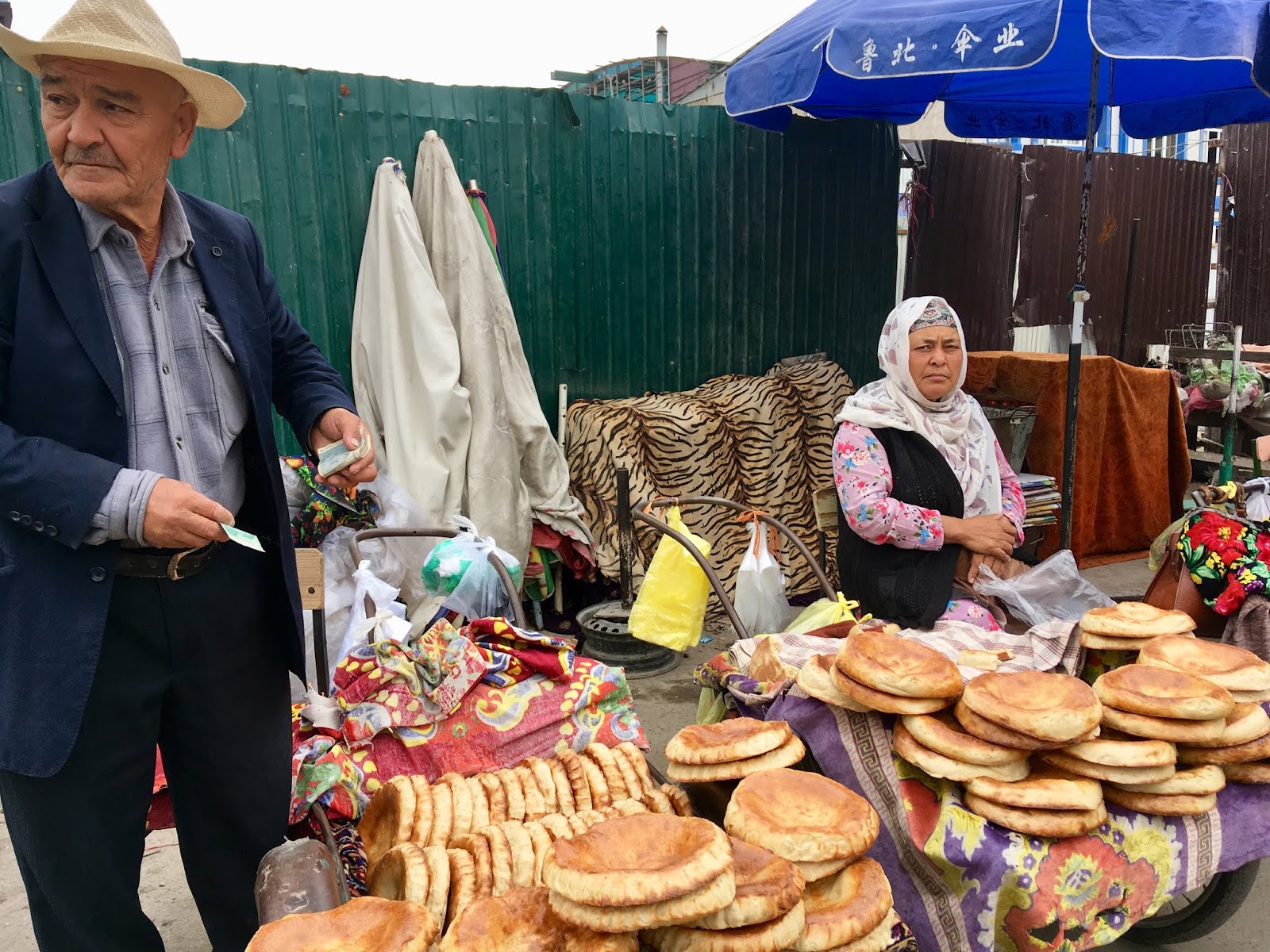
Tashkent is a city of some 4.5 million and the center resembles that of a European capital. On our first afternoon, we strolled through Amir Temur Square and to Independence Square. Next day was a free day and we used the subway to get around. Although it’s not easy to figure out the Cyrillic names, we managed without getting lost. Three one-way rides for the two of us cost $1.25 CDN! A good evening meal for two in a nice restaurant cost about $20 CDN. As for the local currency, the Uzbekistani Som, $1,000 CDN would just about fill a bucket. A bulging pocketful of 10,000 Som notes is about enough to buy dinner for two.

We visited the Kukaldosh Madrassa (Islamic school), the Juma Mosque, and the huge Chorsu Bazaar in the morning of our free day and spent part of the afternoon at the biggest mall in the city, the Samarkand Darvosa. There was quite a contrast between the bazaar and the mall. The former is where ordinary Tashkenters shop; the latter is for the better-off. We like to experience both wherever we go. In the evening, we welcomed two new travellers, one from Germany and one from Chicago.

Next morning, we drove by coach to Samarkand, Uzbekistan’s second-largest city. Along the way, we passed by fields that would make Island farmers drool: rich soil as flat as a pancake and stretching as far as the eye can see. There is a downside though. During the Soviet era, Moscow decided that this part of the USSR would grow cotton. And to grow cotton, you need a lot of water. And so, water from the Syr Darya and the Amu Darya (rivers) was diverted to the plains of Uzbekistan, Kazakhstan, and Turkmenistan. Instead of supplying the Aral Sea, these mighty rivers were reduced to a trickle. Google “Aral Sea” and you’ll see from satellite imagery just how dramatically the sea has shrunk. I can’t help but compare this environmental disaster with the impact the potato industry is having on my Island.

Samarkand is a city rich in history. It is one of the oldest continuously-inhabited cities in Central Asia, founded between the seventh and eighth centuries BC. In the fourteenth century AD, it became the capital of the empire of Amir Timur (also known as Tamerlane). Buildings constructed during the period of his rule have been well preserved and are the reason the city was designated as a UNESCO World Heritage Site.

While there, we visited a necropolis known as the Shahi Zinda Ensemble, the tomb of Amir Timur, the tomb of his favourite wife, Bibi Khanum, and the magnificent Registan Complex which consists of three madrassas (Islamic schools) and a mosque. All of these structures date from the period between the eleventh and sixteenth centuries. Despite being damaged by earthquakes, they have been restored and are major tourist attractions. The visual effect of lights on the Registan is magical. Along with many hundreds of tourists, most of them European, we watched a sound and light show there that would rival anything you’d see at Disney.

Next morning, we drove east toward our next destination, a yurt camp. Along the way, we stopped in Nurota to visit the remains of one of Alexander the Great’s fortresses and the artificial lake called Aydarkul. The landscape on the drive to the lake reminded us of the Australian Outback, and not surprisingly, since 80% of Uzbekistan is desert. The land is dry, sandy, and featureless except for the occasional farmstead and herds of sheep and goats. As for the lake, knowing it’s artificial and partly responsible for the disappearance of the Aral Sea kind of ruined it for me.
Our yurt camp was already overrun with French tourists when we arrived. We’d barely settled in when they started singing in the dining hall, so loudly, we had to tell them to shut up. The highlight of the camp was definitely a ride on the two-humped dromedaries (also called Bactrian camels). They are gentle and beautiful animals. Elva loves riding a camel. She just doesn't like the getting up and getting down part. Our travelling companion, John, is on the camel in front of her. No pictures of me.
 
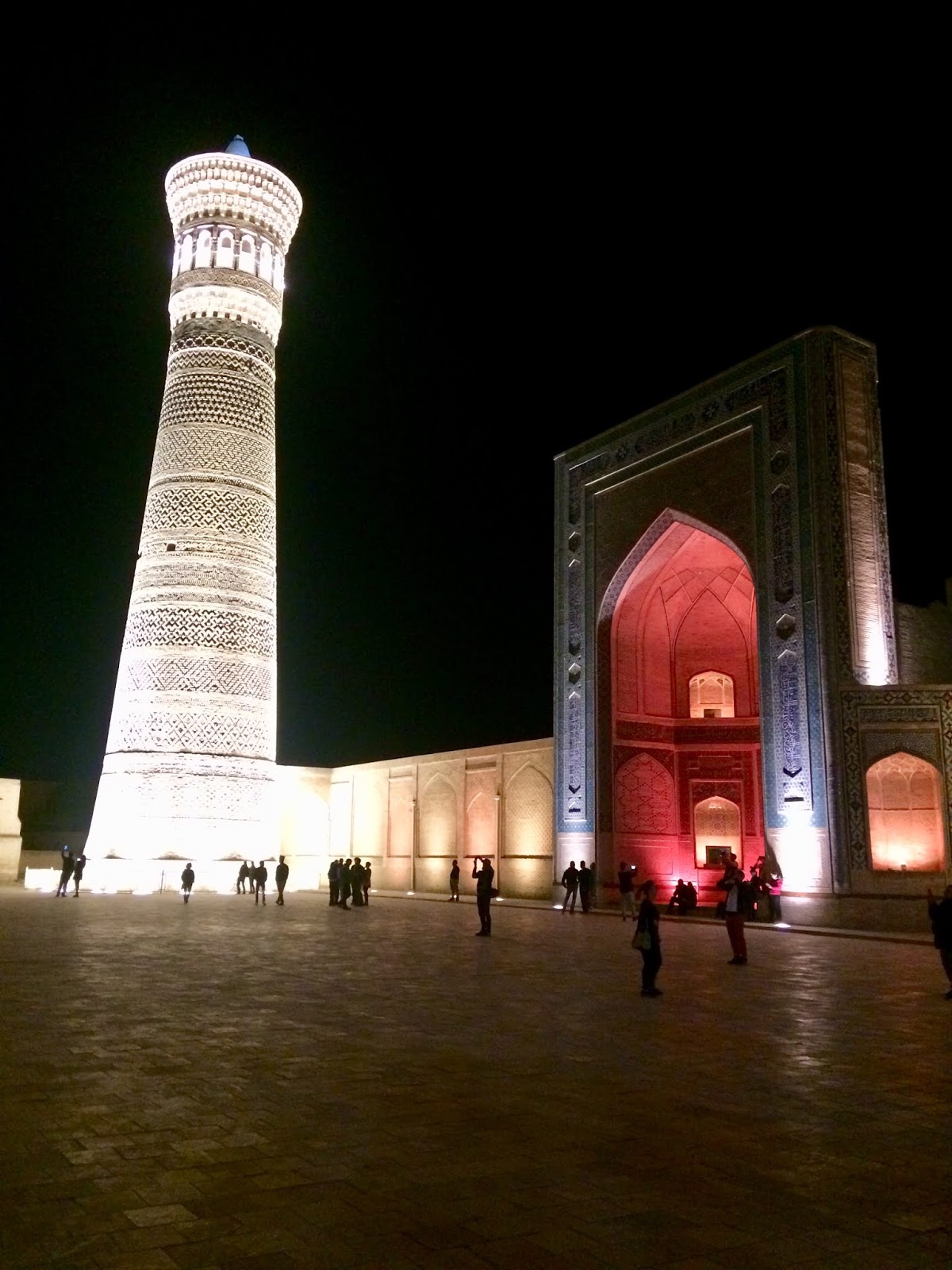
The drive to Bukhara took us about seven hours. Our hotel was located in the historic center of the city, itself a UNESCO World Heritage Site. Next morning, we strolled through the streets on a guided tour and experienced the historic ambience. The city is a major destination, welcoming 1.5 million tourists per year. The center of Bukhara is very walkable and there are many things to see in addition to mosques and madrassas. Particularly interesting are the craftspeople: hat makers, carpet makers, embroiderers, knife makers, spice merchants, blacksmiths, etc. Some of the families have plied their trade in the same market stall for many generations. Bukhara is our favourite place so far on this tour.
A word about toilets in Central Asia. I’ve divided them into four categories: European-style, privy (bécosse), squat, and long drop. The European is found mostly in hotels and the better restaurants and feels quite comfortable, if you know what I mean. The bécosse is quite familiar to those of us who grew up in the 1960s (there are even some to this day at Le Barachois!). The squat is like a toilet with no seat; you squat and do your business, and it usually has a flush. And then there’s the long drop! Imagine a too-small triangular hole in the floor positioned above a deep pit full of you-know-what. I don’t care how good your aim is, there will be an occasional miss. Not a place to go barefoot. And the smell! Holy Jesus! At one of them, our six-foot-four Swedish Viking came running our, one hand pinching his nose and the other pulling up his pants, shouting: “Get me out of here! Now!”


It took us eight hours to drive 450 kilometers from Bukhara to Khiva, a city of 90,000. The roads ranged from four-lane divided highway to barely passable broken asphalt. While there are signs that Uzbekistan is on the move, much needs to be done to upgrade its road network. Khiva contains one of the best-preserved walled cities in the region and includes 50 ancient monumental structures and 250 residences. We enjoyed an evening stroll through the streets and had dinner in one of the many restaurants.
After another full day of exploring Khiva, we had one last dinner with our group and said goodbye to nine fellow travellers. Seven of us will then cross the border into Turkmenistan. Not sure what to expect in this mysterious country. Should be interesting!

We’re really going to miss our guide, Aktilek, who’s done excellent work keeping us informed and on schedule. He’s getting married later this month and we’re sure his fiancée will be pleased to have him at her side as they prepare for the big day. AK is a bright, open-minded, and engaging young man, a credit to his home country, Kyrgyzstan. He told us that he dreams of owning a guest house one day. Whatever his chosen career, we know he will be successful.


Sunday, 6 October 2019


CENTRAL ASIA ADVENTURE – PART II

There comes a time in each of these adventures when you ask yourself: “What the hell am I doing here?” We drove two and a half hours from Karakol to the Kazakhstan border in the pouring rain, the last half over a very rough gravel road. We crossed the middle-of-nowhere border on foot, dripping wet, and boarded the buses again. First impressions of Kazakhstan were not that great: a ten-kilometer jounce through the ditch beside an unfinished road. Fortunately, things got a bit better as we neared our destination for the night, a guest house in Saty village.

The highlight of the day was an off-road drive into Kolsay Lakes National Park followed by a hike to Kaindy Lake, known as the sunken forest. The lake was formed when a 1911 earthquake triggered a massive limestone landslide that formed a natural dam. We climbed into a Soviet-era four-wheel-drive, parked our butts on benches, and hung on for dear life on the roughest ride I can remember. One hour later, we ground to a halt in a parking lot and hiked the rest of the way to the lake. As these views show, the drive was worth it. Back down in the village, we feasted on a home-cooked meal and settled in for the night.

So far on this trip, we’ve stayed in three types of accommodations: hotels, yurt camps, and guest houses. Yet to come are a home stay and a night in a tent. Guest houses are like B&Bs. In Saty, we stayed with a three-generation family that has been welcoming guests for ten years. Sixteen of us shared one bathroom but there was wifi! What struck me about this scenario was the spirit of entrepreneurship displayed by the family. They realize that improvements are required, so they’re expanding with rooms that will have full baths. Think about how far they’ve come. Not even seventy years of Soviet oppression could kill their desire to work hard and make a better future for themselves.

Between Saty and Almaty, we hiked in Charyn Canyon. Although smaller than the Grand Canyon, it has been described as being equally impressive (probably by someone who hasn’t seen the Grand Canyon). Still, we had a nice walk and, best of all, had the place to ourselves.
Kazakhstan is the richest of the five Stans, boasting significant reserves of oil and natural gas, and a wealth of mineral resources. In terms of land area, the country ranks ninth, bigger than Algeria and smaller than Argentina. The average monthly salary is $600 CDN, three times that of Kyrgyzstan. Although we spent only two days in the country, it was enough to show that it’s on the move economically. The largest city, Almaty, looks and feels very European. It features wide boulevards, pedestrian malls, a modern university, a subway system, and a strong café culture. The contrast between urban and rural is huge though. In terms of development, there is a fifty-year gap between the two.
After spending the night in a four-star hotel, we flew from Almaty to Dushanbe, capital of Tajikistan. We said goodbye to five of our fellow travellers and welcomed others from Malta, Alaska, and Toronto, along with our new G Adventures Chief Experience Officer (CEO), Aktilek (AK). The luxurious four-star Atlas Hotel was quite impressive for such a poor country. But, as we were about to find out, Dushanbe looks anything but poor.

The President, Emomali Rahmon, in effect the supreme leader, came to power in 1994, three years after the country declared its independence. Credited with stopping a civil war and preventing the country from becoming an Islamic republic, he seems much loved by the population though it’s hard to tell whether the reverence is genuine. Suffice to say that his likeness is everywhere and his handlers are very accomplished users of Photoshop. Dushanbe is clearly the jewel of the nation and boasts infrastructure and public buildings far more impressive than what we saw in Bishkek, capital of Kyrgyzstan.

We toured the city with our local hosts, Panjakent Intour, led by its owner, Farid. We stopped first at a mosque, then walked around the central square, visited the National Museum of Antiquities, and browsed the impressive city market.


From Dushanbe, we headed north through the magnificent Fann Mountains destined for our home stay in Saritag, near Iskanderkul. Iskanderkul (Lake Iskander) is named for Alexander the Great, the Macedonian conqueror, who passed through the area in the fourth century B.C. The road to the lake is off-road standard, similar to some of the tracks we travelled on in Kyrgyzstan. Just when we thought we couldn’t go any further, the road somehow kept going. Up the face of the mountain we went, bouncing from one pothole to another, around switchbacks and, finally, through the high alpine village of Saritag. Our homestay was higher up the valley still, basically at the end of the road. As we approached it, the two-storey house looked like something out of a fairy tale. The dormitory-style rooms were to be our home for the next two nights.
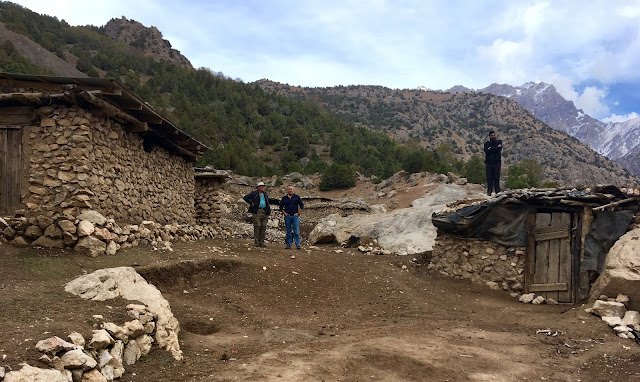
Our group was the last of the season. Because the homestay had no central heating, we had to bundle up and sleep fully clothed, just as we had in the yurts. Next morning, the sun greeted us as we hiked up the valley, following the route of shepherds and their families who spend their summers in primitive stone houses. It was breathtakingly beautiful.
In the late afternoon, our guides drove us into the village where we had tea at another homestay and learned about Tajik culture and values. As different as these people appear to be from us, their strong system of values bears many similarities. We found ourselves thinking back to the time of our grandparents, realizing that we have much in common. We walked around Saritag in the pouring rain, taking in the sights, sounds and smells of this village of 400, meeting the people as we went. It’s a way of life that’s destined to change, for better or for worse.


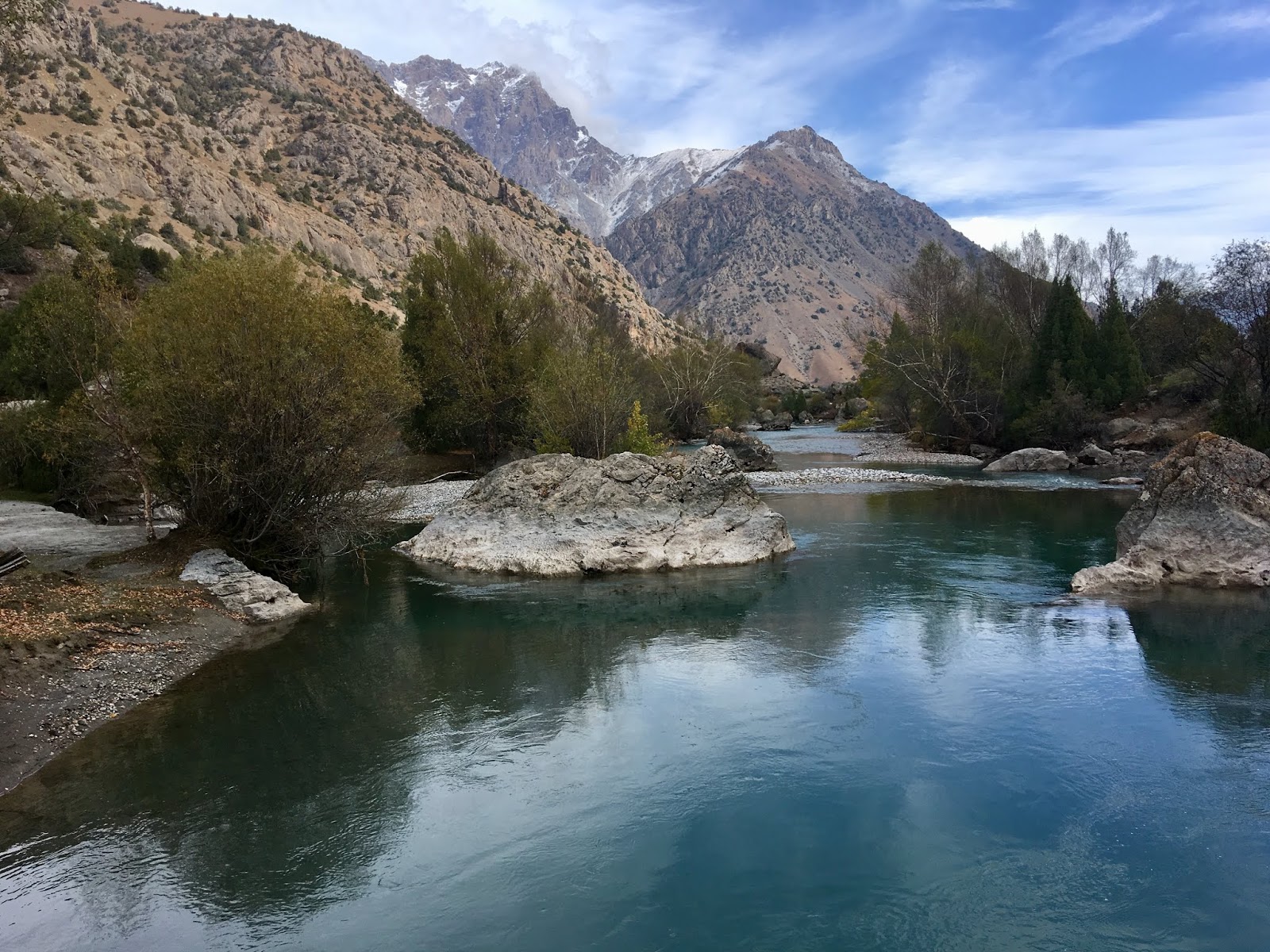
After a cold night in the homestay (I wore two sweaters!), we drove back down the valley and headed north toward Khujand, the country’s second-largest city. On the way, we stopped for a panoramic view of Iskanderkul, a landscape equal to anything we’ve seen in the Canadian Rockies, the Alps, or the Pyrenees.
Tajikistan is 90% mountains. The nine million people who live in the country occupy the valleys, most of them quite favourable to agricultural production. On the way to Khujand, we stopped in Istaravshan for a visit to a mosque and a reconstructed fortress. In Khujand, we toured the museum and drove to our lodging for the night, the Firuz Hotel.

Next morning, we drove to the Uzbekistan border after spending time in Khujand’s vast central market. We said goodbye to Farid (on the left in the photo) and our excellent driver, Abdul (center) and walked the kilometer or so across the border to country number 78 on our list.
Two days in Kazakhstan were far too little to give us a taste of that vast country. The five days we spent in Tajikistan were just enough. Half-way through our Central Asian adventure, we’re quite pleased with what we’ve seen so far. Our experiences have been genuine, we’ve met the locals on many occasions, and we’ve gone to places only accessible to those who know how to get there. We’ve found the people friendly and unfailingly polite, and we’ve never felt unsafe or harassed. People here understand the meaning of service and that they will not be able to build a tourism industry without it. But they do have a long way to go; it takes more than effort to make a satisfied customer.

Every morning, we start the day by reminding ourselves how lucky we are to be able to see these wonderful places and enjoy quality time together!


Sunday, 29 September 2019


CENTRAL ASIA ADVENTURE – PART 1

The question asked by most people when they heard we were heading to Central Asia and the “Stans”: “Why would you want to go THERE?”. The best answer I could come up with was “Because we’ve never been there before.” From the G Adventures tour description, this part of the world seemed interesting. And then there are the other things that motivate me, number one being to learn. At this stage in my life, learning opportunities are few and far between. Travel is one of the most rewarding.

The five Stans achieved independence in 1991 following the breakup of the Soviet Union. So did nine other countries that were part of the old USSR: Estonia, Latvia, Lithuania, Belarus, Ukraine, Moldova, Georgia, Armenia and Azerbaijan. I guess I’d just like to know how they’re getting along, twenty-eight years later. Maybe I’ll visit them all before I’m done.

Thirty-six hours and nine times zones after leaving Charlottetown, we touched down in Bishkek, capital of Kyrgyzstan (pronounced Keer-ghiz-ston). Along the way, we had a six-hour layover in Istanbul airport. It opened in April 2019 and will be the world’s biggest when it’s finished in 2025. Soaring concourses, magnificent skylights, and sparkling marble floors combine to create an unreal experience. Best of all, there are no PA announcements. None! Either get to your gate on time or you miss your flight. Turkish Airlines took very good care of us on the Toronto-Istanbul and Istanbul-Bishkek legs of our journey. I’d fly with them anytime. Flight attendants tell stragglers to “Hurry up and take your seat!” And they mean it. I like that.

Bishkek was the starting point of our journey. The city of 1 million or so is rather drab. Most buildings date from the Soviet era and look very much like what we saw in Romania, Hungary, and Bulgaria: ugly and ready to fall apart. Below is an example of the ugliest public sculpture I've ever seen, a concrete monstrosity typical of the Soviet brutalist style.
But the people are very friendly and things are cheap. A very nice restaurant meal for two cost us $33 CDN. (We’d eat for much less outside the capital.) We wandered around in a bit of a daze the first couple of days, recovering from jet lag. Very few people speak English, very few places accept credit cards, everything is written in the Cyrillic alphabet, and ATMs are very fussy about which cards they’ll accept. Elva says: “You brought me here. Now figure it out!” Lesson learned: never leave home without an ample supply of $US.

We met up with our G Adventures group on the evening of Day 2 and had a very nice meal together. Our fellow travellers range in age from early twenties to early seventies and hail from several countries: Australia, the UK, Canada (six of us), and Sweden.
Our guide, Assan, led us on a walking tour of Bishkek in the morning and gave us a brief history lesson. Not surprisingly, the Kyrgyz people have had a difficult history over the past 150 years characterized by war, genocide, revolution, corruption and, finally, independence. As an example, 400,000 Kyrgyz fought on the Russian side during World War II. Only half came home.

After lunch, we drove to Burana, a UNESCO World Heritage Site, and climbed to the top of the tower, all that remains of the ancient city of Balasagun, established in the ninth century as a caravan stop on the silk road. Tour buses carrying Dutch and Chinese tourists stopped while we were there, another indication that the “Stans” are being discovered.
Our accommodation for the night, Ashu Guest House in the village of Chong-Kemin proved to be the biggest surprise of the day. The village itself is rather quaint, reminding us of what Prince Edward Island might have looked like seventy-five years ago. But the guest house had wifi and was undergoing a major expansion, including a pool. Eighty people showed up for dinner!

On a bright, sunny morning, we walked around the village and watched people pick potatoes by hand, the way we used to as kids. We boarded the vans bound for Son-Kul (Lake Son) and stopped a few times along the way to check out the scenery. We had lunch in a home stay in Konchar and climbed to the top of a mountain pass at 3,400 metres along a rutted gravel track before descending to our camp beside the lake. Five of us settled in for the night in our yurt after a delicious meal. (Just so you know, we’re not staying in a yurt because we have to but because we want to.) It was a damned cold night on the shores of Son-Kul. I’m not used to sleeping with a crowd; let’s just say that each of us took a turn on the saw… The pungent smell of a dung fire greeted me as I took photos of the sunrise over the camp. Because there isn’t a tree for miles, cow dung is the fuel of choice for heating and cooking. Everything tasted fine to me!
The area around the lake is summer grazing ground for local herders. A couple of families spend the season there in their yurts and move the herds around on horseback. With winter on the way, the herds of cattle, yaks, sheep, and goats are driven down the valley, a three-day trek, where they will spend the cold months. We watched as they rode along the track, expert horsemen all, the youngest only twelve years old. As we drove by farm houses, I noted each one had a dung pile where you’d expect to see stacked wood.

On the way to Bokonbayev, we were treated to a felt-making demonstration by Ms. Fatima, leader of a cooperative and brimming with entrepreneurial spirit. Carpets and bed covers are made by hand from wool using a technique as old as time. (As you may have guessed, the photo below is not Ms. Fatima.)
Next morning, we drove along the south shore of Issyk-Kul, the second-largest mountain lake in the world, topped only by South America’s Lake Titicaca. The lake is lined with beautiful beaches and several resorts, most of them half finished or boarded up. We were told these are a holdover from the Soviet regime and that there is simply no money to finish them.

We stopped in the town of Barksoon to visit a rather unique tourist attraction that doubles as a yurt factory. We were welcomed by Mr. Mekenbek, artist, craftsman, inventor, and musician; a truly impressive renaissance man. He and his employees showed us how a yurt is made and erected. Elva even went for a swing. As in every other place we visited, we were treated to way too much food.
 
Next on the agenda was a photo stop at Jeti-Oguz where we saw sheer cliffs composed of red conglomerates. 
From the village of the same name, we took a track that led us into the Sarychat-Ertash Nature Reserve and our eventual destination, a yurt camp. The meadow where the camp is located is called Kok-Jayik, meadow of the flowers, and is truly one of the most beautiful places I’ve ever laid eyes on. It reminded us of the Alps and the Rockies.


The plan was for us to either hike in the area or take a ride on horseback. Elva chose the latter while I stayed behind due to a mild case of la touristique. Suddenly, the heavens opened and we were treated to a spectacular thunderstorm. Fortunately, the yurts are waterproof and we stayed dry through supper and a restful night.

Next morning, we set out for Karakol, a regional centre of some 90,000 souls. Along the way, we stopped in at the Przhewalsky museum, dedicated to the memory of the great Russian geographer before settling in to the three-star Green Yard Guest House. Point of information, there are no showers, or electricity for that matter, in a yurt camp! We ended the day with a pleasant dinner together at a local restaurant. Tomorrow, we cross the border into Kazakhstan.

Our impressions of Kyrgyzstan are very favourable. Although it’s a poor country (the average monthly wage being only $200 CDN), the people are very friendly. The scenery is spectacular and tourism is on the rise. Of the five Stans, Kyrgyzstan is the most democratic. But they have a long way to go. In conversation with an Australian pediatrician we met at the Jeti-Oguz yurt camp who runs a clinic in Karakol, I learned that one of the biggest threats to progress is the brain drain. We leave here knowing we’ll not likely return and hoping people’s lives will get better.

Sunday, 7 July 2019


ON BEING A GRANDFATHER

I went fishing on July 2, the day André Campbell Arsenault was born to Julia and Clément in Edmonton, Alberta. It was my way of celebrating the marvel of new life and, in a sense, to close the loop. There is no better setting in which to contemplate the meaning of life than standing waist-deep in a fast-flowing stream, surrounded by nature. On June 11, 1980, the day our eldest, Sylvie, was born, I went fishing on Barlow’s Pond in Wellington and came home with a nice feed of trout. This time, I let the fish go. Maybe it was my way of giving thanks.

Growing up as the only child in a single-parent family, I was ill-prepared for fatherhood. Fortunately, I partnered with someone who’d grown up in a large family, the second-oldest of eight. Elva’s family taught me how a real family functioned; the good times and the hard times. She’d learned how to look after the little ones, to play with them, and to change their diapers. I hadn’t! As the youngest of my first cousins living in Wellington, I was always the baby of the group.

Yet the urge to have a family of my own was always there. Four years after we married, Elva and I decided the time had come to go from two to three. She didn’t want to be pregnant during the summer and she didn’t want to miss a significant part of the school year. (These were the days before paid parental leave, remember) Do the math! The pressure was on to conceive in September and we made it happen. Sylvie was born two weeks before the end of semester, a healthy and beautiful baby girl. We’d moved to Wellington in the fall of 1979 and prepared a room in the old family home just for her. Clément followed two years later and Jacques in 1984, all spring babies. (Remember, Elva didn’t want to be pregnant during the heat of the summer! And she usually has her way…)

We’d decided that Elva would put her teaching career on hold until our youngest started school. I commuted two hours each day to Charlottetown for nine years, often arriving home exhausted, sometimes in the middle of a snowstorm. Elva played the role of primary caregiver and I that of breadwinner. It was the norm for our parents’ generation and not uncommon for ours. In the interest of advancing my own career and our family’s prospects, I uprooted my young family and moved to Québec City for two years to complete an MBA. It was a difficult adjustment for all of us but it paid off eventually.

I wish I’d been more involved as a parent when my own children were younger. Perhaps not knowing my own father and not having siblings affected my ability to do so. There are certainly things I wish I could do over. Not remorse, just regret.

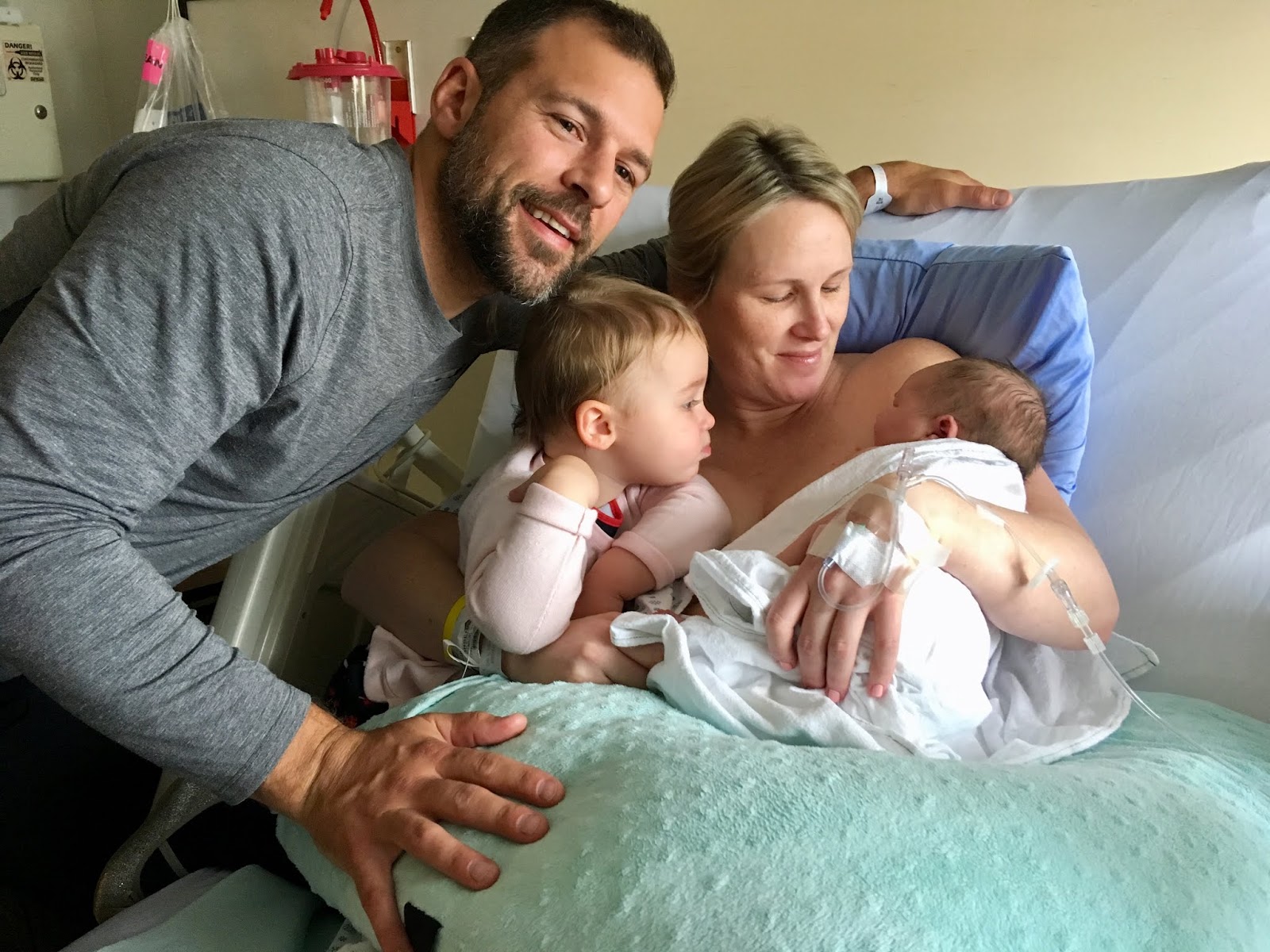
I cycled up Mont Ventoux, a punishing 21-kilometre climb, on October 17, 2006 with four of my buddies. Back down, I called Sylvie from Malaucène at the foot of the Provençal mountain to see how she was doing. The next day, our first grandchild, Samuel Gallant, was born. Two years later, Sylvie and Ghislain welcomed Natalie into their family. Lucie was born in Edmonton on May 26, 2012 to Isabelle and Jacques. Finally, after years of wanting a child, Julia and Clément were rewarded with Estelle, born November 1, 2017, the closest thing to a miracle I’ve experienced in my life. And now André, a healthy boy — “10, 10, 2 and 1” as the nurses say!

I watch my grandchildren’s fathers — Ghislain, Clément and Jacques — raise their children and wonder how they learned to do it so well. Parenting seems to have come so naturally to them, and I couldn’t be prouder. They’re so much better with babies than I was. All three changed diapers and got up during the night; rocked babies to sleep and gave them their baths. Ghislain is very involved in Samuel and Natalie's lives. Jacques was Lucie’s primary caregiver before she started school. Clément is with Estelle from the time he gets home from work until he drops her off to daycare the next morning.

From just the two of us, Elva and I have seen our family grow to thirteen. The mere thought of it astounds me. We did our best to pass along strong moral standards to our three children. We’re thankful that our five grandchildren will speak French to us and hope they’ll learn more than two languages. We love their French names.

Admittedly, this a male perspective, written by an aging baby-boomer. I know how fortunate I was to have been raised by a strong, independent woman and to have been influenced positively by strong female role models during my formative years. My five grandchildren will know the love of their fathers and I know it will serve them well as they grow into manhood.

The need to pass on one’s genes is a primal and a powerful urge. In this age of political correctness and respect for all orientations, one might wish to suppress it or, at least, not admit it’s there. But not me. I know my life is more complete because of my family. And I’m a better person because of the life lessons fatherhood has taught me. I love being a father and a grandfather and I hope, someday, to hold great-grandchildren in my lap.

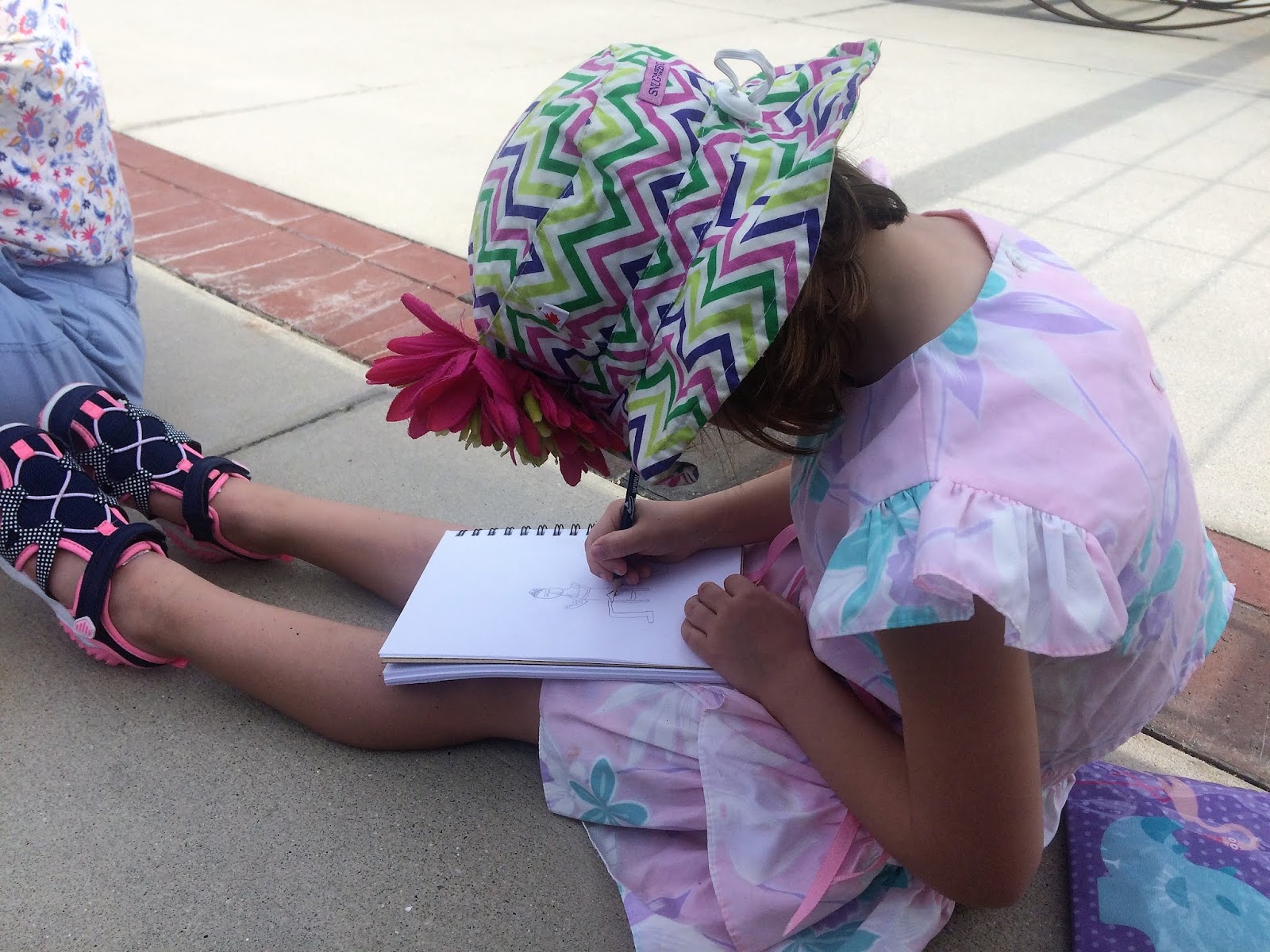
These random thoughts would be incomplete without pictures of the grand-kids, n’est-ce-pas? Here are some of my favourites.

Samuel and Natalie


Lucie


Estelle and André